
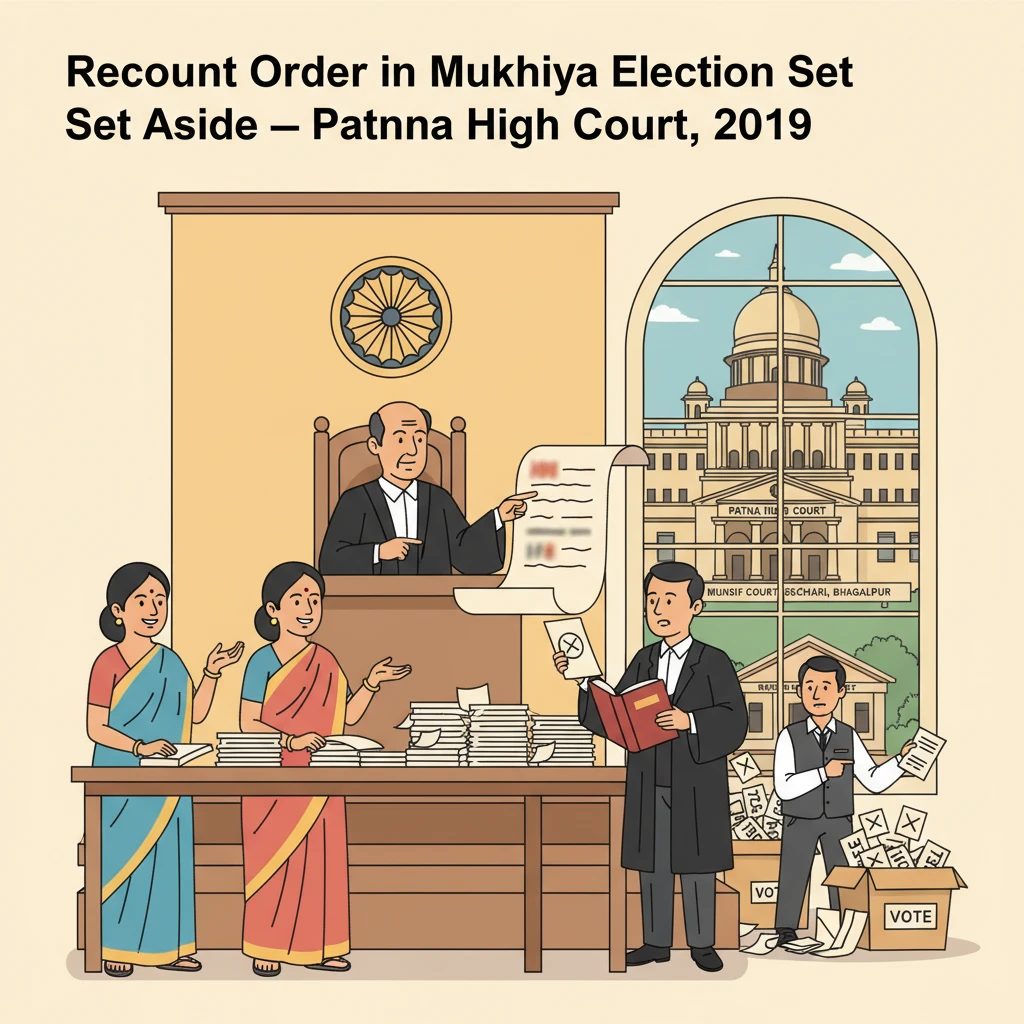
Case Background
The dispute arose from the 2016 election for the post of Mukhiya of Gram Panchayat Ekchari, Block Kahalgaon, District Bhagalpur.
There were 8,889 registered voters in the village. Out of these, 6,304 voters cast their votes. During counting, 438 ballot papers were declared invalid. This left 5,866 votes to be counted as valid.
On this count, one candidate, Indira Devi, secured 2,022 votes. The rival candidate, Beauty Patel, secured 1,979 votes. The margin of victory was therefore 43 votes.
Beauty Patel challenged the result by filing an election petition before the Munsif. She claimed that many of the 438 rejected ballot papers had been wrongly rejected and should have been counted in her favour. She also claimed that some votes wrongly counted in favour of Indira Devi were invalid.
The Munsif allowed her prayer for recounting. He directed that all 438 rejected ballot papers should be counted first. If, on that basis, the election petitioner (Beauty Patel) was found to have secured the highest votes, she would be declared elected in place of Indira Devi.
The Munsif further ordered that if this recount of the rejected ballots did not change the result, then the ballot papers of seven booths, as indicated in his order, should be fully recounted. On that recount, the candidate getting the highest votes would be declared elected.
Indira Devi, whose election had been upheld by the original count, challenged the Munsif’s recount order in a writ petition before the Patna High Court (single judge). The learned single judge allowed the writ petition on 3rd October 2018 and quashed the Munsif’s order, holding that the conditions for ordering a recount were not satisfied.
Aggrieved by this, Beauty Patel filed the present Letters Patent Appeal (LPA No.1611 of 2018) before a Division Bench of the Patna High Court, challenging the single judge’s decision.
What the Court Examined and Decided
The Division Bench, comprising Hon’ble the Chief Justice and Hon’ble Justice Smt. Anjana Mishra, delivered an oral judgment on 12-03-2019.
The core question was whether the learned single judge was right in setting aside the Munsif’s order directing recounting of votes in the Mukhiya election.
To answer this, the Court closely revisited the facts, pleadings, evidence, and legal principles on recounting of ballot papers in election disputes.
First, the Court restated the essential facts. Out of 6,304 votes cast, 438 were treated as invalid. On the remaining 5,866 valid votes, Indira Devi led by 43 votes. The election petition alleged that:
1. The 438 rejected ballots had been wrongly rejected and should be counted, mostly in favour of the election petitioner (Beauty Patel).
2. Some votes were cast on ballot papers without the signature of the Presiding Officer.
3. In some ballot papers, there was overlapping of the signatures and thumb impressions of voters and the seal of the Presiding Officer.
The election petitioner claimed that such ballot papers were wrongly counted in favour of Indira Devi, materially affecting the result.
The Court noted that evidence had been led before the Munsif. Apart from the election petitioner herself, three other witnesses deposed in support. The other contesting candidates filed written statements, and State witnesses were also examined.
The Division Bench then examined how the Munsif had approached the case. The Munsif ordered recounting of all 438 rejected ballots and, if necessary, a full recount of seven booths, and linked these recounts directly to the declaration of a new result.
Indira Devi’s main grievance before the single judge, and again before the Division Bench, was that the Munsif had ordered a recount without:
1. Any clear and specific allegations in the election petition about particular irregularities in counting.
2. Recording any concrete reasons or “prima facie satisfaction” as to why recounting was necessary.
3. Trying any limited or sample inspection first, as a cautious step.
She argued that the Munsif had effectively allowed a fishing and roving inquiry into the ballot papers, contrary to settled law.
In the Letters Patent Appeal, counsel for Beauty Patel tried to support the Munsif’s order primarily on two grounds.
First, he referred to paragraph 5 of the counter affidavit filed by her before the writ Court, to say that a request for recount had been made at the time of counting itself and a complaint was lodged then. He submitted that the authorities were informed in time, but no action was taken, and this inaction was also raised in the election petition.
Second, he relied on paragraph 10 of the same counter affidavit, where it was claimed that videography had been done during counting and that video footage could have supported the allegations regarding irregularities leading to wrongful rejection of 438 votes. He also relied on the Supreme Court decision in Sohan Lal vs. Babu Gandhi, (2003) 1 SCC 108, particularly paragraph 14.
The Division Bench carefully considered these submissions. On the videography point, the Court made a clear and important finding. It noted that the allegation about videography was contained only in the counter affidavit filed later before the writ Court. It did not find any such allegation in any paragraph of the original election petition (Annexure 1 to the writ petition).
Because of this, the Bench held that, in the absence of a corresponding plea in the election petition itself, the issue of videography could neither be raised nor examined in the appeal. This is significant: new grounds cannot be built at a later stage when they were not originally pleaded in the election challenge.
The Court then turned to the heart of the matter: whether the Munsif had any solid material to justify a recount.
The Division Bench noted that the Munsif’s order did not indicate the specific material on which he based his satisfaction about the need for recounting. The statements of facts in the election petition were “not specific”. Similarly, the depositions of the four witnesses supporting the election petition did not contain details spelling out the exact nature of any illegality in counting or rejection of ballot papers.
The allegations remained general, merely asserting that 438 votes had been wrongly rejected. The election petition itself stated that there were 16 counting tables and only two counting agents for the appellant. Because of this, her side could not supervise all tables.
For the Division Bench, this disclosure was crucial. It showed that the petitioner did not have complete knowledge of what happened on each table. In such circumstances, a broad statement that 438 votes were wrongly rejected, without specifying which votes, at which table, and what exact defect or illegality existed, was nothing more than a bald assertion.
The Court held that this kind of general allegation was not enough to reopen ballot boxes. It emphasised that the Munsif had overlooked settled legal principles, particularly those summarised by the Supreme Court in Bhabhi vs. Sheo Govind, (1976) 1 SCC 687.
The Division Bench quoted paragraph 15 of Bhabhi vs. Sheo Govind in full. That passage lists several strict conditions that must be satisfied before a court can allow inspection or recount of ballot papers. These include:
1. Secrecy of ballot is sacrosanct; it should not be violated on frivolous, vague or indefinite allegations.
2. Allegations against the elected candidate must be clear, specific and supported by adequate statements of material facts.
3. The Court must be prima facie satisfied, on the material produced, about the truth of the allegations made for a recount.
4. Inspection must be found necessary to do full justice between the parties.
5. Discretion should not be exercised to permit a roving inquiry meant only to fish for grounds to void an election.
6. Sample inspection may be ordered only to support a prior prima facie satisfaction, not as an exploratory fishing exercise.
The Division Bench found that these mandatory conditions were not met in the present case. There were no clear and specific material facts; at best, there were general complaints and vague depositions. No attempt was made by the Munsif to carry out any sample inspection to first test the allegations. Instead, he directly ordered recount of all 438 rejected ballots and then a full recount of seven booths, while also reshaping the relief by creating a “second direction” for how the result should be declared.
The single judge, after examining all this in detail, had concluded that the Munsif’s directions were not in conformity with the law. The Division Bench agreed with this view.
The Bench also reiterated that courts must be very cautious in passing recount orders, particularly in close elections, because such orders disturb the secrecy of the ballot and can themselves become tools of harassment against a validly elected candidate.
After reviewing the pleadings, the evidence, the Munsif’s order, the single judge’s reasoning, and the Supreme Court precedents, the Division Bench held that there was no legal error in the single judge’s decision. The appeal by Beauty Patel had no merit.
Accordingly, the Letters Patent Appeal was dismissed, and the quashing of the Munsif’s recount order was confirmed. This effectively maintained Indira Devi’s election as Mukhiya based on the original count.
Why This Judgment Matters
This judgment is important for candidates and voters in local body elections, especially Gram Panchayat elections in Bihar.
First, it shows that courts will not permit recounting of votes simply because the margin is small or because a losing candidate broadly says that many votes were wrongly rejected.
To get a recount, the election petition must clearly state specific facts: which votes, from which booths, and what exact irregularity is alleged. Witnesses must support these details. Without this, courts will treat such claims as vague.
Second, the judgment protects the secrecy of the ballot. The Court reminded that opening ballot boxes and re-examining ballot papers is a serious step and cannot be used for “fishing” for evidence after an election is over.
Third, the decision confirms that later affidavits or arguments (like claims about videography footage) cannot improve a weak election petition. What matters is what is written in the original election challenge.
For village-level leaders and their supporters, this ruling from the Patna High Court sets a clear message: if you want to challenge a Panchayat election in court, your petition must be detailed, well-drafted, and supported by concrete facts from the beginning.
Legal Issues and Answers
-
Issue: Whether the Munsif was justified in ordering recounting of 438 rejected ballots and, if needed, full recount of seven booths in the Mukhiya election of Gram Panchayat Ekchari.
Answer: No. The Patna High Court held that the election petition contained only vague and general allegations, lacked specific material facts, and did not justify reopening ballot papers under the law governing recount. -
Issue: Whether the single judge correctly quashed the Munsif’s recount order in writ proceedings.
Answer: Yes. The Division Bench affirmed that the single judge rightly applied the principles laid down by the Supreme Court, particularly in Bhabhi vs. Sheo Govind, and that the Munsif’s order was not in conformity with those legal requirements. -
Issue: Whether allegations regarding videography of counting, raised later in a counter affidavit, could support the recount order.
Answer: No. Since no such allegation appeared in the original election petition, the Court held that this issue could not be considered at the stage of writ or appeal.
Cases Cited by the Court
- Bhabhi vs. Sheo Govind, (1976) 1 SCC 687 – relied upon for the strict conditions required before ordering inspection or recount of ballot papers.
- Sohan Lal vs. Babu Gandhi, (2003) 1 SCC 108 – cited by the appellant; referred to by the Court in recording the submissions.
Case Details
Case Number: Letters Patent Appeal No.1611 of 2018 in Civil Writ Jurisdiction Case No.11385 of 2017
Case Title: Beauty Patel vs. Indira Devi & Ors.
Citation: 2019(2) PLJR 903
Coram: Hon’ble the Chief Justice Amreshwar Pratap Sahi and Hon’ble Justice Smt. Anjana Mishra
Advocates: Mr. Mirtyunjay Kumar Mishra, Advocate for the appellant; Mr. Harendra Prasad Singh, Advocate and Mr. Santosh Kumar, Advocate for the respondents
Nature of the Case: Letters Patent Appeal arising out of a writ petition challenging an order of recount in a Gram Panchayat Mukhiya election (election dispute)
Date of Judgment: 12-03-2019
Link to Full Judgment: https://patnahighcourt.gov.in/viewjudgment/MyMxNjExIzIwMTgjMSNO-moaHkFc8OKw=
If you found this explanation helpful and wish to stay informed about
how legal developments may affect your rights in Bihar,
you may consider following Samvida Law Associates for more updates.







