
Case Background
The dispute arose in Title Suit No.33 of 1997 pending before the court of the learned Munsif, Pupri at Sitamarhi. In that title suit, several persons were arrayed as plaintiffs and defendants, including one Late Bindeshwar Rai as original defendant no.2.
During the pendency of the title suit, defendant no.2, Bindeshwar Rai, died. After his death, an application was filed by one Ram Pukari Devi @ Karia Devi seeking to be substituted in his place as his legal representative.
Defendant no.3, Ram Naresh Rai, opposed this move. He asserted that Ram Pukari Devi was not the daughter of the deceased defendant, but in fact the daughter of another person, Late Ram Charitar Roy, who was said to be the brother of Late Bindeshwar Rai.
Despite these objections, by order dated 25.09.2018, the learned Munsif allowed the substitution application. Aggrieved by this order, defendant no.3 approached the Patna High Court by filing Civil Miscellaneous No.273 of 2019 under Article 227 of the Constitution of India.
What the Court Examined and Decided
The Patna High Court, through Hon’ble Mr. Justice Ashwani Kumar Singh, heard learned counsel for the petitioner (defendant no.3). The challenge was limited: the petitioner questioned the correctness and legality of the trial court’s order allowing substitution of Ram Pukari Devi as the legal representative of the deceased defendant, Late Bindeshwar Rai.
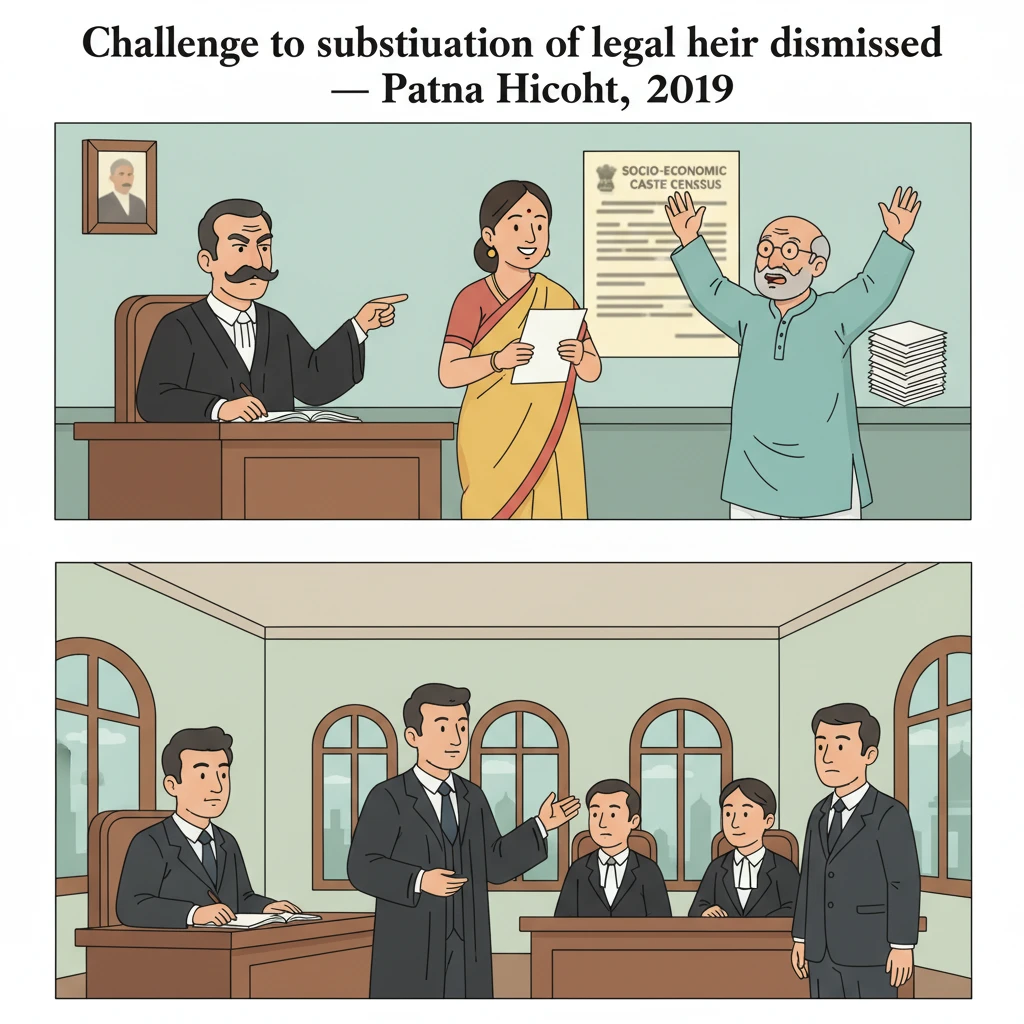
The petitioner’s counsel advanced a specific case. He argued that the learned Munsif had committed an error by relying on the socio-economic caste census list to treat Ram Pukari Devi as the daughter of Late Bindeshwar Rai. According to the petitioner, this census list was not a reliable document for deciding family relationships in a civil dispute.
He submitted that the petitioner was the nephew of the deceased defendant. From his perspective, the trial court should have accepted his version that Ram Pukari Devi was not the deceased’s daughter. The counsel contended that she was actually the daughter of Late Ram Charitar Roy, the brother of the deceased.
It was also argued that, although the socio-economic caste census list had been issued by an authority of the State Government, it had not been prepared in the ordinary course of official conduct. Therefore, according to the petitioner, the document had “no probative value”. He alleged that the list might have been manipulated, or at least was not trustworthy for establishing the relationship claimed by Ram Pukari Devi.
The petitioner further contended that the learned Munsif had overlooked material documents produced by him to support his stand. Instead of considering his evidence, the trial court had placed undue reliance on the census list and had, therefore, wrongly accepted Ram Pukari Devi as the legal representative of the deceased defendant.
Against this backdrop, the High Court proceeded to examine the legal framework and the reasoning adopted by the trial court.
The Court first referred to Order 22 Rule 5 of the Code of Civil Procedure. This provision clearly states that when a question arises whether any person is or is not the legal representative of a deceased plaintiff or defendant, that question has to be determined by the court in which the case is pending.
The High Court then recalled the settled legal position regarding substitution. It emphasized that substitution in a civil case is done only to ensure that the estate of the deceased party is properly represented before the court so that the litigation can continue. Importantly, the Court pointed out that mere substitution of a person as legal representative does not amount to a declaration of that person’s substantive right, title or interest in the disputed properties involved in the suit.
In other words, allowing someone to be added as a legal representative is a procedural step. It does not, by itself, decide who owns the land or property or who has better title. The substituted person can only pursue and protect the interest that the deceased party had in the litigation. Questions of title or ownership are to be decided at the stage of final adjudication of the suit, based on full evidence.
The Court further clarified that, before allowing any person to be substituted in place of a deceased party, the trial court does have a duty to see whether a proper person is being brought on record. For this purpose, an inquiry is indeed required. However, this inquiry is “summary in character”. It is not a full trial on questions of title, inheritance or succession.
Turning to the facts of the case, the High Court examined how the learned Munsif had handled this inquiry. From the impugned order, it appeared that the trial court had conducted an inquiry, taken evidence from the parties, and, on the basis of that evidence, had come to the conclusion that Ram Pukari Devi was the daughter of Late Bindeshwar Rai.
The High Court recorded that the learned Munsif had relied upon the socio-economic caste census list. This document, the Court noted, is a public document. It disclosed that Ram Pukari Devi was shown as the daughter of the deceased, Bindeshwar Rai.
Apart from this documentary evidence, the trial court also had the benefit of the statement of the plaintiff. The plaintiff identified Ram Pukari Devi in court as the daughter of the deceased defendant. This identification, coupled with the public record, formed the basis of the trial court’s satisfaction.
In light of this, the High Court found that the trial court had indeed performed the summary inquiry mandated by Order 22 Rule 5. It had considered evidence from both sides. It then made a factual finding, based on a public document and oral identification, that Ram Pukari Devi could be treated as the legal representative of the deceased defendant for the purposes of continuing the suit.
The High Court then assessed whether any “illegality” or jurisdictional error had been committed by the Munsif. Since the proceeding before the High Court was under Article 227 of the Constitution, its role was not to re-appreciate evidence as if in an appeal but only to see whether the trial court’s decision suffered from gross perversity or violation of law.
After considering the submissions, the Court held that, based on the materials available, the learned Munsif had taken a reasonable view. Once documentary evidence in the form of a public record and supportive oral evidence were available, the trial court’s decision to allow substitution could not be termed illegal.
Therefore, the High Court concluded that there was no ground to interfere with the impugned order in its supervisory jurisdiction under Article 227 of the Constitution of India.
On this reasoning, the Civil Miscellaneous application filed by defendant no.3 was dismissed. As a result, the order dated 25.09.2018 of the learned Munsif, Pupri at Sitamarhi, allowing the substitution of Ram Pukari Devi @ Karia Devi in place of late defendant no.2, Bindeshwar Rai, remains in force. The title suit will proceed with her on record as the legal representative of the deceased defendant.
Why This Judgment Matters
This judgment is important for parties involved in civil suits where a litigant dies during the case. It clarifies that substitution of legal representatives is mainly a procedural step to keep the case alive, not a final decision on property rights.
For families, this means that if someone is added as the legal representative of a deceased party, it does not automatically mean that person has been declared owner of the disputed property. Actual rights will still be decided at the end of the suit.
The case also shows that trial courts can rely on public documents like the socio-economic caste census list, along with oral evidence, to decide who should be substituted. Objections to such documents must be strong enough to show clear illegality or manipulation, otherwise higher courts will not interfere.
Finally, the judgment underlines the limited scope of the Patna High Court’s powers under Article 227. It will not normally disturb factual findings of the trial court on substitution matters if a proper, though summary, inquiry has been conducted.
Legal Issues and Answers
-
Issue: Whether the trial court’s decision to substitute Ram Pukari Devi @ Karia Devi in place of deceased defendant no.2, Late Bindeshwar Rai, was illegal or improper and liable to be set aside under Article 227 of the Constitution of India.
Answer: No. The Patna High Court held that the learned Munsif had conducted a proper summary inquiry under Order 22 Rule 5 CPC, relied on a public document (socio-economic caste census list) and supporting oral evidence, and rightly allowed substitution. There was no illegality warranting interference in supervisory jurisdiction.
Cases Cited by the Court
- No prior judgments or case law have been expressly cited or relied upon in the text of this judgment.
Case Details
Case Number: Civil Miscellaneous Jurisdiction No.273 of 2019; arising out of Title Suit No.33 of 1997 (order dated 25.09.2018 of the court of Munsif, Pupri at Sitamarhi).
Case Title: Ram Naresh Rai v. Ram Pukari Devi @ Karia Devi & Ors.
Coram: Hon’ble Mr. Justice Ashwani Kumar Singh.
Citation: 2019(2) PLJR 1014.
Advocates: For the petitioner: Mr. Alok Kumar Jha, Advocate; Mr. Santosh Kumar Pandey, Advocate. For the respondents: Name not specified in the judgment.
Nature of the Case: Civil Miscellaneous application under Article 227 of the Constitution of India challenging a trial court order on substitution of legal representative under Order 22 Rule 5 of the Code of Civil Procedure.
Link to the Judgment: Patna High Court Judgment – C.Misc. No.273 of 2019
If you found this explanation helpful and wish to stay informed about
how legal developments may affect your rights in Bihar,
you may consider following Samvida Law Associates for more updates.







