
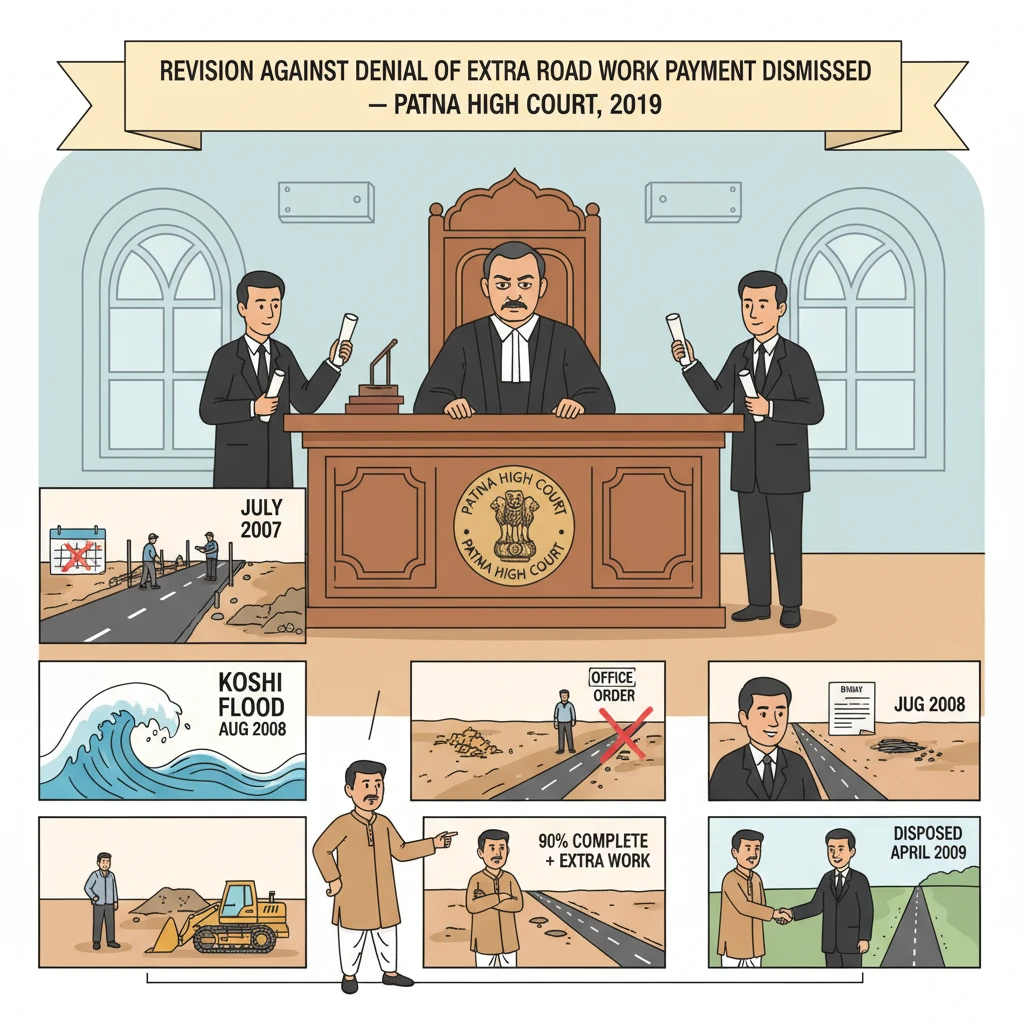
Case Background
The dispute began with a road construction contract under the “Improvement of Riding Quality Programme” (IRQP) of National Highway 106 from kilometre 77 to 88 in Madhepura district. The work was allotted to the petitioner, a contractor, as the lowest bidder under Agreement No. 33F2 of 2006-2007. The estimated cost of the work was Rs. 5,00,42,744/-.
The date of commencement of work was fixed as 17.01.2007 and the work was to be completed by 16.07.2007, within six months. According to the State authorities, the petitioner did not even start the work till 16.04.2007, despite reminders and directions to speed up work and install machinery at site.
The Executive Engineer issued several letters and show-cause notices pointing out slow progress and calling upon the petitioner to explain the delay. On the petitioner’s request, the period for completion was extended multiple times, ultimately till 31.03.2008. However, by 30.06.2008, the petitioner had completed only about 42.9% of the work.
Finding the progress unsatisfactory, the Executive Engineer rescinded the contract by Office Order No. 20 dated 04.07.2008 under clauses 3(a) and 3(c) of the conditions of contract. The petitioner then approached the Patna High Court by filing CWJC No. 11824 of 2008 challenging this rescission order.
On 20.08.2008, the High Court stayed the operation of the rescinding order till November 2008 and directed the petitioner to complete the work within that time to the satisfaction of the department, failing which the authorities would be free to act as per law.
Immediately thereafter, a devastating flood hit north Bihar due to breach of Kushaha Bandh on the Koshi river. The petitioner claimed that the entire Madhepura district was inundated, his stored materials by the roadside were washed away, and the road itself was badly damaged.
The petitioner sought further extension of time through I.A. No. 6700 of 2008, undertaking to complete the work by March 2009. On 02.03.2009, the High Court extended the time for completion till March 2009. The petitioner told the Court he had already completed 90% of the work, including extra work beyond the agreement, and the Court directed the Executive Engineer to prepare an estimate for the extra work and make payment along with payment for work under the agreement.
According to the petitioner, he then completed 100% of the work, including extra work, by 31.03.2009 and submitted a report to the Court on 06.04.2009. The writ petition was disposed of on 06.04.2009 with a direction to the respondents to measure the work done by the petitioner and ensure payment.
When the petitioner alleged that payment for extra work and for flood damage was not made, he initiated contempt proceedings by filing MJC No. 497 of 2011. In that proceeding, the Executive Engineer (respondent no. 4) disputed his claim regarding completion of work and performance of extra work. Considering the rival stands, the High Court, by order dated 13.05.2015, disposed of the contempt petition and gave liberty to the petitioner to move the Bihar Public Works Contracts Disputes Arbitration Tribunal for any surviving claims related to the contract or to the earlier High Court orders.
Acting on this liberty, the petitioner filed Reference Case No. 110 of 2015 before the Tribunal. On 08.08.2016, the Tribunal dismissed his claim. The petitioner then filed the present Civil Revision No. 204 of 2016 before the Patna High Court challenging that award.
What the Court Examined and Decided
The core dispute before the Patna High Court in this civil revision was whether the Tribunal was right in refusing the contractor’s claims for extra work payment and compensation for flood damage.
Before the Tribunal, the petitioner made two major monetary claims:
Payment of Rs. 84,88,650/- allegedly for extra work done by him beyond the original agreement, particularly work executed after the devastating floods.
Compensation of Rs. 98,39,500/- for damage to materials such as metal, stone chips and stone dust which he said were stored along the road and washed away in the unprecedented flood.
He argued that the time allowed for completion of work was unreasonably short, so he had stocked materials all along the 11 kilometre stretch and had started earthwork on both sides. According to him, after the flood and after the High Court extended time till March 2009, he completed not only the original work but also additional work to repair flood damage. He asserted that the department failed to prepare an estimate or make payment for this extra work despite the High Court’s directions in the writ case.
The State authorities, led by the Executive Engineer, firmly denied these claims. They maintained that:
The petitioner had carried out only 42.9% of the work under the original agreement even after repeated extensions and notices up to 30.06.2008.
Because of this failure, the contract was lawfully rescinded on 04.07.2008.
After the August 2008 flood, the Road Construction Department and the District Magistrate constituted Task Forces under letter dated 23.09.2008 for speedy repair of damaged roads in several affected districts, including Madhepura.
In pursuance of these orders, restoration work on NH 106 from kilometre 77 to 88 was carried out by the Task Force and the Road Construction Department, not by the petitioner.
Therefore, the petitioner’s claim that he did extra work for flood repair was “absolutely false”.
The respondents further stated that:
All work actually done by the petitioner had been duly measured and recorded in Measurement Book No. 151.
The final bill, recorded as the 29th and final bill, was prepared on the basis of these measurements, including minor flood damage repair work attributed to him.
The petitioner accepted these measurements and signed the measurement book at page 99, clearly indicating receipt of the entire amount in full and final settlement of his claims.
The Executive Engineer informed higher authorities through letter dated 02.06.2009 that full and final payment had been made.
After hearing both sides and scrutinising the record, the Tribunal accepted the State’s version. It relied heavily on Annexure-Q, consisting of the measurement book entries and the contractor’s acknowledgement. The Tribunal found that the petitioner had received the entire amount due for work done and had endorsed the measurement as full and final satisfaction. It therefore held that no further payment was due either for extra work or for compensation of loss of materials and dismissed the reference.
In the High Court, the petitioner’s counsel argued that the Tribunal had committed irregularity by not deciding the reference properly and by ignoring material documents produced by the petitioner. He repeated that the petitioner had completed the work including extra work within the extended period fixed by the High Court and that he was entitled to substantial amounts towards extra work and flood damage.
Justice Prabhat Kumar Jha examined the entire sequence: the original contract, the repeated extensions, the rescission order, the writ proceedings, the flood, the Task Force repairs, the contempt case and finally the arbitration reference. He noted as an admitted fact that:
The work was to be completed between 17.01.2007 and 16.07.2007.
Due to non-completion, several show-cause notices were issued and time was extended till 31.03.2008.
Despite these extensions, only 42.9% work was completed by 30.06.2008, leading to rescission of the agreement on 04.07.2008.
The Court then looked at what happened after the devastating flood. It recorded the State’s stand that the Collector had constituted a Task Force to repair roads in the inundated area and that the repairs on NH 106 were carried out through this mechanism, not by the petitioner. It further recorded that the petitioner, taking advantage of this work by the Task Force, had filed an affidavit claiming completion of work, which led the High Court in the writ case to dispose of the matter with a direction for payment.
However, the Executive Engineer subsequently measured the work actually done by the petitioner, prepared the final bill, and made payment, all recorded in Measurement Book No. 151. Crucially, the petitioner signed the measurement book and accepted the final bill without any protest or objection regarding non-payment for extra work or flood damage.
Justice Jha emphasised that there was no material on record to show that the work done by the petitioner was not properly measured. On the contrary, the measurement book showed clearly that the petitioner had received the entire amount for the work done by him. The Court noted that the Tribunal had carefully considered these facts and the petitioner’s endorsement in the measurement book acknowledging full and final satisfaction of his claim.
The High Court also observed that the petitioner could not show that any document produced by him before the Tribunal had been ignored or misread. On a “consideration of entire material” and the petitioner’s own acceptance of measurement and payment, the Court held that the Tribunal’s conclusion was correct.
In revision, the High Court’s role is limited to interfering only when there is illegality or material irregularity in the order under challenge. Justice Jha found no such illegality or irregularity in the Tribunal’s award. Since the petitioner had already accepted full and final payment for measured work, he could not claim further amounts under the heads of “extra work” or “compensation for flood damage.”
Accordingly, the Patna High Court dismissed Civil Revision No. 204 of 2016 as devoid of merit, thereby affirming the Tribunal’s award dated 08.08.2016.
Why This Judgment Matters
This judgment is important for contractors engaged in government works in Bihar and similar states. It shows that once a contractor signs the measurement book and accepts the final bill in full and final settlement, it becomes very difficult to later claim additional payments for alleged extra work or losses.
The Patna High Court made it clear that courts and tribunals will rely heavily on official records like measurement books and the contractor’s own acknowledgements. Vague claims of extra work or damage, especially raised years later, will not succeed without clear supporting evidence and timely objection.
The decision also highlights that natural disasters, like floods, do not automatically entitle a contractor to extra compensation. The contractor must prove that he actually carried out additional work, that this work was not already paid for, and that he did not earlier accept a final settlement.
For ordinary citizens and small contractors, this ruling is a reminder to read documents carefully before signing, especially where “full and final” settlement is recorded, and to raise objections immediately if they believe measurements or payments are incomplete.
Legal Issues and Answers
Issue: Was the contractor entitled to further payment for alleged extra work and compensation for materials lost in the 2008 flood, despite having signed the measurement book and received final payment?
Answer: No. The Court held that the measurement book entries and the contractor’s endorsement showed full and final settlement of all dues for work actually done. There was no evidence of unpaid extra work or uncompensated loss.
Issue: Did the Bihar Public Works Contracts Disputes Arbitration Tribunal commit any illegality or material irregularity in dismissing the contractor’s reference case?
Answer: No. The Patna High Court found that the Tribunal had properly considered the materials on record, including the measurement book and the petitioner’s acknowledgements, and rightly concluded that no further amount was payable.
Cases Cited by the Court
- No prior judicial precedents are cited or relied upon in the text of this judgment.
Case Details
Case Number: Civil Revision No. 204 of 2016
Case Title: Dinesh Kumar Yadav v. State of Bihar & Ors.
Citation: 2019 (2) PLJR 806
Court: High Court of Judicature at Patna
Coram: Hon’ble Mr. Justice Prabhat Kumar Jha
Date of Judgment: 25.04.2019
Nature of Case: Civil revision against award of Bihar Public Works Contracts Disputes Arbitration Tribunal in Reference Case No. 110 of 2015
Tribunal Award Challenged: Award dated 08.08.2016 of the Chairman, Bihar Public Works Contracts Disputes Arbitration Tribunal, Patna
Advocates:
- For the Petitioner (Contractor): Mr. Uma Shankar Tiwary (before the High Court); submissions in judgment attributed to Mr. Subodh Kumar Jha, learned counsel for the petitioner
- For the Respondents (State Authorities): Mr. Kameshwar Prasad Gupta, GP X
Respondent Authorities: State of Bihar through Principal Secretary, Building Construction Department; Chief Engineer, N.H. Wing, Road Construction Department; Superintending Engineer, N.H. Circle, Purnia; Executive Engineer, N.H. Division, Madhepura
Link to Full Judgment: Click here to access the Patna High Court judgment
If you found this explanation helpful and wish to stay informed about
how legal developments may affect your rights in Bihar,
you may consider following Samvida Law Associates for more updates.







