
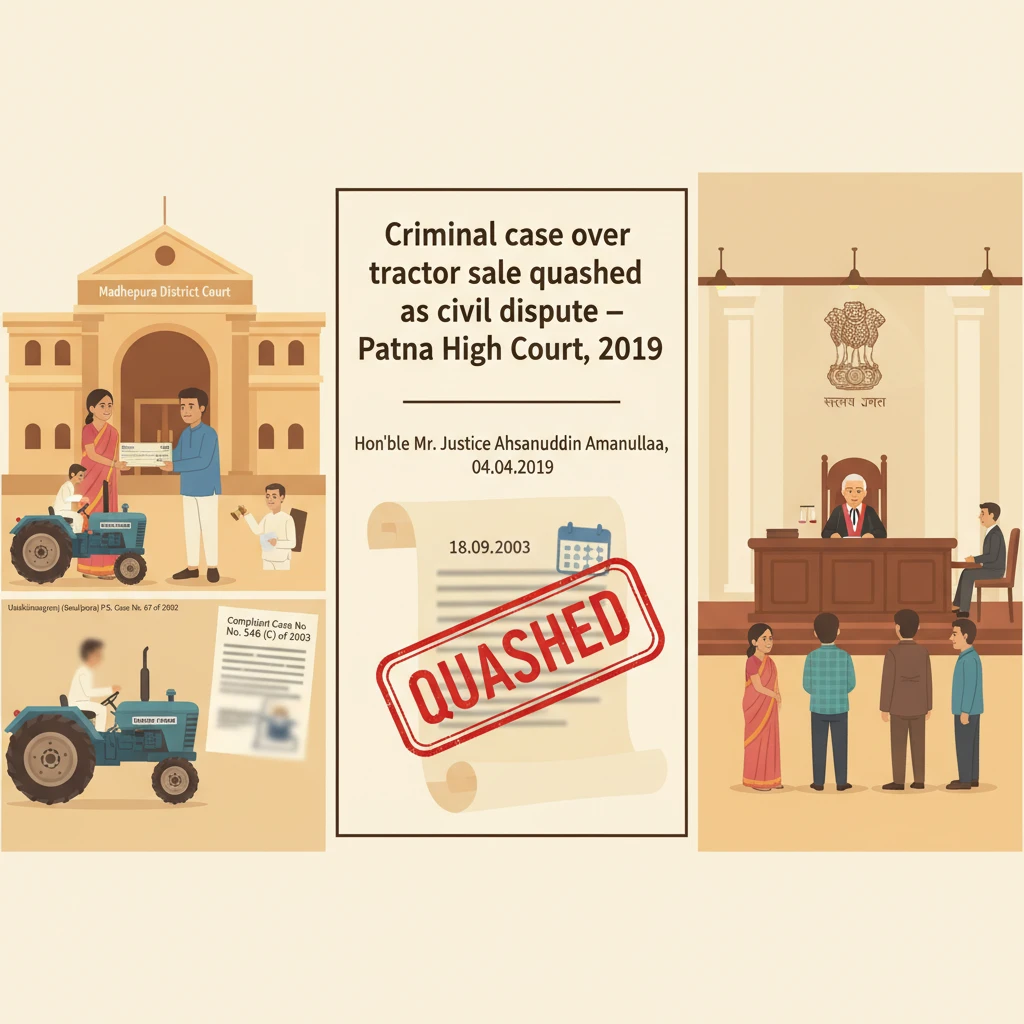
Case Background
This case arose out of a complaint filed in Madhepura district regarding the sale and purchase of a tractor. The complainant, described in the High Court order as opposite party no. 2, alleged that the woman buyer (the petitioner before the High Court) had cheated him.
According to the complaint, the petitioner took the tractor from opposite party no. 2 for a total agreed price of Rs. 1,35,000/-. She allegedly gave a cheque of Rs. 60,000/- and promised to pay the remaining Rs. 75,000/- within 15 days. The complainant said that despite his repeated demands and his willingness to transfer the tractor’s ownership in her name, she did not pay the balance.
On this basis, a complaint case (Complaint Case No. 546 (C) of 2003) was filed, and by order dated 20.02.2013, the Judicial Magistrate, 1st Class, Madhepura, took cognizance under Section 420 of the Indian Penal Code (cheating) against the petitioner.
Aggrieved, the petitioner approached the Patna High Court under Section 482 of the Code of Criminal Procedure, 1973, seeking quashing of the cognizance order and the entire criminal proceeding. The matter was heard and decided by Hon’ble Mr. Justice Ahsanuddin Amanullah on 04.04.2019.
What the Court Examined and Decided
The petitioner’s main stand was that the complaint was false, frivolous and motivated. Her counsel argued that even if every allegation in the complaint was taken as true, it showed at most a civil dispute over a sale transaction, not a criminal offence of cheating.
The petitioner highlighted several facts which, according to her, had been suppressed or mis-stated in the complaint. She pointed out that the complainant mentioned in his complaint that he was released on bail on 25.08.2003. However, the High Court record showed he had actually been released on bail earlier, on 08.07.2003, in a different case. The petitioner described this as a false statement on oath.
The High Court was also informed that long before the present complaint was filed on 05.08.2003, the petitioner herself had lodged a criminal case, Udakishanganj (Gwalpara) P.S. Case No. 67 of 2002, on 20.07.2002, against opposite party no. 2 and four others. That FIR concerned the same tractor transaction, but from the opposite angle: the petitioner alleged that she had been cheated by them.
In that earlier case, the petitioner’s version was that the accused persons had represented that they would repay the bank loan on the tractor and get the ownership transferred from the original owner directly in her name within 15 days. It was also allegedly agreed that any amount the petitioner spent on repairing the tractor would be adjusted against the price.
According to the petitioner, she spent Rs. 25,000/- on repairs, and taking that into account, the total amount that had passed from her side towards the tractor came to Rs. 85,000/-. She claimed that when she asked either for transfer of the tractor in her name or refund of Rs. 85,000/-, the accused refused both. She further stated that without ownership papers she was unable to use the tractor for any purpose.
The petitioner’s counsel stressed that, as per the complaint itself, the date of occurrence began on 15.06.2001. Yet the “owner book” of the tractor showed that ownership was transferred in the complainant’s name only on 18.09.2003. In other words, when the complainant allegedly promised on 15.06.2001 to transfer ownership to the petitioner, he was not even the owner. He acquired ownership more than two years later, and even after more than a month from filing his complaint against the petitioner.
The State’s representative, the learned A.P.P., accepted that while the complaint did disclose some dispute, the core of the matter was a monetary transaction regarding sale and purchase of a tractor. In his fair submission, such a dispute was civil in nature, and the continuation of a criminal complaint in this background was not justified.
Counsel for opposite party no. 2 contested this picture. He submitted that the petitioner had abused the trust placed in her. According to him, after receiving the tractor on payment of only Rs. 60,000/- out of Rs. 1,35,000/-, the petitioner used the tractor and earned income from it, but when the time came to pay the remaining amount she failed to do so. On this basis, he argued, she was guilty of cheating.
He also referred to an earlier order dated 02.04.2010 passed by a co-ordinate Bench of the Patna High Court in Criminal Misc. No. 56398 of 2007. That case had been filed by the present petitioner, challenging a revisional order. In that earlier round, the Judicial Magistrate had dismissed the petitioner’s complaint; the complainant (present opposite party no. 2) succeeded in revision; the revisional court set aside the dismissal and directed further enquiry. The petitioner’s challenge to that revisional order had been dismissed by the High Court.
At this stage of the present case, the High Court directly questioned counsel for opposite party no. 2. The Court asked how a criminal proceeding was maintainable when the dispute arose from a sale/purchase agreement between private parties, for which the proper legal remedy is to approach a civil court of competent jurisdiction. The Court also asked how the complaint could be maintainable when, between 15.06.2001 (when the tractor is said to have been taken by the petitioner) and 17.09.2003 (when the tractor’s ownership had still not been transferred in the complainant’s name, and even a month after his complaint), the complainant himself was not the owner. Counsel for opposite party no. 2 was unable to give any reply to these queries.
After hearing all sides, the Patna High Court held that interference under Section 482 CrPC was justified.
The Court agreed with the petitioner’s basic submission: the complaint on its face did not disclose any criminal offence. The entire dispute related to sale and purchase between the parties, and any disagreement over payment or transfer of title gave rise only to a civil cause of action. In such a situation, using criminal proceedings was described as “clearly an abuse of the process of the Court.”
The Court went further, observing that opposite party no. 2 himself “has much to explain.” When the tractor was not in his name, he had no legal competence to sell it or hand it over to a third person, like the petitioner. He only acquired that right more than a month after filing the complaint and over two years after taking Rs. 60,000/- from the petitioner and delivering the tractor to her. A person who himself acts illegally, the Court said, cannot turn around and assert a legal right based on such illegality.
The High Court also referred back to the earlier co-ordinate Bench order of 02.04.2010. In that order, while dismissing the petitioner’s challenge to remand, the Bench had already observed that, because opposite party no. 2 was not the owner of the tractor, he could not claim remuneration from it. That aspect was meant to be examined at the stage of cognizance. The present Bench held that the Magistrate had failed to consider this important factor before taking cognizance, which supported the petitioner’s stand that the impugned order was not a considered one.
To explain the law on quashing, the Court relied on the Supreme Court’s judgment in State of Haryana v. Bhajan Lal, 1992 Supp (1) SCC 335. It quoted paragraph 102 of that decision, which lists illustrative categories where High Courts can use their inherent powers under Section 482 CrPC to prevent abuse of process or to secure the ends of justice.
Out of the seven categories listed in Bhajan Lal, the Patna High Court found that this case fell under category 7: where a criminal proceeding is manifestly attended with mala fide or maliciously instituted with an ulterior motive for wreaking vengeance and to spite the accused due to private and personal grudge.
The Court also relied on State of Karnataka v. L. Muniswamy, (1977) 2 SCC 699. Quoting paragraph 7, the High Court emphasised that it has power to quash a proceeding if continuing it would amount to an abuse of the court’s process or if the ends of justice require that it be stopped. The Supreme Court had warned that court proceedings must not become a weapon of harassment or persecution.
Applying these principles, the Patna High Court concluded that the complaint case was “mala fide, frivolous and totally untenable” and had been lodged only to wreak vengeance and harass the petitioner. Consequently, the Criminal Miscellaneous application was allowed, and the entire criminal proceeding in Complaint Case No. 546 (C) of 2003, including the cognizance order dated 20.02.2013, was quashed. The Court directed that the lower court records be returned.
Why This Judgment Matters
This judgment is important for people involved in private money or property transactions, such as sale of vehicles, land, or machinery.
The Patna High Court has made it clear that if the dispute is essentially about payment, ownership papers, or performance of an agreement, the proper forum is the civil court, not the criminal court. Turning a civil dispute into a cheating case under Section 420 IPC, just to put pressure on the other side, can be treated as an abuse of the criminal justice system.
The decision also warns that a person who does not follow the law himself—here, trying to sell a tractor not yet in his own name—cannot later claim protection or advantage from that very act. Courts will not allow such litigants to use criminal proceedings as a tool to harass the other party.
For lawyers and litigants in Bihar, this ruling reinforces that the Patna High Court will actively use its inherent powers under Section 482 CrPC to stop mala fide prosecutions, especially where the facts clearly show a civil dispute dressed up as a criminal case.
Legal Issues and Answers
-
Issue: Whether the allegations in Complaint Case No. 546 (C) of 2003, arising from a tractor sale transaction, disclosed a criminal offence of cheating under Section 420 IPC against the petitioner.
Answer: No. The Patna High Court held that the dispute was purely about sale/purchase and money, giving rise only to a civil cause of action. Instituting and continuing a criminal proceeding on these facts was an abuse of the process of the Court, mala fide and meant to harass the petitioner. The entire criminal proceeding, including the cognizance order, was quashed under Section 482 CrPC.
Cases Cited by the Court
- State of Haryana v. Bhajan Lal, 1992 Supplementary (1) Supreme Court Cases 335.
- State of Karnataka v. L. Muniswamy, (1977) 2 Supreme Court Cases 699.
Case Details
Case Number: Criminal Miscellaneous No. 21402 of 2013; arising out of Complaint Case No. 546 (C) of 2003, Thana Madhepura Complaint Case, District Madhepura.
Case Title: Thresiamma Jose @ Thresiamma Kalpura vs. The State of Bihar & Md. Rajbool.
Coram: Hon’ble Mr. Justice Ahsanuddin Amanullah.
Citation: 2019 (2) PLJR 1055.
Advocates:
- Mr. Najmul Hoda, Advocate – for the petitioner.
- Mr. Jharkhandi Upadhyay, APP – for the State.
- Mr. Pawan Kumar, Advocate – for opposite party no. 2.
Nature of the Case: Petition under Section 482 of the Code of Criminal Procedure, 1973, seeking quashing of cognizance under Section 420 IPC in a complaint case.
Date of Judgment: 04.04.2019.
Link to Judgment: Patna High Court judgment link
If you found this explanation helpful and wish to stay informed about
how legal developments may affect your rights in Bihar,
you may consider following Samvida Law Associates for more updates.







