
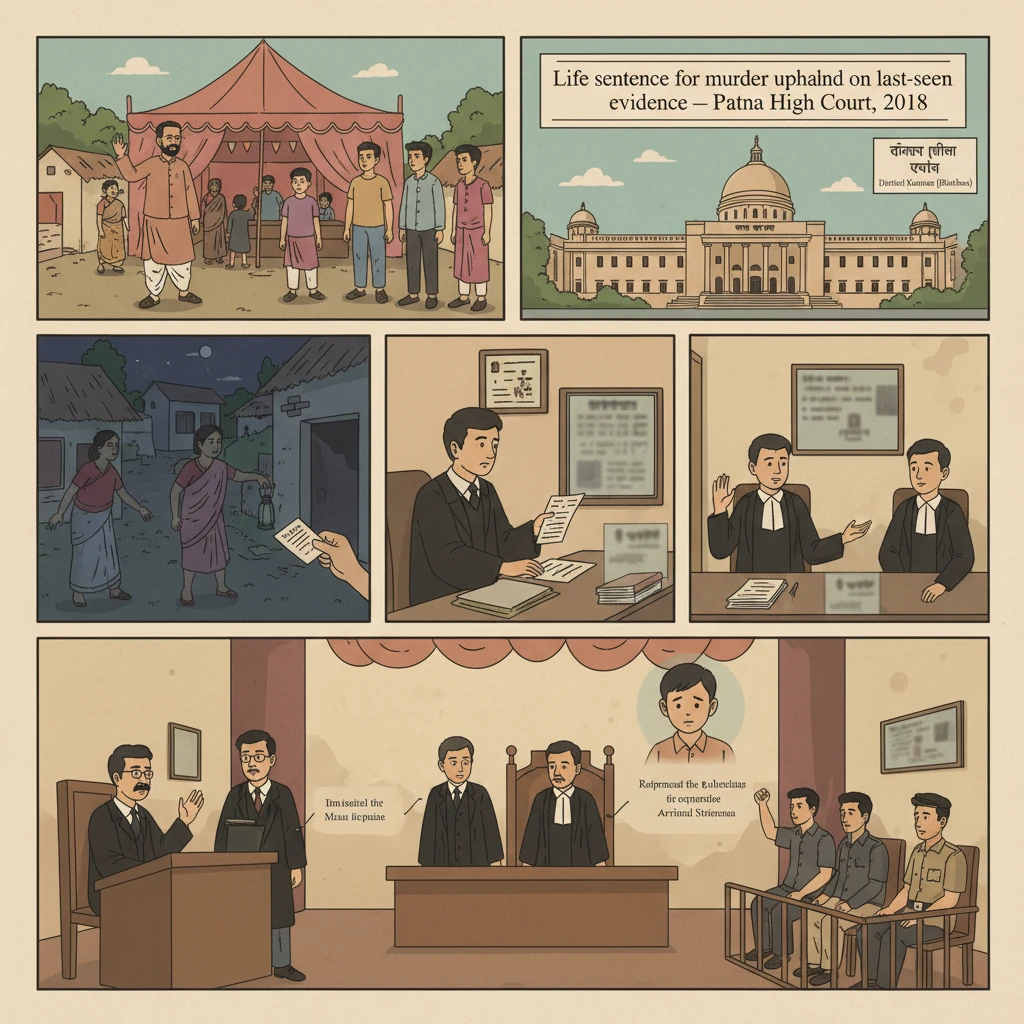
Case Background
This case arises from a tragic incident in village Chipali, under Durgawati Police Station, District Kaimur (Bhabhua). The deceased, Arvind Kumar Kewat, was the son of the informant, Vinod Kumar Kewat (P.W. 4).
On 27.12.2010, there was a shradh karm (post-death ritual) of Sudama Kewat, a co-villager. The informant and his son went there to participate. According to the informant, after taking meals he himself returned home, but his son stayed back at the shradh along with the four accused persons.
When the son did not return home till late in the night, the family started searching for him. The informant and others went to the houses of the four accused but did not find either the accused or the boy. The search continued the next morning, but with no success.
On 09.01.2011, at about 5.00 A.M., the family found a letter near the door of the informant’s house. The letter demanded Rs. 1,00,000/- and threatened that if the amount was not paid by 13.01.2011, the son would be killed. The informant took this letter to the police (“Daroga Ji”), but he was scolded and no case was registered.
Left with no option, the informant filed Complaint Case No. 40 of 2011 before the Chief Judicial Magistrate, Bhabhua, on 13.01.2011. In this complaint he accused the four appellants of kidnapping his son for ransom and named the place of occurrence as village Chipali.
The Magistrate sent the complaint to the police under Section 156(3) Cr.P.C. for registration and investigation. On 06.02.2011, Durgawati P.S. Case No. 7 of 2011 was registered under Sections 364/34 IPC against all four accused. On the very next day, 07.02.2011, a dead body was recovered from a field belonging to one Vijay Tiwary.
During investigation, after it became clear that the boy had been killed, Sections 302 and 201 IPC were added on 29.03.2011. A charge-sheet was filed on 31.03.2011 for offences under Sections 364, 302, 201, 34 IPC. Cognizance was taken on 07.05.2011, and after compliance of Section 207 Cr.P.C., the case was committed to the Sessions Court on 13.07.2011, becoming Sessions Trial No. 231 of 2011.
On 09.08.2011, a joint charge under Sections 302/34, 364, and 201 IPC was framed against all four accused. After trial, the Sessions Judge, Kaimur at Bhabhua, by judgment dated 20.09.2014, convicted all four under Sections 302/34 and 201 IPC. By order dated 22.09.2014, they were sentenced to life imprisonment and fine of Rs. 15,000/- each for murder, with six months’ rigorous imprisonment in default, and three years’ rigorous imprisonment under Section 201 IPC. Sentences were ordered to run concurrently.
Against this conviction and sentence, the four accused filed Criminal Appeal (DB) No. 868 of 2014 before the Patna High Court.
What the Court Examined and Decided
The Division Bench of the Patna High Court (Hon’ble Mr. Justice Rakesh Kumar and Hon’ble Mr. Justice Arvind Srivastava) heard the criminal appeal and examined both oral and documentary evidence produced during the trial.
From the prosecution side, six witnesses were examined:
- P.W. 1 – Bengali Kewat (uncle of the informant)
- P.W. 2 – Radhey Kewat (another uncle of the informant)
- P.W. 3 – Tetari Devi (mother of the deceased)
- P.W. 4 – Vinod Kumar Kewat (informant and father of the deceased)
- P.W. 5 – Rameshwar Singh (Investigating Officer)
- P.W. 6 – Dr. Arvind Prasad (doctor who conducted post-mortem)
Key documents like the complaint petition, formal FIR, inquest report, endorsement of the SHO, post-mortem report, and confessional statements recorded by police were exhibited. The ransom letter was marked as a material exhibit.
Defence arguments in the High Court
Counsel for the appellants argued mainly two points. First, that the prosecution had failed to prove that the deceased was last seen alive in the company of the appellants, so the “last seen” theory could not form the basis of conviction.
Second, they argued that the prosecution’s story that the dead body was recovered on the basis of confessional statements of the accused was false and legally useless. They pointed out that all four confessional statements (Exhibits 6 to 9) were recorded between 12.40 and 1.15 P.M. on 07.02.2011, whereas the inquest report shows that the dead body had already been recovered that morning and inquest was done at 8.30 A.M.
On this basis, they claimed that:
- the recovery could not have been based on those later confessions, and
- since the confessions were made only before the police and after recovery, they had no evidentiary value.
They also criticized the investigation for not proving the exact time of arrest of the appellants and for not producing arrest memos. It was further pointed out that the accused were not produced before a Magistrate when their so-called confessions were recorded.
Prosecution and informant’s stand in the High Court
The Additional Public Prosecutor relied heavily on the testimony of the Investigating Officer (P.W. 5). According to P.W. 5, appellants Bhajan Kewat and Rajesh Kewat were apprehended earlier, and on their disclosure the police came to know that the dead body was buried in the field of one Vijay Tiwary.
The I.O. stated that after arranging torches he went with the accused towards the southern side of village Chipali and searched the field at night. After much effort, at sunrise they could locate the place where the body was buried. In presence of villagers, the body was exhumed and was in decomposed condition. On the basis of clothes on the body, the informant and villagers identified it as that of Arvind Kumar Kewat.
The A.P.P. accepted that the confessional statements were recorded only after recovery, but maintained that the actual disclosure leading to the discovery was made earlier by appellants Bhajan and Rajesh. The formal recording of their statements later did not, in his view, weaken the evidence of recovery based on their disclosure.
On the “last seen” aspect, P.W. 3 (mother), P.W. 4 (father), and both uncles (P.Ws. 1 and 2) consistently stated that the deceased was last seen with all four appellants at or near the shradh place.
Counsel for the informant also reminded the Court about the ransom letter, arguing that the boy was kidnapped and killed because the ransom was not paid. At the same time, he accepted that the prosecution had not been able to prove kidnapping under Section 364 IPC during trial.
Evidence of last seen together
The High Court analysed in detail the depositions of the family witnesses.
P.W. 4 (father) deposed that after he finished his meal at the shradh and returned home, his son remained there, and at that time all four appellants were with him. His wife also came home later after taking meals, but the son did not return even by night. The family then searched the village and the houses of the appellants, but neither the appellants nor the boy were found.
In cross-examination, P.W. 4 clearly stated that while he was leaving the shradh he had seen his son at the house of Sudama along with the appellants. His evidence about identification of the decomposed body by clothes was also accepted.
P.W. 1 (Bengali Kewat), uncle of the informant, stated that after taking meals at the shradh, the deceased went with all four appellants. He also referred to receiving the ransom letter and to the later recovery of the body from the field of Vijay Tiwary on the disclosure of the accused. Cross-examination did not produce any material contradiction.
P.W. 2 (Radhey Kewat), another uncle, similarly stated that he had last seen the deceased with all four appellants at the shradh. He also supported the evidence on the ransom letter and the recovery of the body after disclosure.
Most important was the testimony of P.W. 3 (Tetari Devi), the mother of the deceased. She said that on the date of occurrence she saw her son sitting near the door of Sudama along with all four appellants. The next morning she went to the house of appellant Bhajan to enquire, but got no satisfactory reply. She stated that, on disclosure by the appellants, the buried body of her son was recovered from the field of Vijay Tiwary after about one month and seventeen days from the occurrence, in the month of “Maagh”. She, too, had gone with the police to that place. Nothing significant could be brought out in her cross-examination to shake her evidence.
The High Court considered this chain of family evidence consistent and trustworthy. It noted that even if many people attended the shradh, the specific evidence that the deceased was last seen alive with these four appellants stood firm.
Medical and forensic evidence
P.W. 6, Dr. Arvind Prasad, Professor and Head, Forensic Medicine, A.N. Magadh Medical College, Gaya, conducted the post-mortem on 08.02.2011 at 1.00 P.M. He found that the head was separated from the trunk at the level of the sixth cervical vertebra, with clean-cut margins on the vertebra and soft tissues. The oesophagus and trachea were also cleanly cut.
He opined that the cause of death was shock and haemorrhage due to injury on the neck by a sharp-cutting weapon. He described advanced decomposition: absence of rigor mortis, liquefaction of tissues, presence of maggots, missing body parts, exposed bones, absent brain, and other details. He estimated time since death as within 3 to 4 weeks.
In cross-examination he explained that in a completely decomposed body it is difficult to distinguish between lacerated and incised wounds due to loss of regularity in margins, but noted that in this case the body, though in an advanced stage, was not totally decomposed. He also explained the general timelines of decomposition, both in open air and when buried, and accepted that identification becomes difficult if the skin is totally decomposed.
This medical evidence matched the prosecution case that the body was buried and recovered several weeks after the disappearance, and that the boy had been killed by a sharp weapon.
Evidence of the Investigating Officer and recovery of body
P.W. 5, the Investigating Officer, proved the formal FIR (Exhibit 3), the SHO’s endorsement on the complaint (Exhibit 4), and the inquest report dated 07.02.2011 (Exhibit 5). He stated that, acting on the disclosure of appellants Bhajan and Rajesh, he proceeded with them to the southern side of village Chipali, about half a kilometre away, at night with torches.
He searched various spots in the field of Vijay Tiwary. After much effort and on specific pointing out by the two appellants, he finally located the place where the body was buried. By then sunrise had occurred and villagers had gathered. The buried, decomposed body was then exhumed. The informant and villagers identified the body from the clothes.
He also stated that, after killing the deceased, the accused had buried the body in that field to conceal evidence. In cross-examination he admitted that on 07.02.2011 at 12.00 noon he formally arrested appellants Bhajan and Rajesh and then began recording the confessional statements of the appellants. He also said that he took up investigation on 06.02.2011 at 12.45 hours. He specifically denied the suggestion that the body was not recovered on disclosure by the accused.
High Court’s reasoning and final decision
The High Court accepted that the formal confessional statements (Exhibits 6 to 9) were recorded after recovery of the body and, being made before police, had no direct relevance for proving guilt. However, the Court stressed that the recovery itself, as narrated in the oral evidence of the Investigating Officer, was still significant.
The Bench held that there was no reason to doubt the I.O.’s testimony that the police could locate the buried body only after disclosure by appellants Bhajan and Rajesh. The fact that the written confessional statements were recorded later did not, in the Court’s view, break the chain of events regarding the recovery.
More importantly, the Court found the “last seen” evidence of P.Ws. 1 to 4 reliable and consistent. It noted that although many villagers attended the shradh, the specific evidence of the mother and father that they had last seen the deceased with the four appellants stood unshaken. Combined with the subsequent discovery of the dead body, this formed a strong circumstance against the appellants.
On overall appraisal of the evidence, the High Court concluded that the Sessions Judge had committed no error in convicting the appellants under Sections 302/34 and 201 IPC. The appeal was therefore dismissed and the conviction and sentences of all four appellants were affirmed.
Why This Judgment Matters
This Patna High Court judgment is important for families of crime victims and for criminal trials based mainly on circumstantial evidence. The Court showed that even when there is no eyewitness of the actual killing, a conviction can stand if:
- the deceased was clearly last seen alive with the accused, and
- the dead body is later recovered in a manner closely linked to information given by the accused.
The Court carefully separated two things. It did not rely on written confessional statements made before police after recovery of the body, because such confessions have weak evidentiary value. But it still accepted the investigating officer’s account that the buried body was discovered based on earlier oral disclosure by the accused.
For ordinary readers, the message is that delayed police action or flaws in recording of statements do not automatically demolish a case, if reliable witnesses and consistent circumstances are present. For lawyers, the case reinforces how “last seen” evidence from close relatives, supported by recovery of the body and medical findings, can be sufficient to uphold a conviction for murder.
Legal Issues and Answers
-
Issue: Whether the prosecution proved, through reliable circumstantial evidence, that the appellants committed the murder of the deceased.
Answer: Yes. The Patna High Court held that consistent “last seen” testimony of four close witnesses, coupled with recovery of the buried body on disclosure by two appellants and supporting medical evidence, justified affirming the conviction under Sections 302/34 and 201 IPC. -
Issue: Whether the alleged confessional statements recorded by police after recovery of the dead body could be relied on to support the conviction.
Answer: No. The Court found that these confessions, being made before police and recorded after recovery, had no real relevance. However, the fact that the body was located on the basis of the appellants’ earlier disclosure to the Investigating Officer remained a valid circumstance.
Cases Cited by the Court
- No earlier cases or precedents have been specifically cited or relied upon in the extracted judgment text.
Case Details
Case Number: Criminal Appeal (DB) No. 868 of 2014; arising out of Durgawati P.S. Case No. 7 of 2011
Case Title: Bhajan Kewat & Ors. v. The State of Bihar
Citation: 2019(3) PLJR 260
Court: High Court of Judicature at Patna
Coram: Hon’ble Mr. Justice Rakesh Kumar; Hon’ble Mr. Justice Arvind Srivastava
Date of Judgment: 19.03.2018
Advocates:
- For the appellants: Shri Vikramdeo Singh, Advocate; Shri Sada Nand Roy, Advocate
- For the State (respondent): Shri Ajay Mishra, A.P.P.
- For the informant: Shri Rajni Kant Pandey, Advocate
Nature of Case: Criminal appeal (Division Bench) against conviction and sentence passed in Sessions Trial No. 231 of 2011 for offences under Sections 302/34 and 201 IPC.
Impugned Trial Court: Court of the Sessions Judge, Kaimur at Bhabhua (Sessions Trial No. 231 of 2011)
Outcome in High Court: Appeal dismissed; conviction and life sentence under Sections 302/34 and 201 IPC affirmed for all four appellants; sentences to run concurrently.
If you found this explanation helpful and wish to stay informed about
how legal developments may affect your rights in Bihar,
you may consider following Samvida Law Associates for more updates.







