
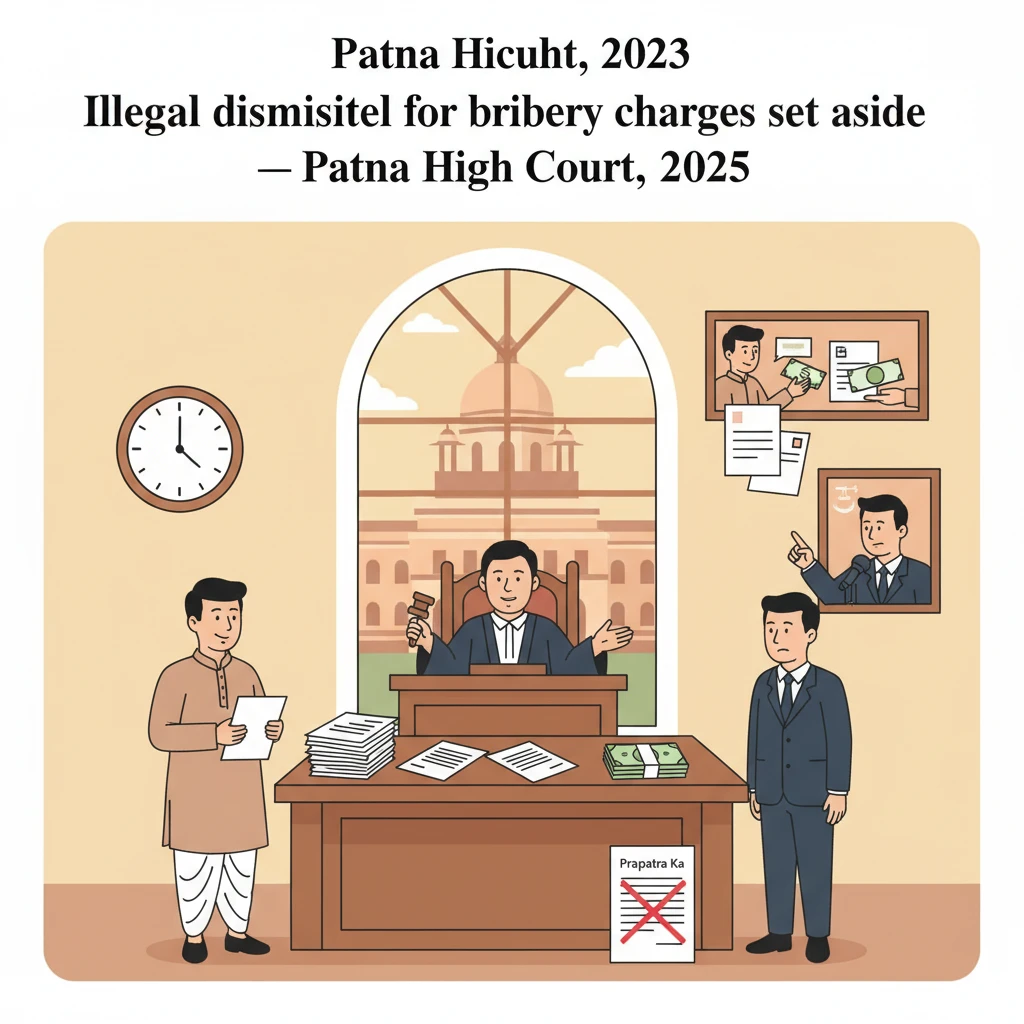
Case Background
The writ petition was filed in the Patna High Court as Civil Writ Jurisdiction Case No. 1673 of 2023. The petitioner was serving as Land Reforms Deputy Collector (LRDC) at Sherghati in the district of Gaya.
In 2012, he was trapped by the Economic Offence Unit (EOU) while allegedly receiving a bribe of Rs. 40,000/- from one Santosh Kumar. On this allegation, EOU P.S. Case No. 28 of 2012 was registered for offences under Sections 7 and 13 of the Prevention of Corruption Act.
Following the criminal case, the General Administration Department of the Government of Bihar initiated a departmental enquiry against him by Resolution dated 03.04.2014. This departmental proceeding was separate from the criminal case and was meant to decide his service fate.
The petitioner appeared before the Enquiry Officer, denied the charges and repeatedly requested that all relevant documents be supplied to him. According to him, the Department gave only an incomplete set of papers and never supplied the remaining documents, despite his continuous requests.
During the enquiry, no witness was cited in the charge memo and none was examined by the Department. Still, the Enquiry Officer submitted an enquiry report dated 17.02.2021, holding both charges proved against the petitioner.
On the basis of this report, the Department issued a second show cause notice dated 09.02.2021. The petitioner filed a detailed written statement on 12.07.2021, again denying the allegations and specifically pointing out non-supply of documents and non-examination of witnesses.
While these issues were pending, the Department passed Resolution dated 13.04.2022 dismissing the petitioner from service and declaring him ineligible for future government employment. His review petition was also rejected by order dated 23.06.2022.
The petitioner first challenged the enquiry report and later the dismissal and review orders in CWJC No. 18157 of 2021. That petition was ultimately withdrawn on 12.12.2022 with liberty to file a fresh writ. The present writ petition (CWJC No. 1673 of 2023) was then filed, challenging the enquiry report, the dismissal order and the rejection of review.
What the Court Examined and Decided
The single judge, Hon’ble Mr. Justice Arvind Singh Chandel, examined the entire service record placed on file, the writ petition, the annexures and the counter affidavit of the State.
The core complaint of the petitioner was that the departmental enquiry violated Rule 17(4) of the Bihar Government Servants (Classification, Control and Appeal) Rules (commonly known as Bihar CCA Rules). Under this rule, the Presenting Officer must prove the charges through oral and documentary evidence, and witnesses must be examined by or on behalf of the Presenting Officer.
The petitioner argued that in his case, although the Presenting Officer remained present, he led no oral or documentary evidence. No witnesses were examined, and the documents on which reliance was later placed were never proved through any witness. Therefore, according to the petitioner, it was a classic “no evidence” case, and the entire proceeding stood vitiated.
It was also argued that despite the petitioner’s repeated demand, the Department did not provide him with the complete set of documents or list of witnesses. These points were specifically raised again in his reply to the second show cause notice. Yet, the Disciplinary Authority and the Reviewing Authority did not deal with these objections while passing the final orders.
The State, on the other hand, supported the dismissal order. The State counsel submitted that there was documentary material on record and that, based on such material and the alleged admission of the petitioner during enquiry, the Enquiry Officer rightly held both charges to be proved. It was therefore argued that the orders of the Disciplinary and Reviewing Authorities did not call for interference.
The Court first looked at the charge memo (Prapatra Ka), which was annexed to the writ petition. It clearly indicated that no list of witnesses was attached with the charge memo and no witness was even cited by the Department.
The Court then examined the enquiry report dated 17.02.2021. This report confirmed that during the enquiry, no witness was actually examined by the Department. The Enquiry Officer formed his opinion “only on the basis of submission made by the Presenting Officer”. In other words, there was no oral evidence at all.
On the first charge, which related to allegedly accepting a bribe of Rs. 40,000/- from the complainant, the Enquiry Officer concluded that the charge stood proved mainly because a criminal case had been registered against the petitioner. He further wrote that during the enquiry, on various dates, the petitioner had himself admitted that he was caught with the bribe money.
The High Court scrutinised this finding and found a serious problem. The State could not show any material from the enquiry record to prove that the petitioner had ever made such a confession or admission before the Enquiry Officer. There was simply no record of any such statement by the petitioner. Thus, the Court found that the Enquiry Officer’s observation about admission was not supported by any material on record.
Regarding the second charge, the Enquiry Officer had observed that despite direction, the petitioner did not produce any defence evidence, and therefore he had “indirectly admitted” the charge. The Court held that this reasoning was also contrary to the record.
For this second charge too, no witness was examined by the Department. The documents relied upon by the Enquiry Officer had not been formally produced or proved through any witness. As a result, there was again no legal evidence to sustain the finding of guilt on the second charge.
The Court then referred to the decision of the Supreme Court in Satyendra Singh v. State of Uttar Pradesh and Another, 2024 SCC Online SC 3325, which in turn followed the earlier judgment in Roop Singh Negi v. Punjab National Bank and Others, (2009) 2 SCC 570.
Paragraph 17 of the Supreme Court judgment in Satyendra Singh was quoted, where the apex court clearly held that even in an ex parte enquiry, it is essential (“sine qua non”) to record the evidence of witnesses for proving the charges. Where no oral evidence is recorded, especially in cases involving major penalties, the enquiry is “totally vitiated and non-est in the eyes of law”.
Applying this principle to the present case, the Patna High Court noted that the petitioner, in his reply to the second show cause notice, had clearly raised all the legal objections: non-supply of list of witnesses and documents, non-examination of witnesses and violation of the Bihar CCA Rules. Yet the Disciplinary Authority, while passing the dismissal order, did not deal with any of these contentions. The Reviewing Authority also ignored them while rejecting the review petition.
The Court therefore characterised the matter as a case of “no evidence”. Without any legal evidence being led by the Department, the Enquiry Officer had still reached a conclusion of guilt. On that basis, the petitioner’s services were terminated and he was also debarred from future government employment.
Such an approach, the Court held, could not be sustained in law. Major punishment like dismissal from service and future disqualification cannot rest merely on unproved documents, the existence of a criminal case, or unsubstantiated claims of admission. Departmental proceedings must follow the rules and basic principles of natural justice.
In conclusion, the Court held that the dismissal order dated 13.04.2022 and the Reviewing Authority’s order dated 23.06.2022 were both liable to be set aside. The writ petition was allowed.
The Court directed that the petitioner be reinstated in service “with all consequential benefits”. The judgment also records that the petitioner had stated he was not in gainful employment after dismissal, and he had sought full back wages and salary for the suspension period. While the Court did not separately spell out the exact monetary calculations, its direction for reinstatement with all consequential benefits indicates that service benefits flowing from setting aside the dismissal must follow.
Why This Judgment Matters
This judgment is significant for government employees across Bihar, especially those facing departmental proceedings arising from criminal cases such as bribery traps.
The Patna High Court has made it clear that departments cannot dismiss an employee simply on the strength of a criminal case or the say-so of a Presenting Officer. They must still follow the Bihar CCA Rules and lead proper oral and documentary evidence before an Enquiry Officer.
The judgment reinforces that:
First, a charge memo must be accompanied by a list of witnesses, and those witnesses must actually be examined during the enquiry. Second, documents relied upon must be proved by some witness and cannot be treated as evidence merely because they exist in a file. Third, any alleged “admission” by an employee must be supported by a clear record. It cannot be assumed.
Fourth, when an employee raises serious objections in response to a second show cause notice, the Disciplinary Authority and Reviewing Authority must deal with them in their orders. Ignoring such points can render their decisions invalid.
For employees wrongly dismissed after sham enquiries, this judgment shows that the High Court will intervene and order reinstatement where there is a complete absence of legal evidence. For departments, it is a strong reminder to conduct fair, rule-based enquiries, particularly when imposing the harsh penalty of dismissal and future debarment.
Legal Issues and Answers
- Issue: Whether the petitioner’s dismissal from service, based on an enquiry conducted without examining any witnesses and without proper proof of documents, was legally valid under the Bihar CCA Rules.
Answer: No. The Patna High Court held that the enquiry was a case of “no evidence”, violated Rule 17(4) of the Bihar CCA Rules and the principles laid down by the Supreme Court. The dismissal and review orders were quashed. - Issue: Whether the mere registration of a criminal case and unsubstantiated claims of admission could be treated as sufficient basis for holding bribery charges proved in departmental proceedings.
Answer: No. The Court held that without legal evidence, including examination of witnesses and proof of documents, the charges could not be treated as proved, and the findings of guilt were unsustainable. - Issue: What relief the petitioner was entitled to after the departmental proceedings were found vitiated.
Answer: The Court directed reinstatement of the petitioner with all consequential benefits, thereby restoring his service rights affected by the invalid dismissal.
Cases Cited by the Court
- Satyendra Singh v. State of Uttar Pradesh and Another, 2024 SCC Online SC 3325.
- Roop Singh Negi v. Punjab National Bank and Others, (2009) 2 SCC 570 (relied upon through the Supreme Court’s discussion in Satyendra Singh).
Case Details
Case Number: Civil Writ Jurisdiction Case No. 1673 of 2023
Case Title: Ramesh Prasad Diwakar v. The State of Bihar and Others
Citation: 2026(1) PLJR 657
Court: High Court of Judicature at Patna
Coram: Hon’ble Mr. Justice Arvind Singh Chandel
Date of Judgment: 08.04.2025
Advocates:
For the petitioner: M/s Ranjeet Kr, Shikhar Mani, Kanishk Kaustubh, Lakshmi Kri, Rajnish Prakash, Advocates
For the respondents (State): Mr. Dhurendra Kr, AC to GP V
Nature of the Case: Writ petition (service law challenge to departmental enquiry, dismissal order and rejection of review)
Link to Judgment: View official judgment on Patna High Court website
If you found this explanation helpful and wish to stay informed about how legal developments may affect your rights in Bihar, you may consider following Samvida Law Associates for more updates.







