
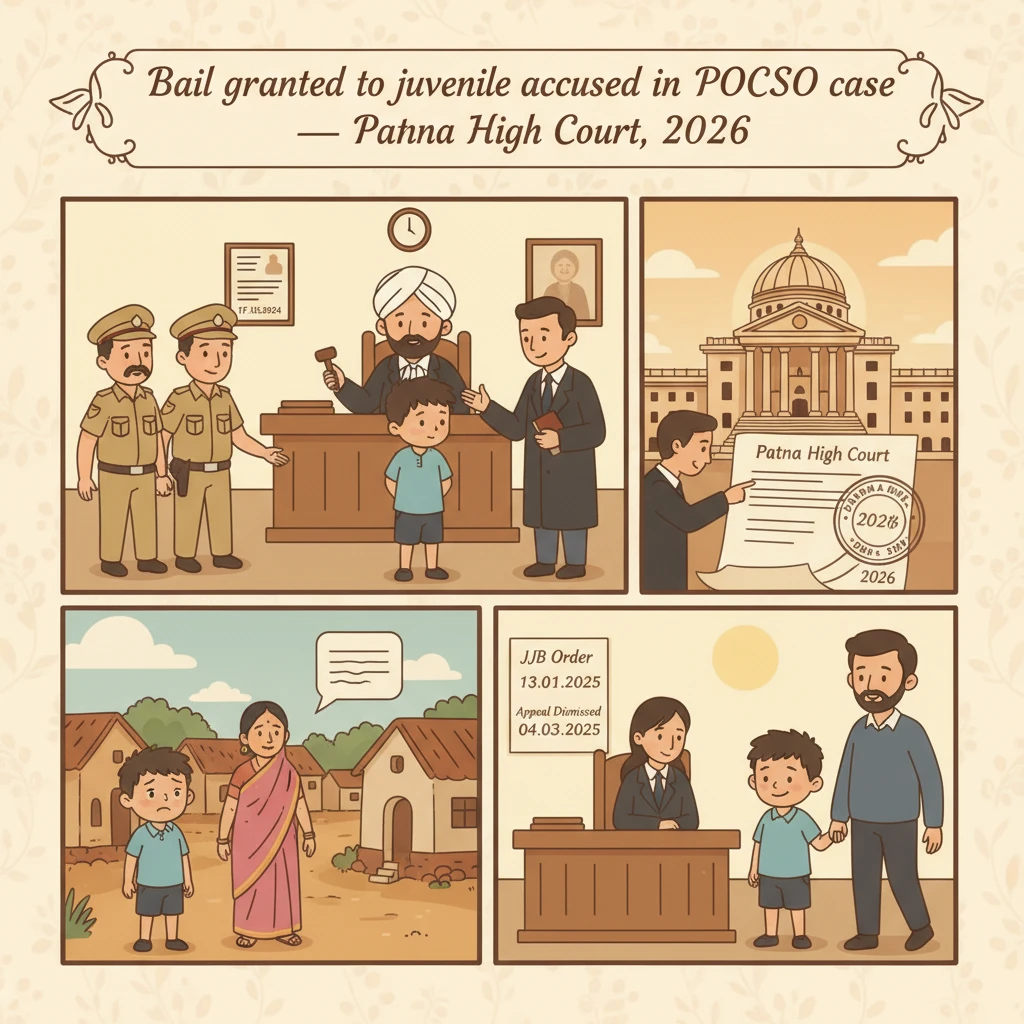
Case Background
This case arose from Araria Mahila P.S. Case No. 44 of 2024, registered under Sections 341, 376, 313, 417/34 of the Indian Penal Code and Section 6 of the Protection of Children from Sexual Offences (POCSO) Act.
Opposite party no. 2, a young woman, lodged the FIR alleging that when she was alone at home, the child in conflict with law (CICL) forced himself on her after gagging her mouth. She stated that he later promised to marry her and, relying on this allurement, he continued to have sexual relations with her.
According to the FIR, when she became pregnant, the boy allegedly gave her some medicines and took her to a doctor, resulting in termination of the pregnancy. Thereafter, in a panchayati, the boy and his family allegedly refused to solemnise the marriage. The age of the victim was stated to be about 18 years.
The boy was apprehended and taken into custody on 17.10.2024 in connection with this case. Before the Juvenile Justice Board (JJB), Araria, his age was determined. By order dated 30.10.2024, the JJB declared him a juvenile. His age on the date of occurrence was found to be 12 years 06 months and 21 days.
The CICL applied for bail before the JJB in J.J.B. Case No. 117 of 2024 arising out of the same police case. On 13.01.2025, the JJB rejected his bail petition. Aggrieved, he filed Criminal Appeal No. 06 of 2025 before the learned Additional Sessions Judge-I-cum-Special Judge (Children Court), Araria.
On 04.03.2025, the appellate court dismissed the appeal and upheld the JJB’s refusal of bail. The boy, through his father and natural guardian, then approached the Patna High Court in Criminal Revision No. 484 of 2025, challenging both orders.
What the Court Examined and Decided
Hon’ble Mr. Justice Arun Kumar Jha heard the criminal revision. The Court considered the submissions of counsel for the petitioner (CICL), the learned APP for the State, and counsel for opposite party no. 2 (the informant/victim).
Counsel for the petitioner argued that the boy had been falsely implicated due to ill motive of the victim. He emphasized that the boy had been declared a juvenile of 12 years 06 months and 21 days on the date of occurrence and had no criminal antecedent.
He submitted that the victim was about 18 years old. According to him, both the JJB and the appellate court passed orders “bad in the eye of law as well as on facts,” because they did not properly consider the legal presumption in favour of bail to a child, nor the alleged false implication.
It was also argued that by keeping the child in custody, he was being deprived of the care and protection of his family. Counsel stressed there was no possibility of the boy doing any harm to the victim or witnesses after release.
The Court was taken through the social investigation report and social background report. Petitioner’s counsel highlighted that those reports did not recommend that the child be kept in custody. They only noted a lack of discipline at home, that the father is a labourer, that the boy had studied up to Class V, and that his friends were illiterate.
At the same time, the report mentioned that the boy had clean antecedents and a normal mental condition. Counsel submitted that the parents were ready to take responsibility for him and that continuous custody would harm his mental and physical well-being. He maintained that there was no chance of the boy falling into bad company and that no family member had criminal antecedents.
On the other hand, counsel for opposite party no. 2 strongly opposed the bail. He argued that the alleged offence was very serious, involving rape and termination of pregnancy. He pointed out that the victim had supported the allegations in her statement recorded under Section 183 of the Bharatiya Nagarik Suraksha Sanhita (BNSS).
He further relied on the social investigation and social background reports to say that there was general lack of discipline in the boy’s house and that his peer group consisted of illiterate friends. According to him, the boy came from a very poor social and economic background, with lack of education and values of a model society, which might negatively influence him.
Counsel argued that if the boy was released on bail, he might repeat the same type of offence and could also influence the trial.
After hearing both sides, the Patna High Court examined Section 12 of the Juvenile Justice (Care and Protection of Children) Act, 2015. The Court reproduced Section 12 in full. This provision states that any person who is apparently a child and alleged to have committed a bailable or non-bailable offence shall be released on bail, with or without surety, or placed under proper supervision.
The proviso to Section 12 lays down limited grounds on which bail can be refused to a CICL: if there are reasonable grounds to believe that release is likely to bring the child into association with any known criminal, or expose him to moral, physical or psychological danger, or if release would defeat the ends of justice. In such cases, reasons must be recorded.
The Court held that, in light of this provision, a CICL can be denied bail only if these specific risks are shown. In the absence of such material, bail cannot be denied.
The Court then referred to Section 3 of the Juvenile Justice Act, 2015, which lays down general principles of care and protection of children. The judgment extracted relevant principles, including:
the principle of presumption of innocence up to 18 years, the principle of dignity and worth, the principle of participation, the principle of best interest, the principle of family responsibility, the principle of safety, the principle of non-stigmatising semantics, the principle of institutionalisation as a measure of last resort, and the principle of repatriation and restoration.
The Court observed that a combined reading of Section 12 and Section 3 shows that a child in conflict with law should be released on bail unless there is material on record to show that the child may come in contact with known criminals or that release may endanger his moral, physical or psychological well-being.
The Court stressed that courts, acting as parens patriae (protector of the child), must look after the best interest of the child and take steps aimed at reformation and rehabilitation.
Applying these principles to the case, the Court acknowledged that the alleged offence was “very serious.” However, it reiterated that bail to a CICL can be refused only on the limited statutory grounds. Otherwise, “bail is a rule and jail is an exception in case of CICL as well.”
It took note that the boy had been in custody since 17.10.2024 and that his parents were ready and willing to take care of him and protect his best interest so that he does not fall into bad company or commit any other offence.
The High Court then examined the impugned orders. It found that the lower courts had denied bail on the ground that release would be against the best interest of the child and that there was a possibility of mental, physical or psychological danger.
However, on perusal of the record, the High Court did not find any concrete material to infer that the child would, on release, come in contact with any known criminal or suffer moral, physical or psychological harm. The social reports mainly referred to poverty, lack of discipline and low education, but also noted clean antecedents and normal mental condition.
The Court observed that, for reformatory measures and rehabilitation, the “best place could be the house of the child” and noted that the parents had undertaken to take care of his best interest. In such circumstances, the legal test for denial of bail under Section 12 was not satisfied.
Consequently, the Patna High Court held that the CICL was entitled to be released on bail. It directed that he be released in connection with J.J.B. Case No. 117 of 2024 arising out of Araria Mahila P.S. Case No. 44 of 2024, on furnishing bail bonds of Rs. 10,000/- with two sureties of the like amount to the satisfaction of the JJB, Araria or concerned court.
The Court imposed conditions: one of the bailors must be a parent of the petitioner, and the other bailor must be a relative without criminal antecedent who shall undertake to keep proper care and upkeep of the boy. Further, the petitioner must remain present before the Board on every date of trial fixed by the Board.
With these directions, the High Court set aside the order dated 13.01.2025 of the Juvenile Justice Board, Araria, and the appellate judgment/order dated 04.03.2025 of the Additional Sessions Judge-I-cum-Special Judge (Children Court), Araria. The criminal revision was allowed, and the office was directed to return the lower court records.
Why This Judgment Matters
This decision is important for families of children accused in serious criminal cases in Bihar. The Patna High Court has clearly reiterated that, under the Juvenile Justice Act, a child in conflict with law is normally entitled to bail, even in grave offences, unless very specific risks are proved.
Poverty, low education, or general lack of discipline at home, without more, are not enough to deny bail. Courts must see whether there is real material showing that release will expose the child to known criminals, or cause moral, physical or psychological danger, or defeat the ends of justice.
The judgment underlines that institutional custody is a last resort. For rehabilitation and reform, the family home is usually the best place, provided the parents are willing and there is no evidence of danger.
For victims, the criminal case continues and the trial will go on before the Juvenile Justice Board. The order only decides whether the child will stay in a home or in custody during trial, not whether he is guilty or innocent.
Legal Issues and Answers
-
Issue: Can a 12-year-old child in conflict with law, accused of serious offences under IPC and POCSO, be denied bail on the basis of seriousness of the allegation and general social background?
Answer: The Patna High Court held that bail cannot be denied merely because the offence is serious or the child comes from a poor, undisciplined background. Under Section 12 of the Juvenile Justice Act, bail can be refused only if there are reasonable grounds to believe that release will bring the child into association with known criminals, expose him to moral, physical or psychological danger, or defeat the ends of justice. As no such material existed, the Court granted bail with conditions.
Cases Cited by the Court
- No earlier judicial precedents or case citations are expressly referred to in this judgment. The Court relied directly on the text of the Juvenile Justice (Care and Protection of Children) Act, 2015.
Case Details
Case Number: Criminal Revision No. 484 of 2025; arising out of Araria Mahila P.S. Case No. 44 of 2024; J.J.B. Case No. 117 of 2024.
Case Title: Md. Anwar @ Anwar S/O Md. Kalam @ Kalam @ Abdul Kalam vs. The State of Bihar & Rahmina Praween.
Citation: 2026(1) PLJR 639.
Coram: Hon’ble Mr. Justice Arun Kumar Jha.
Advocates: Mr. Mukesh Kumar Rana, Advocate for the petitioner; Mr. Kumar Ranjit Ranjan, APP for the State; Mr. Kundan Kumar Singh, Advocate for opposite party no. 2.
Nature of the Case: Criminal revision petition challenging appellate and original orders refusing bail to a child in conflict with law under the Juvenile Justice (Care and Protection of Children) Act, 2015.
Link to the Judgment: View full judgment on the Patna High Court website
If you found this explanation helpful and wish to stay informed about
how legal developments may affect your rights in Bihar,
you may consider following Samvida Law Associates for more updates.







