
Case Background
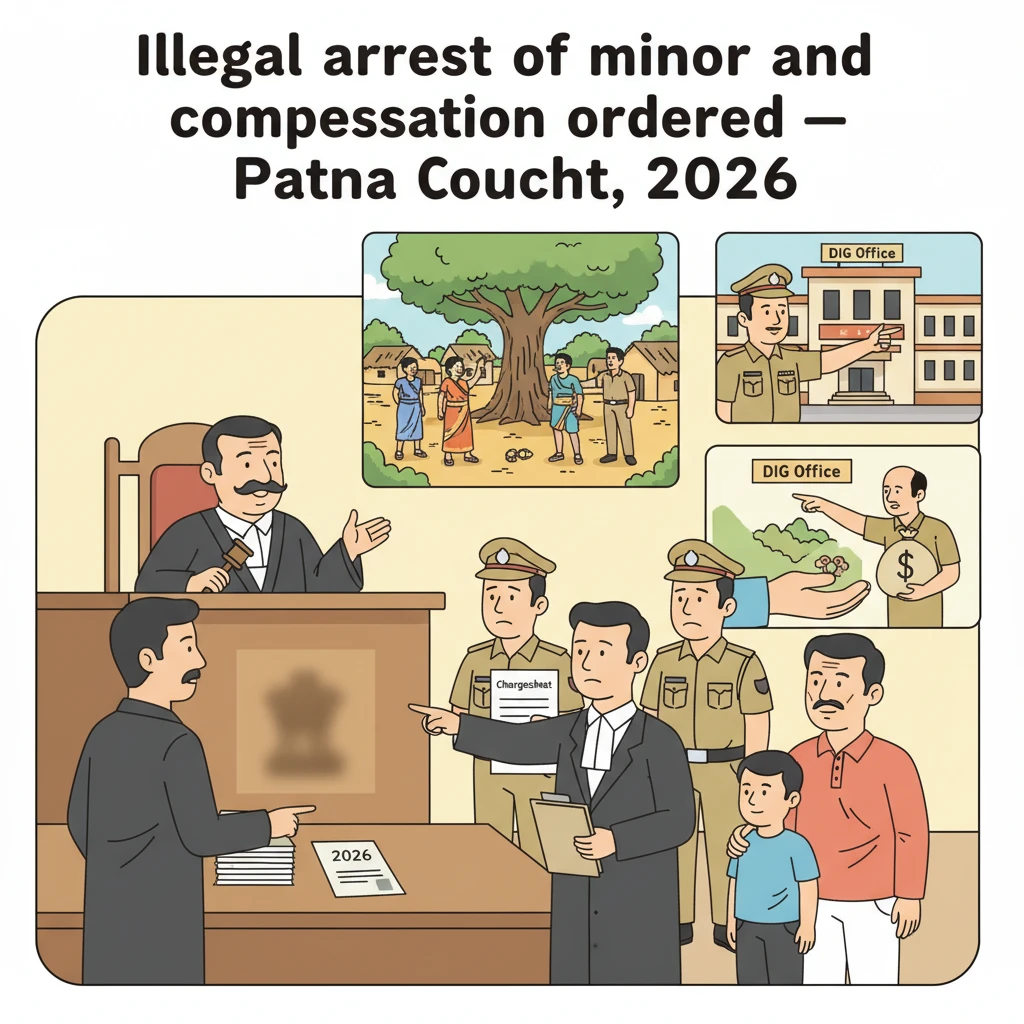
The case started from a village land dispute in Puraini, District Madhepura. A Panchayati was allegedly held with the help of co-villagers to settle this dispute.
According to the first information report, one woman from the village alleged that during this Panchayati, fourteen co-villagers, including the present petitioner, assaulted her side and also snatched a silver chain and other ornaments. On this basis, Puraini P.S. Case No. 128 of 2025 dated 11.07.2025 was registered under Sections 126(2), 115(2), 76, 308(2), 109, 303(2), 3(5) of the Bhartiya Nyaya Sanhita, 2023.
Five days later, the petitioner’s mother lodged a counter case about the same incident. This became Puraini P.S. Case No. 131 of 2025 dated 16.07.2025, under Sections 191(2), 191(3), 190, 115(2), 76, 126(2), 109, 303(2), 352, 351(2), 351(3) of the BNS, 2023.
During investigation of Case No. 128 of 2025, the Investigating Officer found no sufficient material against ten of the named accused, including the petitioner. One accused, Md. Naushad, was arrested and sent up for trial. On the direction of a senior police officer, the I.O. submitted Chargesheet No. 235 of 2025 dated 01.09.2025. In this chargesheet, the petitioner and nine others were shown in Column No. 12 as “not chargesheeted”, meaning they were not being sent for trial. Investigation was kept open only against three absconding accused.
Despite this, later developments led to the petitioner’s arrest and custody, which finally brought the matter before the Patna High Court through a criminal writ petition seeking a writ of habeas corpus.
What the Court Examined and Decided
The Patna High Court, hearing the criminal writ petition, focused on two main issues: the legality of the petitioner’s arrest and his treatment as an adult despite being a juvenile.
First, the Court looked closely at how the investigation changed course. About 25 days after filing the chargesheet, the I.O. received a review or supervision note from the Deputy Inspector General of Police, Koshi Range, Saharsa. This note came after the informant went to the DIG with a complaint that the local Inspector had wrongly exonerated ten named accused persons.
In his supervision note, the DIG broadly recorded the allegations and witness statements and then directed the I.O. to proceed with the investigation on the assumption that the allegations were true. He instructed the Superintendent of Police, Madhepura to ensure further action and to arrest all remaining accused persons quickly.
The case diary showed that this supervision note was entered on 25.09.2025. After that, the I.O. directly started conducting raids at the houses of the accused. The case diary did not show any instruction from the Superintendent of Police, Madhepura after this note. Nor did it show that the I.O. made any application before the Magistrate seeking permission for further investigation, even though a chargesheet had already been filed and cognizance taken.
Importantly, the I.O. did not collect any new material against the petitioner. Nevertheless, on 23.10.2025, he arrested the petitioner from his house, recorded his age as 19 years, produced him before the Magistrate, and the petitioner was remanded to jail.
The High Court observed that at the time of production, the Magistrate’s attention was not drawn to the fact that the petitioner was shown as a “not chargesheeted” accused in Column No. 12 of the chargesheet. Once a chargesheet is filed and the accused is not sent up for trial, an officer cannot simply change course and arrest that person without seeking permission for further investigation from the trial court.
The Court found that the Magistrate also did not independently examine the record to see that the petitioner was not chargesheeted, and mechanically sent him to jail without questioning the basis of arrest.
Next, the Court examined the claim that the petitioner was a juvenile. The writ petition stated that he was a minor and relied on his Bihar School Examination Board registration card, which recorded his date of birth as 01.01.2010. If correct, he was 15 years and some months old on the date of occurrence.
On 24.11.2025, the High Court took note of this claim and directed the State to file a counter affidavit sworn by the I.O. It also observed that the jurisdictional Magistrate was free to take corrective measures, and if the petitioner was indeed below 18 years, he must be sent to the Juvenile Justice Board and kept in an observation home, not in jail with adults.
Later, it was brought to the Court’s notice that on 21.11.2025, even before the High Court’s order was passed, the Magistrate had referred the petitioner’s case to the Juvenile Justice Board, Madhepura for age assessment. Subsequently, the Superintendent of Police, Madhepura sent a report to the High Court through Letter No. 13 dated 07.01.2026. This report confirmed that the petitioner had been declared a juvenile, aged about 15 years 6 months and 8 days on the date of the occurrence.
With these facts, the High Court framed the central question: how could the petitioner be arrested on 23.10.2025 when he was not chargesheeted in Chargesheet No. 235 of 2025, and when no new material had been gathered against him?
The State’s counsel, after interacting with the I.O., stated that he was not satisfied with the I.O.’s explanation. From the records, it appeared that the sole reason for the arrest was the supervision note of the DIG. There was no separate judicial permission for further investigation after submitting the earlier chargesheet.
The Court examined the case diary itself. It confirmed that there was no recorded instruction from the Superintendent of Police after the DIG’s note, and the I.O. alone decided to arrest the petitioner. The Court observed that if the DIG believed further investigation was needed, he should have directed the I.O. to move the Magistrate for permission, because the court had already taken cognizance on the previous chargesheet.
The learned AC to AG could not produce any document or material to show that the I.O. had collected fresh evidence against the petitioner, or that he had any legal ground to arrest the petitioner without court’s leave for further investigation.
On these facts, the Court held that the petitioner’s liberty and his fundamental Right to Life and Personal Liberty under Article 21 of the Constitution had been violated. The DIG’s direction to proceed with investigation “assuming the allegations true” was found to be against the basic criminal law principle of presumption of innocence.
The Court also stressed that the petitioner was a student below 16 years of age. He had been arrested and kept first in jail and then in an observation home, without any cogent material and in disregard of the Juvenile Justice (Care and Protection of Children) Act, 2015. The Magistrate’s failure to check his age and status, and to question the basis of arrest, compounded this illegality.
The Court noted that due to misuse of power by the police and the Magistrate’s failure to protect the minor’s rights, the petitioner had been incarcerated for more than two and a half months. This, the Court said, was an unlawful arrest and detention, and a constitutional court could not be a “mute spectator”.
The Bench then referred to leading Supreme Court decisions on illegal detention and compensation. It cited Nilabati Behera @ Lalita Behera v. State of Orissa and Others, reported in AIR 1993 SC 1960, where the Supreme Court held that compensation awarded under Articles 32 and 226 for violation of fundamental rights is a public law remedy based on strict liability, and sovereign immunity is no defence.
The Court also relied on its own earlier judgment in Arvind Kumar Gupta v. State of Bihar and Others, reported in 2025 (6) BLJ 52. In that case, it had discussed Rudal Sah v. State of Bihar and Another (AIR 1983 SC 1086) and a Delhi High Court judgment in Pankaj Kumar Sharma v. Government of NCT of Delhi and Others, 2023 SCC OnLine Del 6215, to underline that courts can and should award monetary compensation for unlawful detention, and that the amount paid by the State can be recovered from erring officers.
Applying these principles, the Patna High Court ordered that the Juvenile Justice Board, Madhepura must immediately release the petitioner from the observation home or children’s home, and issue appropriate release orders forthwith.
For his unlawful arrest and detention, the Court directed the State of Bihar to pay the petitioner compensation of Rs. 5,00,000 (Rupees Five Lakhs). This amount was fixed keeping in view the physical and mental agony suffered by a young boy over more than two and a half months.
Recognising that the petitioner and his family had been forced to approach the High Court through a habeas corpus petition and had incurred expenses because of the police misuse of power, the Court also awarded litigation costs of Rs. 15,000, to be paid by the State within the same period.
The Court then addressed accountability of the officers involved. It reiterated that when the State is saddled with costs or compensation due to misuse of power by its officers, the amounts must be recovered from those erring officials. It referred to its judgment in K.K. Pathak @ Keshav Kumar Pathak v. Ravi Shankar Prasad and Others, reported in 2019 (1) PLJR 1051, which has attained finality as it was not interfered with by the Supreme Court in SLP (Crl) No. 003566/2019.
Following this principle, the Court directed the Director General of Police, Bihar to start an administrative inquiry into the matter. After examining the materials in that inquiry, the competent authority must decide responsibility and recover the entire compensation and cost amounts paid to the petitioner from the erring officers. This recovery must be completed within six months from receipt of the High Court’s order.
Finally, the writ application was allowed to the extent of these directions, and copies of the order were directed to be communicated to the Principal District Judge, Madhepura, the Juvenile Justice Board, Madhepura, and the Director General of Police, Bihar for strict compliance.
Why This Judgment Matters
This judgment is important for ordinary people, especially in Bihar, because it shows that the Patna High Court will not tolerate illegal arrests, particularly of minors. It makes clear that police cannot arrest someone who has already been left out of a chargesheet without first getting court permission for further investigation and without collecting fresh evidence.
For juveniles, the ruling reinforces that they must be treated under the Juvenile Justice law and not like adult accused. Sending a child to jail with adults is a serious violation of law, and courts will step in to correct it.
The decision also gives a clear message to police officers and magistrates: if they misuse their powers and violate fundamental rights, the State may pay compensation but will then recover that money from their salaries after proper inquiry. This creates a strong warning against casual or pressure-driven arrests.
For villagers facing land disputes or criminal cases, this case shows that a writ of habeas corpus before the Patna High Court can be an effective remedy when someone is detained without legal authority. It also shows that courts can award financial compensation for the suffering caused by such illegal detention.
Legal Issues and Answers
Issue: Can police arrest a person, already shown as “not chargesheeted” in a filed chargesheet, based only on a supervisory note, without new material and without court’s permission for further investigation?
Answer: No. The Patna High Court held that such arrest is unlawful and violates the person’s right to life and liberty under Article 21.
Issue: How should a minor accused be treated when arrested or produced before a Magistrate?
Answer: A juvenile must be dealt with under the Juvenile Justice (Care and Protection of Children) Act, 2015, sent to the Juvenile Justice Board for age assessment, and kept in an observation home, not in jail with adults.
Issue: Is compensation payable for unlawful arrest and detention, and who ultimately bears this cost?
Answer: Yes. The Court awarded Rs. 5,00,000 as compensation and Rs. 15,000 as costs to the petitioner, to be paid by the State and then recovered from the erring officials after departmental inquiry.
Cases Cited by the Court
- Nilabati Behera (Smt) Alias Lalita Behera v. State of Orissa and Others, AIR 1993 SC 1960
- Rudal Sah v. State of Bihar and Another, AIR 1983 SC 1086 (referred through Arvind Kumar Gupta case)
- Pankaj Kumar Sharma v. Government of NCT of Delhi and Others, 2023 SCC OnLine Del 6215
- Arvind Kumar Gupta v. State of Bihar and Others, 2025 (6) BLJ 52
- K.K. Pathak @ Keshav Kumar Pathak v. Ravi Shankar Prasad and Others, 2019 (1) PLJR 1051
Case Details
Case Number: Criminal Writ Jurisdiction Case No. 3077 of 2025
Case Title: Md. Jahid (Minor) under the guardianship of cousin brother Mohammad Navi Hussain/Parokar v. The State of Bihar & Anr.
Coram: Hon’ble Mr. Justice Rajeev Ranjan Prasad and Hon’ble Mr. Justice Ritesh Kumar
Citation: 2026 (1) PLJR 611
Advocates: For the petitioner: Mr. Shashwat Kumar, Advocate; Mr. Aman Alam, Advocate; Mr. Amarnath Kumar, Advocate. For the State: Mr. P.N. Sharma, AC to A.G.
Nature of the Case: Criminal writ petition seeking writ of habeas corpus alleging illegal arrest and detention of a juvenile.
Date of Judgment: 09.01.2026
Link to Judgment: Full text of Patna High Court judgment
If you found this explanation helpful and wish to stay informed about
how legal developments may affect your rights in Bihar,
you may consider following Samvida Law Associates for more updates.







