
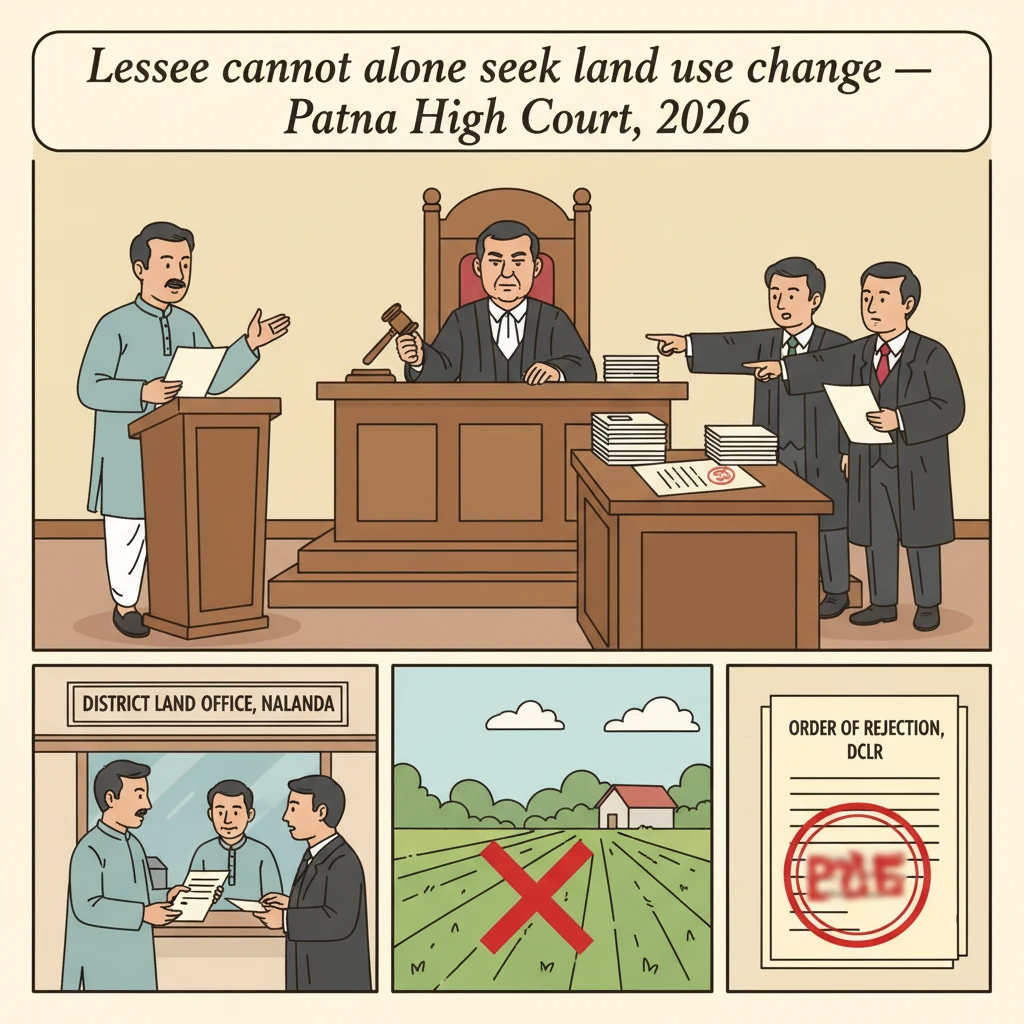
Case Background
The matter arose from an application filed under Section 5 of the Bihar Agricultural Land (Conversion for Non-Agriculture Purposes) Act, 2010. The petitioner had taken a parcel of agricultural land on lease from the original landholder by a registered lease agreement dated 18.07.2018.
After obtaining the lease, the petitioner approached the competent authority notified under the 2010 Act for permission to convert this agricultural land into non-agricultural use. He submitted the prescribed Form No. 3 on 23.07.2018, giving the necessary details as required under the statute.
The application was considered by the Deputy Collector Land Reforms, Hilsa, Nalanda (DCLR). By a memo numbered 130 dated 24.02.2020, the DCLR rejected the request for conversion. This memo referred to an order of the Sub-Divisional Officer, Hilsa, which the petitioner also sought to be called for and quashed.
Feeling aggrieved, the petitioner filed Civil Writ Jurisdiction Case No. 13762 of 2021 before the Patna High Court. He asked the Court to quash Memo No. 130 dated 24.02.2020 and the related order of the Sub-Divisional Officer, and to direct that his application for conversion be allowed.
What the Court Examined and Decided
The writ petition came up before Hon’ble Mr. Justice Purnendu Singh. The Court heard Mr. Abhinay Raj, counsel for the petitioner, and Mr. Arif Daula Siddiqui, counsel for the State of Bihar and its officers.
On behalf of the petitioner, it was submitted that a proper application had been made under Section 5 of the 2010 Act in the required Form No. 3, before the competent authority. According to the petitioner, all details demanded under the Act had been supplied along with the application.
The petitioner’s counsel argued that the order dated 24.02.2020 contained in Annexure-6 was arbitrary and without proper reasons. He pointed out that in the impugned memo the rejection was linked to a supposed likelihood of nuisance in the area if the land was converted for non-agricultural use.
It was argued that there was no evidence of any such nuisance or criminal activity. Further, no report had been obtained from the local police after any inquiry. On this basis, counsel submitted that the order suffered from non-application of mind and deserved to be set aside.
On the other side, counsel for the State supported the DCLR’s order. He submitted that Memo No. 130 dated 24.02.2020 was a reasoned order and that valid grounds had been recorded for rejecting the application.
The State’s stand was that the land in question had only been taken on lease by the petitioner. The original landholder remained the owner. Since no consent or application had been made by this landholder, the DCLR had rightly refused to allow conversion of the land’s character.
After hearing both parties, the Court examined the material on record. It noted, as a matter of fact, that the petitioner’s application dated 23.07.2018 sought conversion of his leasehold land from agricultural to non-agricultural use. This application was finally disposed of by the DCLR through a reasoned order dated 24.02.2020 contained in Memo No. 130.
The Court recorded that the DCLR had rejected the application on a clear ground: the petitioner was not the owner of the land; he was only a lessee. During the writ proceedings, the petitioner produced a registered lease agreement executed on 18.07.2018 by the original landholder, one Shri Ravindra Sharma.
The Court then carefully perused the terms and conditions of this lease agreement. From this document, it found that the agreement did not grant any right to the petitioner to change the very nature of the leased land. In simple words, nothing in the lease permitted the lessee to convert agricultural land to non-agricultural purposes.
The lease also did not impose on the petitioner any obligation to pay rent to the Revenue Authority on behalf of the lessor, who continued to be the original landholder. This aspect became important when the Court examined the legal definitions under the 2010 Act.
The Court referred to the definitions of “Occupier” and “Owner” in the Act, 2010. It quoted clause (j), which defines “Occupier” to include any person who is paying or liable to pay rent for the land or the structure constructed on it, or who is a rent-free occupant.
Clause (k) defines “Owner”. The Court noted that an owner includes any person who is receiving or entitled to receive rent or profits from agricultural land or any structure on such land, whether for his own account or as agent, trustee, guardian, manager, or receiver for another person or for any religious, educational, or charitable purpose.
The definition also extends ownership status in certain specific situations. It includes a lessee if the land has been leased out by the State Government or Central Government for any non-agricultural purpose from which income is derived. It similarly includes a local authority where land is vested in it and used for non-agricultural purposes, generating income.
On reading these provisions, the Court highlighted the clear legal distinction drawn by the Act between an “occupier” and an “owner”. The petitioner, under the private lease agreement with the original landholder, was only an occupier and not an owner.
The Court observed that the petitioner had applied for conversion of the land based on his status as an occupier under the lease. However, his rights were confined to the terms of that contract. Since the lease did not give him any authority to alter the nature of the land from agriculture to non-agriculture, he could not, by himself, seek such conversion from the government authorities.
The Court emphasized that an authority acting under the 2010 Act cannot change the nature of the land at the instance of a lessee alone, in the absence of the owner’s consent or application. The DCLR, therefore, could not be faulted for treating the petitioner’s lack of ownership as a decisive factor.
In paragraph 9 of the judgment, the Court made it clear that while the petitioner claimed to be an occupier under a lease agreement, this did not automatically confer upon him the legal power to demand a change in land use.
Finally, the Court concluded that, in view of the “clear differentiation” between the occupier and the owner within the 2010 Act, there was no reason to interfere with the DCLR’s order dated 24.02.2020 contained in Memo No. 130 (Annexure-6).
However, the Court did leave a narrow window open for the petitioner. In paragraph 11, it observed that if the petitioner intended to apply afresh for conversion, he could do so but only with the consent of the owner of the land. Thus, while dismissing the challenge to the existing rejection order, the Court indicated the proper lawful route for any future attempt.
On this basis, the writ application was disposed of without granting the reliefs prayed for, and the impugned order of the DCLR remained in force.
Why This Judgment Matters
This judgment is important for tenants, lessees, and people who take land on lease in Bihar for development or business. It clearly shows that holding land on lease does not automatically allow a person to change its use from agriculture to non-agriculture.
The Patna High Court has underlined that, under the Bihar Agricultural Land (Conversion for Non-Agriculture Purposes) Act, 2010, there is a clear difference between an occupier and an owner. Only the owner, or a person who is legally treated as owner under the Act, can effectively seek such conversion.
This decision protects the rights of true landowners. It ensures that important decisions like changing the nature of the land cannot be taken behind their back by someone who only holds a limited interest.
At the same time, the judgment gives practical guidance to lessees. If they want to change land use, they must first secure the landowner’s consent and then approach the authorities in a proper manner, possibly through a joint or owner-backed application.
Legal Issues and Answers
Issue: Can a lessee, who is only an “occupier” and not an “owner” under the Bihar Agricultural Land (Conversion for Non-Agriculture Purposes) Act, 2010, independently seek conversion of agricultural land to non-agricultural use?
Answer: No. The Patna High Court held that in view of the clear distinction between “occupier” and “owner” in the Act, the authority cannot change the nature of the land at the instance of a lessee alone. The conversion application by a mere occupier without the owner’s consent was rightly rejected.
Issue: Was the DCLR’s order dated 24.02.2020 rejecting the petitioner’s application arbitrary or without reasons?
Answer: No. The Court found that the DCLR issued a reasoned order, correctly noting that the petitioner was only a lessee and that the lease did not confer any right to change the nature of the land. Therefore, no interference was warranted.
Issue: What is the proper course available to a lessee who still wishes to pursue land conversion?
Answer: The Court indicated that the petitioner may apply afresh, but only with the consent of the owner of the land.
Cases Cited by the Court
- No other judicial precedents or case laws have been cited or relied upon in the text of this judgment.
Case Details
Case Number: Civil Writ Jurisdiction Case No. 13762 of 2021
Case Title: Sumeshwar Prasad v. The State of Bihar & Ors.
Citation: 2026 (1) 606
Court: High Court of Judicature at Patna
Coram: Hon’ble Mr. Justice Purnendu Singh
Date of Judgment: 06.01.2026
Advocates:
- For the petitioner: Mr. Abhinay Raj, Advocate
- For the respondents/State: Mr. Arif Daula Siddiqui, AC to SC-25
Nature of the Case: Civil writ petition challenging rejection of application for conversion of agricultural land to non-agricultural use under the Bihar Agricultural Land (Conversion for Non-Agriculture Purposes) Act, 2010.
Impugned Order: Memo No. 130 dated 24.02.2020 issued by the Deputy Collector Land Reforms, Hilsa, Nalanda, rejecting conversion application.
Final Outcome: Writ petition disposed of; impugned order upheld. Liberty granted to petitioner to apply afresh with the landowner’s consent.
Link to Judgment: View full judgment of Patna High Court
If you found this explanation helpful and wish to stay informed about
how legal developments may affect your rights in Bihar,
you may consider following Samvida Law Associates for more updates.







