
Case Background
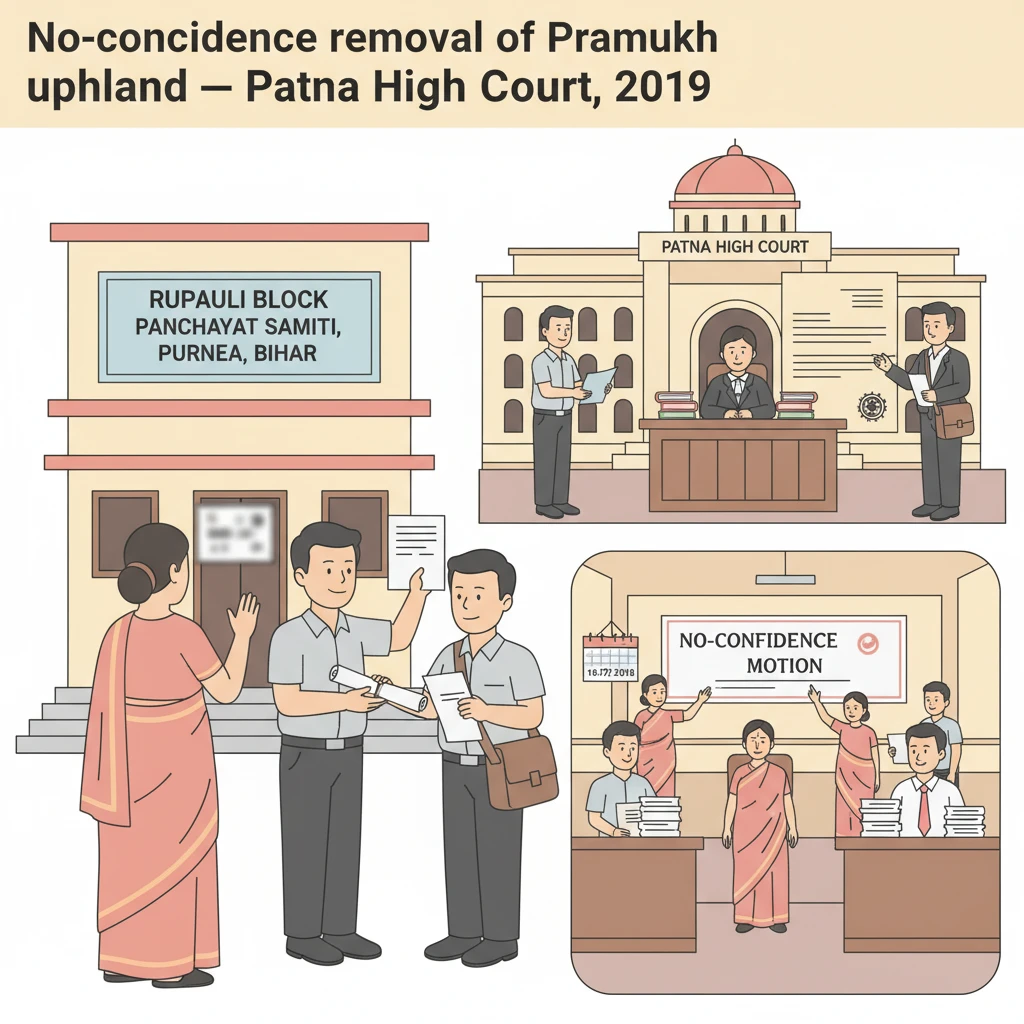
The petitioner was elected as Pramukh of the Rupauli Block Panchayat Samiti in Purnea district. During her tenure, more than one-third of the elected members of the Samiti decided to move a motion of no confidence against her under Section 44(3)(i) of the Bihar Panchayat Raj Act, 2006.
A written requisition for convening a special meeting to consider the no-confidence motion was prepared by these members. According to the petitioner, signatures of members were obtained on a blank sheet and later converted into a requisition. She alleged that some losing candidates in the earlier election were instigating members to remove her from office.
The central dispute arose around how this requisition was served and how the special meeting was convened. The law requires that such a requisition be presented before the Pramukh, with a copy to the Executive Officer. In this case, the requisition ended up being directly submitted in the office of the Block Development Officer-cum-Executive Officer (respondent no. 6) on 03.07.2018.
The petitioner claimed she never received any requisition in the manner prescribed by Section 44(3)(i). She approached the Patna High Court in Civil Writ Jurisdiction Case No. 13513 of 2018 challenging the requisition and the subsequent notice for special meeting. During the pendency of the case, the special meeting was held on 16.07.2018, the no-confidence motion was passed, and she was removed from the post of Pramukh. She then filed an interlocutory application seeking to also quash the meeting, the resolution, and the notice for fresh election of Pramukh.
What the Court Examined and Decided
The Patna High Court, through Hon’ble Mr. Justice Rajeev Ranjan Prasad, closely examined the sequence of events, the conduct of the parties, and the legal framework under the Bihar Panchayat Raj Act, 2006 and the instructions issued by the Bihar State Election Commission.
The petitioner’s core argument was that the entire process was illegal from the very beginning. She relied on Section 44(3)(i) of the Act of 2006, which lays down the procedure for bringing a no-confidence motion against a Pramukh. According to her:
- The requisition dated Nil (presented on 02.07.2018/03.07.2018) was submitted directly in the office of the Executive Officer (respondent no. 6) without being first presented to her as Pramukh.
- Since the requisition was not properly presented, the Executive Officer’s notice dated 08.07.2018 (letter no. 1256) calling a special meeting on 16.07.2018 was invalid.
- As Pramukh, she had a right to consider the requisition for up to seven days and decide whether to convene the special meeting herself, and only upon her failure could the Up-Pramukh or one-third members proceed.
- Consequently, the special meeting of 16.07.2018 and the resolution removing her were vitiated, as was the notice issued later for election to the “vacant” post of Pramukh.
In the interlocutory application, she asked the Court to quash (a) the special meeting proceedings dated 16.07.2018 and (b) the notice by the Sub-Divisional Officer dated 10.08.2018 fixing the date for fresh election of Pramukh.
The private respondents and the Executive Officer presented a different picture in their counter affidavits. They asserted that:
- The requisition signed by more than one-third of the Samiti members was brought on 02.07.2018 intending to be served on the Pramukh.
- The petitioner was avoiding service by remaining absent from office; she was “purposely remaining absenting” when attempts were made on 02.07.2018 and 03.07.2018.
- The Executive Officer issued letter no. 1209 dated 03.07.2018 forwarding the requisition to the petitioner and requesting her to convene a special meeting within 15 days (i.e., by 16.07.2018).
- According to the endorsement of the process server (peon) on this letter (Annexure ‘A’), the petitioner could not be met on 03.07.2018 and then refused to accept the requisition on 04.07.2018.
- Given this refusal, the Executive Officer treated service on his office as service on the Pramukh in terms of the Bihar State Election Commission’s instructions dated 16.09.2008 (Annexure ‘B’).
- The Executive Officer then requested the Up-Pramukh on 07.07.2018 (Annexure ‘C’) to fix the date of the special meeting, and the Up-Pramukh fixed 16.07.2018 by letter dated 08.07.2018 (Annexure ‘D’), ensuring seven clear days’ notice to all members.
They also pointed out that the petitioner never filed any rejoinder to specifically deny these factual statements in the counter affidavits and supplementary counter affidavits.
The Court first noted this absence of rejoinder. It treated the factual narrative of the respondents—about the petitioner avoiding service and refusing to accept notices—as effectively undisputed, because the petitioner chose not to contradict it on affidavit.
From the materials, the Court found the following to be established:
- The requisition for no-confidence was indeed brought on 02.07.2018.
- The petitioner was not attending office on 02.07.2018 and continued to absent herself when attempts to serve the requisition were made.
- The letter dated 03.07.2018 from the Executive Officer forwarding the requisition and asking her to convene the meeting within 15 days was refused by her on 04.07.2018, as recorded by the process server.
- Despite these events, the petitioner did not take any steps up to 07.07.2018 to convene a meeting by 16.07.2018.
The Court then examined the instructions of the Bihar State Election Commission issued on 16.09.2008, particularly clauses (iv) and (v), produced as Annexure ‘B’. These instructions stated clearly that:
- If the Pramukh avoids receiving the requisition for a no-confidence motion, service of the requisition upon the Executive Officer shall be treated as service on the Pramukh.
- The Executive Officer must then inform the Pramukh to convene the special meeting within 15 days.
- To ensure seven clear days’ notice to all members, notices convening the special meeting must be issued within 2–3 days of receiving the requisition.
- If the Pramukh fixes a date for the meeting without allowing for seven clear days’ notice, it will be deemed that she has acted deliberately to create dispute, and in that situation the Executive Officer will not issue such notice; instead, the Up-Pramukh or one-third of the members may issue the notice following the seven-day requirement.
Applying these instructions, the Court held that once the petitioner avoided and then refused service of the requisition and notice, the Executive Officer had no option but to proceed under the Election Commission’s guidelines. By 07.07.2018 he was required to ensure that seven clear days’ notice could be given for a meeting to be held by 16.07.2018. Therefore, calling upon the Up-Pramukh on 07.07.2018 and the Up-Pramukh issuing notices on 08.07.2018 were both justified.
The petitioner relied on a previous single-judge decision of the Patna High Court in Geeta Devi v. The State of Bihar and others, 2015 (1) PLJR 790, which had emphasized that requisitionists must wait for seven days before moving further if the Pramukh does not convene the meeting. The Court, however, distinguished that case.
The Court observed that in Geeta Devi the instructions of the Bihar State Election Commission were not brought to the notice of the Bench. In the present case, those instructions were squarely on record as Annexure ‘B’ and clearly addressed the situation where a Pramukh avoids service. Therefore, the earlier ruling could not assist the petitioner in the changed factual and legal context.
The private respondents had also argued that even if Section 44(3)(i) is mandatory, its non-observance does not automatically entitle a party to relief under writ jurisdiction, especially where that party’s own conduct contributes to the violation. They cited several Supreme Court judgments, including:
- Jaswantsingh Mathura Singh & Anr. v. Ahmedabad Municipal Corporation, AIR 1991 SC 2130
- Krishnalal v. State of J & K, (1994) 4 SCC 422
- Babulal Badriprasad Varma v. Surat Municipal Corporation & Others, 2008 (12) SCC 401
- ITC Limited v. Blue Coast Hotels Limited and Others, (2018) 15 SCC 99
The High Court particularly referred to ITC Limited v. Blue Coast Hotels Limited. In that case, the Supreme Court held that although Section 13(3-A) of the SARFAESI Act, 2002 is mandatory and the bank had not complied with it, the Court could still deny relief considering the conduct of the borrower and other attending circumstances. Using this reasoning, the Patna High Court held that even if Section 44(3)(i) is mandatory, a writ court may refuse discretionary relief when the petitioner’s own conduct is blameworthy.
On facts, the Court concluded that the petitioner had intentionally avoided service by absenting herself from office on and after 02.07.2018 and by refusing to receive the memo dated 03.07.2018. Because of this, she could not be allowed to complain that the requisition had not been presented to her in accordance with the statute.
The Court also examined the service of notices on the other members. From Annexure ‘E’ series to the counter affidavit of respondents 4 to 6, the Court found that all members of the Panchayat Samiti had been duly served with notice of the special meeting and that the no-confidence motion was in fact passed on 16.07.2018.
The Court found that the petitioner was not acting bona fide and was trying to prevent the holding of the special meeting by procedural means. Considering all these circumstances, and noting that relief under Article 226 of the Constitution is discretionary, the Court declined to interfere.
Finally, the Court held that there was no error in the Up-Pramukh issuing the notice dated 08.07.2018 for the special meeting on 16.07.2018 pursuant to the Executive Officer’s letter dated 07.07.2018. As a result, all the reliefs sought—including quashing of the requisition, the Executive Officer’s notice, the special meeting, the no-confidence resolution, and the subsequent election notice—were rejected. The writ application was dismissed as having no merit.
Why This Judgment Matters
This judgment is important for elected Panchayat representatives and members in Bihar, especially Pramukhs and Up-Pramukhs. It shows that a Pramukh cannot block or delay a no-confidence motion simply by avoiding office or refusing to accept notices.
The Patna High Court treated service of the requisition on the Executive Officer as valid service on the Pramukh when she was deliberately avoiding receipt. In such situations, the Executive Officer and Up-Pramukh are expected to move ahead so that members get their right to test confidence within 15 days, with seven clear days’ notice.
The decision also makes clear that the High Court’s writ powers under Article 226 are discretionary. If a leader seeking relief has herself contributed to the alleged procedural breach, the Court may refuse to help her even where the law is otherwise strict or mandatory.
For grassroots politics, this judgment reinforces that internal democratic processes in Panchayat bodies—like no-confidence motions—cannot be defeated through technical objections when the overall process and member participation are fair and the leader has acted in bad faith.
Legal Issues and Answers
- Issue: Was the requisition for no-confidence against the Pramukh invalid because it was not directly presented to her as required by Section 44(3)(i) of the Bihar Panchayat Raj Act, 2006?
Answer: No. The Court held that since the Pramukh purposely avoided and then refused service, service on the Executive Officer was valid under Election Commission instructions, and the requisition process could not be faulted. - Issue: Was the special meeting held on 16.07.2018 and the no-confidence resolution illegal on the ground that the Up-Pramukh fixed the meeting date prematurely and without jurisdiction?
Answer: No. The Court found that the Executive Officer rightly requested the Up-Pramukh to fix the date to ensure seven clear days’ notice within the 15-day limit, and the meeting and resolution were valid. - Issue: Should the High Court exercise its discretionary writ jurisdiction to set aside the petitioner’s removal despite alleged procedural flaws?
Answer: No. Considering the petitioner’s conduct in avoiding service and not acting bona fide, the Court declined to exercise its discretion and dismissed the writ.
Cases Cited by the Court
- Geeta Devi v. The State of Bihar and others, 2015 (1) PLJR 790 (Patna High Court) – distinguished on facts and on the basis that Election Commission instructions were not considered there.
- Bharat Petroleum Corporation Ltd. and another v. N.R. Vairamani and another, (2004) 8 SCC 579 – cited for the principle that judgments are precedent only on their own facts and a small change in facts can make a big difference.
- Jaswantsingh Mathura Singh & Anr. v. Ahmedabad Municipal Corporation, AIR 1991 SC 2130 – relied upon by private respondents regarding waiver and effect of conduct.
- Krishnalal v. State of J & K, (1994) 4 SCC 422 – cited on similar principles.
- Babulal Badriprasad Varma v. Surat Municipal Corporation & Others, 2008 (12) SCC 401 – cited by private respondents on waiver and mandatory provisions.
- ITC Limited v. Blue Coast Hotels Limited and Others, (2018) 15 SCC 99 – relied upon by the Court to hold that even for mandatory provisions, discretionary relief may be refused based on conduct.
Case Details
Case Number: Civil Writ Jurisdiction Case No. 13513 of 2018
Case Title: Neetu Kumari v. The State of Bihar & Others
Citation: 2019 (3) PLJR 513
Court: High Court of Judicature at Patna
Coram: Hon’ble Mr. Justice Rajeev Ranjan Prasad
Date of Judgment: 14.03.2019 (C.A.V.; CAV date 08.03.2019)
Advocates:
- For the petitioner: Mr. S.B.K. Manglam, Advocate
- For the State/official respondents: Mr. Ajay, Government Advocate 5; Mr. Pratik Kumar Sinha, Assistant Counsel to GA 5
- For State Election Commission (Panchayat): Assistant Counsel to Mr. Amit Srivastava, Advocate
- For private respondents (Panchayat Samiti members and Up-Pramukh): Mr. Kumar Kaushik, Advocate; Mr. Bijendra Kumar Singh, Advocate; Mr. Kamlesh Kumar Maharana, Advocate
Nature of the Case: Writ petition under Article 226 of the Constitution of India challenging requisition and notices related to a no-confidence motion, and seeking to quash the special meeting, the no-confidence resolution, and the subsequent election notification.
Link to Judgment: Click here to read the full Patna High Court judgment
If you found this explanation helpful and wish to stay informed about
how legal developments may affect your rights in Bihar,
you may consider following Samvida Law Associates for more updates.







