
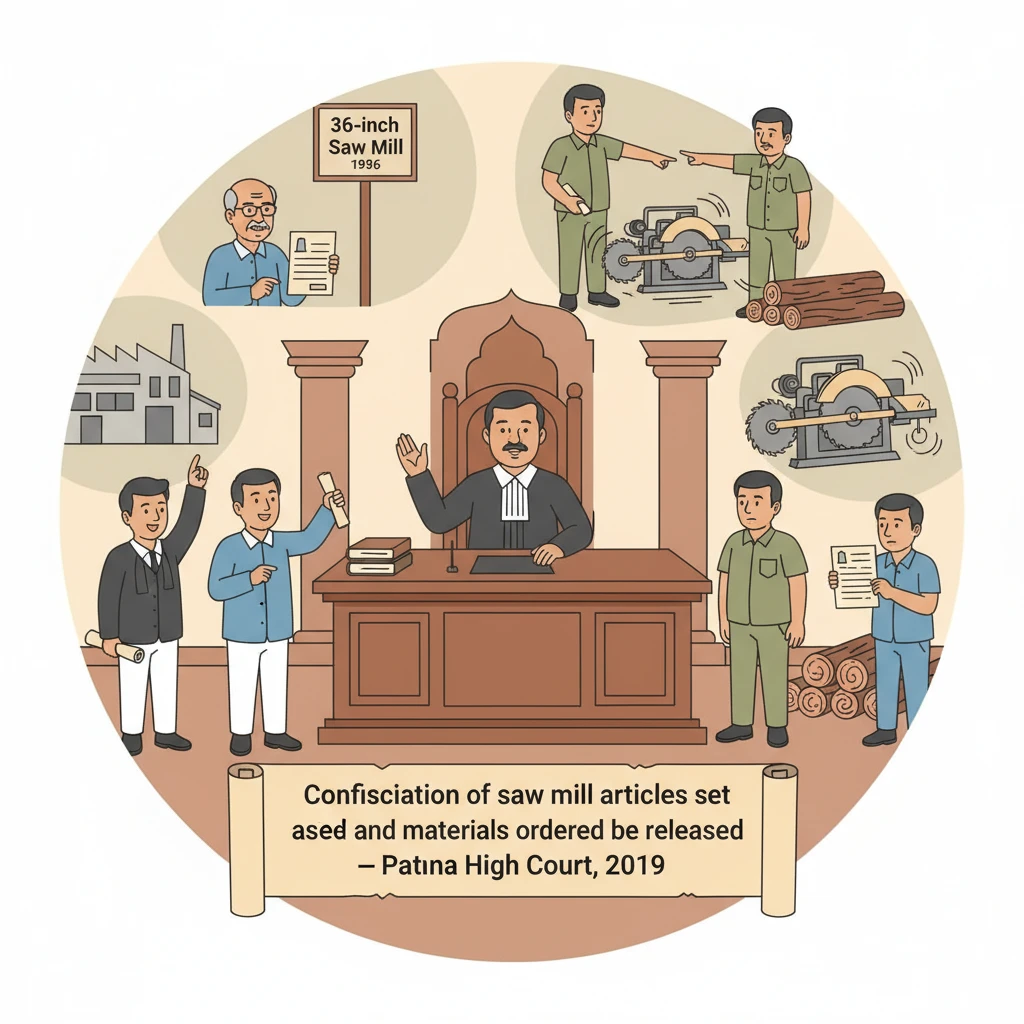
Case Background
The case arises from a writ petition filed in the Patna High Court challenging confiscation orders passed by forest officials in Gaya district.
The petitioner’s father, late Basant Mistry, had applied on 30.09.1996 for a licence to run a 36-inch diameter saw mill. Along with his application he deposited a bank draft of Rs. 1,000/- and a demand draft of Rs. 2,000/-. Despite this, no licence was issued to him, even though his name appeared at serial number 89 in a seniority list of selected saw mills prepared on 30.08.2010.
After his father’s death, the petitioner wrote a letter dated 30.09.2010 to the Licensing Officer-cum-Divisional Forest Officer, Gaya. He requested that the licence be granted on the basis of the seniority position of his father’s application. He also stated that he had already submitted an application with bank drafts of Rs. 1,000/- and Rs. 2,000/- before 29.10.2002.
According to the petitioner, despite his representations, no licence was issued. As a result, the existing saw mill was closed. To earn his livelihood, he then started an 18-inch diameter saw mill. He claimed that, under a government notification of 2012, no licence was required for operating such an 18-inch saw mill for furniture purposes.
On 08.06.2014, the Range Officer, Gurpa, with other forest personnel, raided the petitioner’s premises. They found the 18-inch saw mill in running condition. The Range Officer also seized a complete 36-inch band saw set, which was not in running condition, along with other articles and some timber of Shisham and Mahua. A seizure list was prepared, and Confiscation Case No. 36 of 2014 was initiated before the Licensing Officer-cum-Divisional Forest Officer, Gaya, who acted as the confiscating authority.
What the Court Examined and Decided
In the confiscation proceedings, the petitioner appeared before the Divisional Forest Officer, Gaya, and filed a show cause reply. He denied that he was operating an unlicensed 36-inch saw mill.
In his show cause, the petitioner admitted that his father had applied for a licence to run a 36-inch saw mill and deposited the required fee, but no licence was ever issued. He stated that, for this reason, the 36-inch saw mill had been closed. Though the name of the saw mill appeared in the seniority list, no licence had been granted.
The petitioner further explained that the Shisham timber found in his premises did not belong to him. He stated that one Satyendra Yadav had kept this timber in his saw mill. According to the petitioner, Satyendra Yadav had a valid transport licence for the Shisham timber, and this licence had been produced before the Divisional Forest Officer.
Satyendra Yadav himself also appeared before the confiscating authority. He filed a show cause reply along with an affidavit, clearly claiming ownership of the Shisham timber seized from the petitioner’s saw mill. He admitted that he did not know that the petitioner’s 36-inch saw mill was closed and that only furniture work was going on there.
Satyendra Yadav produced the transport licence for the timber, showing that he had lawfully brought the logs. He stated that he had purchased the Shisham logs in 2012 for the purpose of his sister’s marriage and had transported them by a tractor belonging to one Vishambhar Yadav. A copy of his show cause and transport permit was annexed as Annexure-5 to the writ petition.
Despite these materials, the Licensing Officer-cum-Divisional Forest Officer, Gaya, rejected the petitioner’s show cause on 04.03.2015. The order, treated as that of the confiscating officer, recorded that no valid document had been produced, and directed confiscation of the seized articles and timber.
The petitioner appealed this decision before the prescribed authority-cum-Conservator of Forest, Gaya Division (respondent no. 2) in Appeal No. 01 of 2015. He requested release of the seized articles. However, by order dated 31.03.2016, the appellate authority dismissed the appeal and upheld the confiscation.
In the Patna High Court, the State filed a counter affidavit. The State’s stand was that the petitioner had been found operating a 36-inch diameter saw mill during the raid. It was stated that all relevant materials relating to a 36-inch saw mill, as well as Shisham and Mahua logs, had been seized from his premises.
The petitioner pointed out to the High Court that the seizure list itself described the 36-inch band saw set as “not in running condition”. The seizure list, produced as Annexure-3, recorded that the band saw (36 inch) entire set was seized but not working at the time of raid.
The High Court examined the confiscating officer’s order dated 04.03.2015. It found that Satyendra Yadav had appeared before the confiscating officer, filed his show cause, and clearly claimed to be the owner of the logs seized from the petitioner’s saw mill. He had produced a valid licence for transportation of timber before the Divisional Forest Officer, Gaya.
The Court noted that the confiscating officer did not doubt the genuineness of the transport permit produced by Satyendra Yadav. Even in the counter affidavit filed before the High Court, the State did not allege that the transport licence was fake or invalid.
The Court also observed that, according to the seizure list, the 36-inch saw was not in working condition at the time of seizure. The logs found in the saw mill merely created a doubt in the mind of the raiding authorities that the petitioner might be operating a 36-inch saw mill. In his show cause, however, the petitioner had clearly stated that he was not running any 36-inch saw mill.
Further, in his show cause, Satyendra Yadav stated that he had no knowledge that the petitioner’s 36-inch saw mill had been closed. He maintained that he alone was the owner of the Shisham logs and produced a valid transport permit for them.
From a combined reading of the confiscating officer’s order and the material on record, the Patna High Court concluded that the confiscating authority had failed to take these important facts into account. The order had been passed mechanically, without properly considering the petitioner’s defence and the documents produced by Satyendra Yadav.
The Court held that the confiscation order dated 14.03.2015 (referred to as Annexure-6 in the writ petition) suffered from illegality. It also found that the appellate authority, by its order dated 31.03.2016 (Annexure-7), had mechanically affirmed the confiscation order without independently examining the petitioner’s case.
Consequently, the High Court set aside both orders dated 04.03.2015 (Annexure-6) and 31.03.2016 (Annexure-7).
The Court then issued a direction to respondent no. 3, the Licensing Officer-cum-Divisional Forest Officer, Gaya, to release the articles seized from the petitioner’s saw mill within fifteen days from the date of receipt or production of a copy of the High Court’s order. This release was made subject to proper verification of all relevant documents produced by the petitioner.
At the same time, the Court imposed a condition on the petitioner. It directed that, at the time of receiving the seized articles, he must file an affidavit before respondent no. 3 stating that he would not operate a 36-inch diameter saw mill on his premises without obtaining a licence from the competent authority.
The Court clarified that if the petitioner is later found operating a 36-inch saw mill without licence, he would be liable for punishment. With these directions, the writ petition was allowed.
Why This Judgment Matters
This judgment is significant for small saw mill owners and workers who depend on such units for their livelihood. It shows that forest and licensing authorities cannot ignore important documents and explanations given by citizens.
The Patna High Court emphasised that confiscation orders, which can destroy a person’s means of earning, must not be passed in a mechanical way. The authorities must fairly consider all show cause replies, affidavits and permits produced before them.
The decision also draws a clear line: where a larger saw mill is not in running condition and the timber is owned by a third person holding a valid transport permit, the premises cannot be treated as if an illegal large saw mill is being actively operated without proper scrutiny.
At the same time, the Court has reminded saw mill operators that running a 36-inch diameter saw mill without licence is not permitted. The petitioner has been warned through an affidavit requirement that future violations will attract punishment.
Legal Issues and Answers
- Issue: Whether the confiscation of the petitioner’s saw mill machinery and timber, upheld in appeal, was lawful when the 36-inch saw was not running and the timber owner produced a valid transport permit.
Answer: The Patna High Court held that the confiscation was illegal and mechanical, set aside both the confiscation and appellate orders, and directed release of the seized articles after verification, subject to the petitioner’s undertaking not to operate a 36-inch saw mill without licence.
Cases Cited by the Court
- No previous judgments are cited or relied upon in the text of this decision.
Case Details
Case Number: Civil Writ Jurisdiction Case No. 8437 of 2016
Case Title: Raj Kumar Mistry v. The State of Bihar & Others
Court: High Court of Judicature at Patna
Coram: Hon’ble Mr. Justice Sanjay Priya
Date of Judgment: 22.04.2019
Citation: 2019 (3) PLJR 506
Advocates:
- For the Petitioner: Mr. Pramod Kumar
- For the Respondents (State): Mr. Harish Singh Goldie
Nature of the Case: Writ petition challenging confiscation and appellate orders passed by forest authorities in a confiscation proceeding (Confiscation Case No. 36 of 2014, Appeal No. 01 of 2015).
Link to Judgment: View full judgment on Patna High Court website
If you found this explanation helpful and wish to stay informed about
how legal developments may affect your rights in Bihar,
you may consider following Samvida Law Associates for more updates.







