
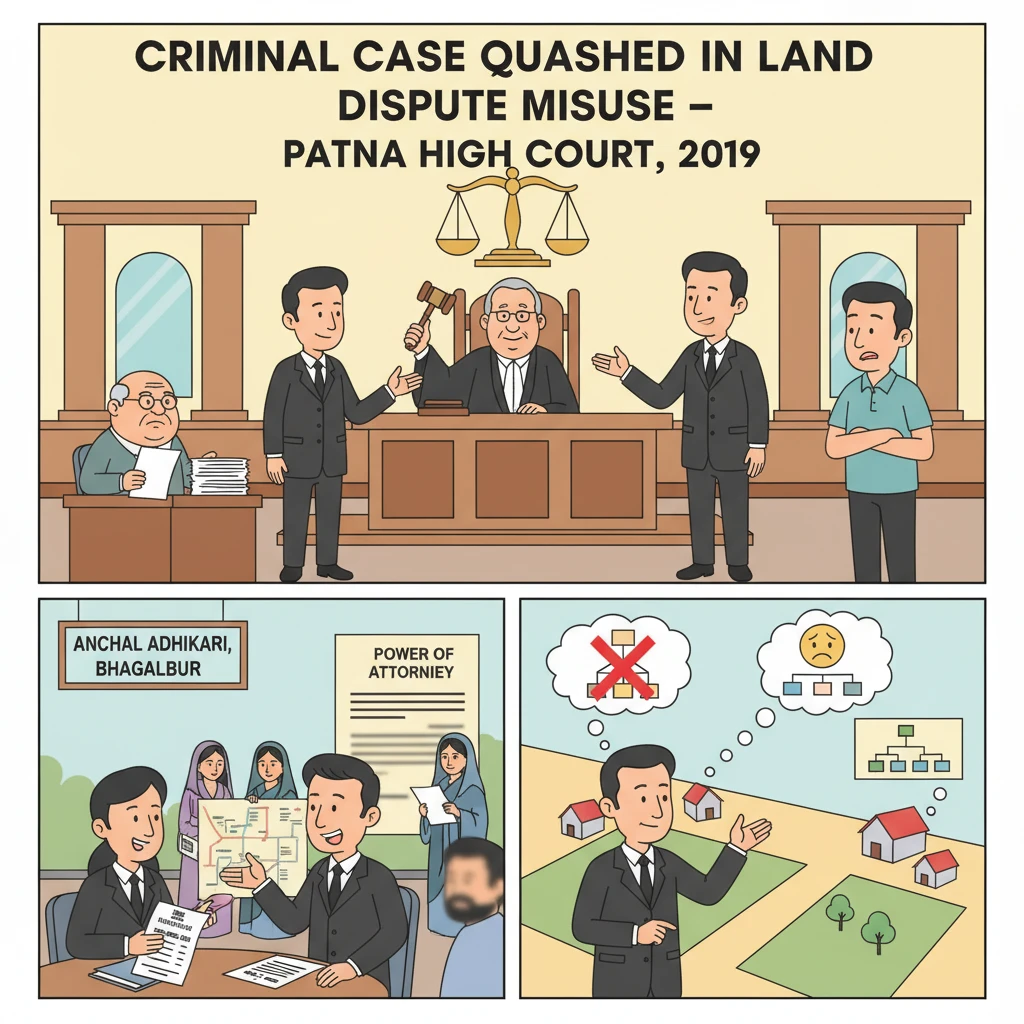
Case Background
The case arose out of a family dispute over ancestral land situated at Mauza Kurban, P.S.-Mazahidpur, District Bhagalpur. The complainant, opposite party no. 2, claimed to have purchased two plots of land after his retirement. The sales were said to be through registered sale deeds executed in 2010 by persons claiming to be connected to the original landowners.
On 22.10.2011, the complainant filed Complaint Case No. 2024 of 2011 before the Chief Judicial Magistrate, Bhagalpur. He alleged that the petitioner and other accused had committed fraud relating to the same lands and had threatened him.
On 31.01.2013, the Judicial Magistrate 1st Class, Bhagalpur, took cognizance of offences under sections 387, 506 and 504/34 of the Indian Penal Code against the petitioner and others and issued process.
The petitioner, who is related to the original landowning family, then approached the Patna High Court under Section 482 of the Code of Criminal Procedure, 1973. He sought quashing of the Magistrate’s order and the entire criminal proceeding, arguing that no offence was made out even if the complaint was read as true.
What the Court Examined and Decided
The Patna High Court, through Hon’ble Mr. Justice Ahsanuddin Amanullah, first called for an independent police enquiry. By order dated 19.02.2019, the Court directed the Senior Superintendent of Police (SSP), Bhagalpur to enquire into specific aspects.
The SSP was asked to find out whether the petitioner’s cousin, Pradeep Kumar Mukherjee, was of sound mind and whether he had executed any power of attorney in favour of a co-accused. The SSP was also directed to examine how lands belonging to the petitioner and his cousin, forming part of common ancestral property of late Sudhanshu Mukherjee, had been bought by the complainant from persons claiming to be related to the family.
On 04.04.2019, after receiving the SSP’s report, the High Court recorded that the petitioner’s stand was “vindicated”. The report indicated that the disputed power of attorney could not have been executed by Pradeep Kumar Mukherjee and that there was no trace of his sister. Therefore there could not have been any general power of attorney in favour of Jaya Chakravarty as alleged in the complaint.
The Court then examined the contents of the original complaint. The complainant had stated that he purchased 62½ decimals and 72 decimals of land in 2010 from Jaya Chakravarty and Moni Chakravarty. He said they were connected to the original owner, late Sitanshu Mukherjee, through his wife and children, and that the land had devolved on their heirs.
According to the complaint, Madhuri Mukherjee had allegedly executed a general power of attorney in favour of Jaya Chakravarty on 09.01.2010. On the strength of this, Jaya Chakravarty is said to have sold 62½ decimals directly to the complainant and 72 decimals to Moni Chakravarty, from whom the complainant later purchased the second plot.
The complainant further alleged that later the petitioner and other accused, after knowing of his purchase, created a false power of attorney dated 22.12.2010. He claimed that a “fake person” was produced in place of Pradeep Kumar Mukherjee at Patna, though Pradeep was mentally ill and never went out of his house. On the basis of this allegedly false power of attorney, a co-accused sold part of the land to third parties.
When the complainant went to enquire from the cousins of Pradeep Kumar Mukherjee (including the present petitioner), he alleged that the petitioner told him that the family had already mutated the entire land including the house in their own names in 2009–2010 on the basis of a family partition. According to the complaint, the petitioner said Madhuri Mukherjee was left out from the partition after obtaining the thumb impression of Pradeep, and allegedly told the complainant in hard words that the “land mafia will destroy him”.
Before the complaint was filed, the petitioner had approached the Superintendent of Police, Bhagalpur on 08.05.2010. He reported that two girls were moving in the area claiming to be daughters of the petitioner’s cousin sister, who had not been in contact with the family since around 1978–1980 and whose whereabouts were unknown. The petitioner stated that when he questioned these ladies, they could not establish their identity, even though they claimed to be daughters of Jaya (Madhuri) Chakravarty.
The petitioner also moved the Anchal Adhikari, Bhagalpur on 11.10.2010. He informed that the sister of Pradeep Kumar Mukherjee had not been in contact with the family for 30 years, and unknown persons were claiming to be her daughters. He requested that the alleged daughters be summoned personally to verify the truth before mutation or other steps.
According to the petitioner, these objections initially prevented mutation in favour of the complainant. However, after cognizance was taken in the complaint case, the Circle Officer allowed mutation. The counter affidavit of the complainant before the High Court annexed a mutation order dated 25.06.2013, which showed the mutation case itself was filed only in 2013–2014.
The petitioner highlighted discrepancies in the mutation records. A correction slip issued by the Anchal Adhikari, Jagdishpur, showed mutation in favour of the complainant for 67¼ decimals on the basis of sale deed no. 626 dated 18.01.2010, though that deed itself showed sale of only 62 decimals.
The family certificate issued by the Anchal Adhikari, Jagdishpur, dated 19.05.2010, was in favour of one Moni Chakravarty, who claimed to be daughter of Madhuri Mukherjee. It mentioned the petitioner’s address, suggesting that documents had been processed using his address though he denied any such relationship. The Court-recorded SSP enquiry further found that there was no trace of Madhuri Mukherjee for 15–20 years, that no partition of the ancestral property had taken place, and that Pradeep Kumar Mukherjee, being of unsound mind, could not have executed any power of attorney or even moved out of his house.
On the criminal aspect, the petitioner argued that the complaint made no specific allegation of cheating, extortion, criminal intimidation or insult against him. The only mention was that he claimed to have mutated the land on the basis of a family partition and, in a hard tone, said that the land mafia would destroy the complainant. He also maintained that the disputed sales had in fact harmed his own interest, as strangers, with no right or title, appeared to have sold his ancestral land through forged documents.
The Additional Public Prosecutor for the State supported the petitioner to the extent that, so far as he was concerned, the complaint did not disclose any criminal offence. The APP stated that even the passing reference to the petitioner’s alleged behaviour could not justify criminal prosecution. He further pointed out that the SSP’s report showed that the very basis of the complainant’s sale deeds was doubtful and that the executors were likely unknown persons.
Counsel for the complainant-opposite party no. 2 was unable to dispute these factual and legal submissions. When specifically asked by the Court to show which portion of the complaint justified criminal prosecution of the petitioner, no clear answer could be given.
After considering the record, the Patna High Court held that the case called for interference under Section 482 CrPC. The Court found that except for a “general and vague” allegation about family partition and a limited allegation of threat that “land mafia will destroy” the complainant, there was nothing against the petitioner that could amount to a criminal offence. No co-sharer had complained about the alleged partition. The Court noted that the Magistrate had taken cognizance mechanically, without applying judicial mind, and termed this a “sorry state of affairs” where courts pass serious orders casually.
Relying on the Supreme Court decision in State of Haryana v. Bhajan Lal, the Court held that the present case fell within categories (1) and (7) of that judgment. These cover situations where allegations do not prima facie constitute any offence and where criminal proceedings are manifestly mala fide and intended to harass. The Court also referred to State of Karnataka v. L. Muniswamy, which recognises the High Court’s power to prevent criminal cases from becoming tools of harassment or persecution.
The Court then discussed at length the nature of inherent powers under Section 482 CrPC, drawing upon earlier decisions including State of Uttar Pradesh v. Mohammad Naim, State v. Navjot Sandhu, Jitendra Raghuvanshi v. Babita Raghuvanshi, Parbatbhai Aahir v. State of Gujarat, and its own decision in Rupesh Kumar v. State of Bihar. It emphasised that these powers are wide, inherent in the High Court as a constitutional court, and must be used whenever necessary to prevent abuse of process and secure the ends of justice.
In this background, the Patna High Court concluded that the prosecution of the petitioner was mala fide, untenable, and solely intended to harass him. It therefore allowed the application, quashed the entire criminal proceeding arising out of Complaint Case No. 2024 of 2011, including the order dated 31.01.2013, as far as it related to the petitioner.
At the same time, the Court did not ignore the larger issue of alleged fraud in the land transactions and involvement of public officials. Exercising its inherent jurisdiction, it issued detailed directions for further enquiry.
First, the Court directed the SSP, Bhagalpur to get the entire matter investigated by a special team headed by a senior and competent officer with good reputation regarding land transfer matters. The enquiry was to start from the earlier report submitted to the Court and had to verify whether the persons who executed the various powers of attorney and sale deeds were real or fictitious. The SSP was directed to ensure that enquiry was completed within two months and, based on the findings, appropriate proceedings should be instituted and taken to their logical conclusion within two months thereafter. The role of officers involved in mutation and issuance of family certificate to the so-called daughter of Pradeep’s sister was also to be examined.
Secondly, the Court directed the District Magistrate, Bhagalpur to conduct a thorough enquiry through a senior officer into the role of district officials in mutating land in favour of the complainant and others, and in issuing family certificates to alleged relatives whose authenticity was under serious doubt. The District Magistrate was to ensure that this exercise was also taken to its logical conclusion within two months.
For this purpose, the Court formally impleaded the District Magistrate, Bhagalpur as opposite party no. 4. The Additional Public Prosecutor accepted notice on his behalf and was directed to communicate the order to both the District Magistrate and the SSP for strict compliance. The Registry was also asked to send the order to opposite parties no. 3 and 4.
Why This Judgment Matters
This judgment is significant for individuals caught in family land disputes where criminal cases are used as pressure tactics. The Patna High Court made it clear that a vague allegation or a heated conversation cannot, by itself, justify a criminal case for serious offences like extortion or criminal intimidation.
For buyers and family members in ancestral property disputes, the case shows that the Court will examine whether the criminal law is being misused. If the complaint itself does not clearly show any offence, the High Court can step in under Section 482 CrPC and quash the proceedings.
The judgment is also important for accountability of public officials. The Court did not stop after quashing the case. It ordered special enquiries into alleged fraudulent sale deeds, fake power of attorney documents, and suspicious mutation and family certificate proceedings. This sends a strong message that officers who facilitate questionable land transfers may also face scrutiny.
Overall, the decision reinforces that the criminal justice system should not become a tool in private land disputes, and that the Patna High Court will use its inherent powers to protect individuals from unjust prosecution while still pushing for investigation into genuine fraud.
Legal Issues and Answers
- Issue: Did the complaint in Complaint Case No. 2024 of 2011 disclose any prima facie criminal offence against the petitioner so as to justify continuation of criminal proceedings and the Magistrate’s order taking cognizance under sections 387, 506 and 504/34 IPC?
Answer: No. The High Court held that the complaint contained only general and vague allegations and a limited allegation of threat, which did not constitute any criminal offence against the petitioner. The cognizance order, passed without application of judicial mind, amounted to abuse of process and was quashed under Section 482 CrPC. - Issue: When can the Patna High Court invoke its inherent powers under Section 482 CrPC in relation to such complaints?
- Answer: The Court reaffirmed that it can use Section 482 CrPC to prevent abuse of process and secure the ends of justice, particularly where allegations, even if taken at face value, do not constitute any offence (category 1 of Bhajan Lal) or where proceedings are mala fide and intended to harass (category 7 of Bhajan Lal).
Cases Cited by the Court
- State of Haryana v. Bhajan Lal, 1992 Supp (1) SCC 335
- State of Karnataka v. L. Muniswamy, (1977) 2 SCC 699
- State of Uttar Pradesh v. Mohammad Naim, AIR 1964 SC 703
- Jairam Das v. Emperor, AIR 1945 PC 94 (referred)
- Emperor v. Nazir Ahmad, AIR 1945 PC 18 (referred)
- State v. Navjot Sandhu, (2003) 6 SCC 641
- Jitendra Raghuvanshi v. Babita Raghuvanshi, (2013) 4 SCC 58
- Parbatbhai Aahir v. State of Gujarat, (2017) 9 SCC 641
- Rupesh Kumar v. The State of Bihar, Cr. Misc. No. 30470 of 2016, Patna High Court, order dated 21.02.2019
Case Details
Case Number: Criminal Miscellaneous No. 47012 of 2014 (arising out of Complaint Case No. 2024 of 2011, P.S. Mazahidpur, District Bhagalpur)
Case Title: Ashutosh Mukherjee v. The State of Bihar & Ors.
Coram: Hon’ble Mr. Justice Ahsanuddin Amanullah
Date of Judgment: 18.04.2019
Citation: 2019(3) PLJR 425
Advocates:
- For the petitioner: Mr. Kali Prasanna Dubey, Advocate
- For opposite party no. 2: Ms. Geeta Kumari Jha, Advocate
- For the State: Mr. Jharkhandi Upadhyay, Additional Public Prosecutor
Nature of the Case: Petition under Section 482 of the Code of Criminal Procedure, 1973 seeking quashing of order taking cognizance and the entire criminal proceeding arising out of a complaint case.
Link to Judgment: Click here to read the full judgment of the Patna High Court
If you found this explanation helpful and wish to stay informed about
how legal developments may affect your rights in Bihar,
you may consider following Samvida Law Associates for more updates.







