
Case Background
The petitioner was appointed as Assistant Professor in English in Maulana Mazharul Haque Arabic and Persian University through a regular selection process of the Bihar Public Service Commission under Advertisement No. 45/2024. His appointment was notified on 03.05.2017, and he joined the same day.
After some years of service, his post was confirmed. This was done on the recommendation of the Post Creation Absorption and Confirmation Committee and with approval of the Syndicate, through notification dated 28.01.2021.
Later, by notification dated 16.03.2024, he was granted promotion as Assistant Professor (Senior Scale/Academic Level-11) with effect from 03.05.2021 under the Career Advancement Scheme in the governing Statutes.
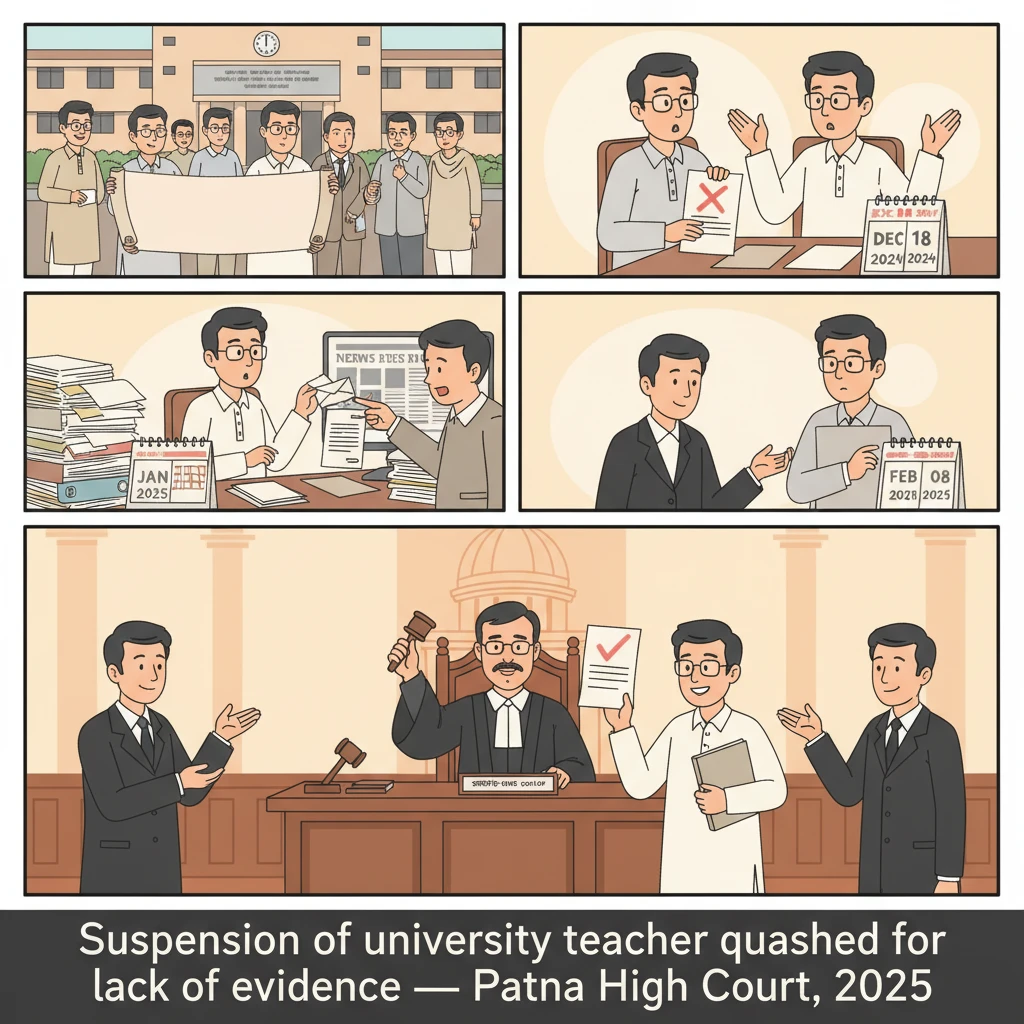
On 08.07.2024, he began functioning as Head of the Department of English. Around this period, the University authorities took a decision to rent out two floors of the main academic block building in Patna. This decision led to protests by several teachers and non-teaching employees. The petitioner also signed the joint protest representation.
On 18.12.2024, the University issued an office order, marked as Annexure P/7 in the case, stating that participation of the petitioner in the protest violated Basic Good Conduct Rules and Regulations of the Syndicate. By this order, he was removed from membership of the Syndicate.
The petitioner submitted a detailed representation explaining his participation and denying any misconduct. However, on 16.01.2025, another notification was issued removing him from the post of Head of the Department of English, despite the Statute on Headship by Rotation providing for a three-year tenure.
On 22.01.2025, the Registrar wrote to him stating that no domicile or residential certificate was found in his personal file and directing him to submit a domicile certificate with valid proof within 48 hours, even though his services had already been confirmed after verification of documents.
The petitioner furnished his explanation and information. Yet, on 08.02.2025, the Registrar issued the impugned order placing him under suspension. This order referred to alleged leakage of an internal letter to the media, alleged misconduct, violations of professional ethics and directions of the Governor’s Secretariat, and doubts about his Non-creamy Layer Certificate and alleged misbehaviour with senior officers.
The same order directed him to report to the Principal of National B.Ed. College, an affiliated but privately managed college, for smooth conduct of enquiry. Aggrieved, the petitioner filed the present writ petition challenging the suspension, the related actions removing him from posts and committees, and the unilateral recovery from his salary.
During pendency of the writ petition, he came to know that the University and State authorities had initiated recovery from his salary and that the Director, Higher Education, Bihar, issued letter no. 2336 dated 03.06.2025, calling upon him to explain alleged submission of a forged residential certificate. He therefore also sought an order restraining further precipitate action.
What the Court Examined and Decided
The core challenge before the Patna High Court was to the suspension order dated 08.02.2025, passed under Article 10(2) of the Service Statute applicable to the University. The petitioner argued that the order did not satisfy mandatory conditions laid down in that Article, and that the action was motivated by malice because he had joined a lawful protest against renting out university premises.
On the petitioner’s side, it was pointed out that:
- His service record before the protest was clean; he had been regularly entrusted with several additional responsibilities, as shown in Annexure-5 series.
- Removal from the Syndicate and from the Head of Department post followed immediately after his participation in the protest and signing the representation.
- The Statute on Headship by Rotation entitled a teacher to a three-year tenure as Head of Department across state universities, and removing him mid-term was contrary to that scheme.
- The sudden demand for a domicile certificate and doubts about his Non-creamy Layer Certificate came after confirmation of his services and appeared to be part of a pattern of harassment.
- Suspending him and directing him to report to a privately managed affiliated college (National B.Ed. College) was arbitrary and beyond the University’s powers.
The University, through its counter affidavit sworn by the Registrar, gave a different picture. It alleged that:
- The petitioner acted in ways prejudicial to academic and administrative discipline.
- There were complaints from students of the English Department against him.
- He leaked internal proceedings of the University and its Syndicate, of which he was a member, to the electronic and print media.
- He instigated other employees and wrote a protest letter to the Chancellor regarding the Syndicate’s decision, supposedly in violation of Section 9(7)(ii) of the Bihar State Universities Act, 1976 and Section 10(7) of the Patna University Act, 1977, which require prior approval of the Vice-Chancellor before directly corresponding with the Chancellor.
- He misbehaved with the Financial Advisor of the University.
- He obtained his post as Assistant Professor using a doubtful Non-creamy Layer Certificate based on a forged domicile certificate, a matter referred to the Government, which issued show-cause notice dated 02.06.2025 under Memo No. 2336.
- Suspension on 08.02.2025 was thus justified to enable enquiry into gross misconduct and dereliction of duty, as per Article 10(2) of the Statute. Recovery of excess salary, it was said, was initiated under Rule 99(6) of the Bihar Service Code.
The Court first reproduced in full Article 10(2) of the Service Statute. This provision states that when a university servant is proceeded against departmentally on charges of gross misconduct, bribery, corruption or dereliction of duty, suspension must be considered with reference to prima facie evidence. Only if there are good reasons to believe, based on materials available at the time proceedings are initiated, that the person has committed such serious misconduct warranting dismissal or removal, should he be suspended. If prima facie evidence is lacking at the start, suspension can be deferred till findings of the enquiring officer are available; in the meantime, the employee may be asked to go on leave.
Reading this clause, the Court held that the key requirement is existence of prima facie evidence and good reasons to believe, at the stage of initiating proceedings, that the alleged misconduct, if proved, would justify dismissal or removal.
Applying this standard to the facts, the Court noted that before the petitioner’s participation in the protest regarding renting part of the academic block, no imputation or show cause notice had ever been issued to him. On the contrary, he had been given multiple responsibilities, reflecting trust and satisfaction of the authorities.
The Court observed that the chain of events and orders in Annexure-5 series showed that resentment among university authorities arose only after he joined the protest with other teachers and staff. His participation and signing the joint representation led to an office order on 18.12.2024 removing him from the Syndicate. He submitted a detailed reply on 19.12.2024 (Annexure P/8), which the Court itself perused and found to be adequate. The University, however, did not fairly consider this explanation before acting against him.
The judgment then turned to the broader question of whether such protest could be treated as misconduct. The Court emphatically stated that peaceful protest against a government decision is an essential aspect of democracy. The right to dissent in a lawful manner is part of the right to live a dignified and meaningful life under Article 21 of the Constitution.
Further, in the Court’s view, the right to protest and dissent in a legitimate and lawful way is an integral part of Article 19(1)(a) rights. While protest must remain within permissible democratic modes, a university employee who believes an order is prejudicial to the institution’s interest cannot be barred from raising the issue with higher authorities.
The Court clarified that information about irregularities or wrongdoing within an institution should first be taken to the controlling authorities. If no action follows, the affected person or employees may approach the next higher authority or an appropriate forum or court. Therefore, the University’s claim that sending a representation to the Governor’s Secretariat itself constituted misconduct was not accepted.
Examining the suspension order (Annexure P/12), the Court noted that it alleged fraudulent Non-creamy Layer Certificate, misbehaviour with a senior officer, and other charges, and that a three-member enquiry committee had been constituted. Because the enquiry was still to be conducted and charges required explanation and deliberation, the Court found that, at this stage, there was a lack of prima facie evidence and good reasons to believe that the petitioner was guilty of grave misconduct or dereliction of duty warranting dismissal or removal.
The Court underscored that “reason to believe” must rest on sufficient cause and substantial grounds, as crystallised by the Supreme Court and by the High Court in various decisions. Mere suspicion or imagination is not enough.
It explained that a preliminary enquiry is meant only to collect facts about the conduct and work of a government or university servant, to decide whether a departmental proceeding should be initiated. Such enquiry may be ex parte and at that stage the employee has no right to be heard. However, where allegations themselves need the employee’s explanation and careful consideration to reach a prima facie view, immediate suspension is not justified.
The Court then examined the broader pattern of actions by the University: cancellation of previous orders assigning responsibilities to the petitioner, including his headship, without cogent reasons; ignoring the Statute on Headship by Rotation; and reducing his salary and recovering amounts without even issuing an order explaining the basis. All these, coupled with the show cause notice, were found to “smack mala fide and ill-will” on the part of the University authorities. Such conduct, the Court held, could not be sustained.
It was also noted that, as of the date of judgment, no charges had been formally framed and the three-member committee had not submitted any enquiry report. Therefore, without deciding on the merits of allegations about domicile and Non-creamy Layer Certificates, the Court confined itself to assessing legality of the suspension order.
On being satisfied that the mandatory statutory conditions were not met and that there was substance in the petitioner’s grievance, the Court set aside the suspension order dated 08.02.2025 (Annexure P/12).
The Court further directed the University to consider reinstating the petitioner as Head of the Department of English in accordance with the Statute on Headship by Rotation, and deprecated the unilateral recovery and reduction of his pay scale without any proper order.
Finally, the University was restrained from taking any coercive steps for recovery from his salary without following established procedures and passing an appropriate order. The writ petition was allowed.
Why This Judgment Matters
This judgment is significant for university teachers and other public servants in Bihar and beyond. It clearly states that suspension cannot be used casually as a tool of punishment, especially when an employee has exercised a lawful right to protest or dissent.
The Patna High Court reminded universities that their own Service Statutes bind them. Before suspending an employee for alleged grave misconduct, there must be solid preliminary material and real reasons to believe that dismissal or removal may follow. Mere complaints, suspicion, or ongoing enquiry without such prima facie material are not enough.
The decision also protects employees who raise questions about decisions that may harm their institution. Approaching the Chancellor or higher authorities after internal avenues fail does not automatically amount to misconduct.
For employees facing sudden suspension, removal from posts, and unexplained salary deductions, this case demonstrates that courts will examine whether due process and statutory safeguards were respected, and whether the action appears mala fide or retaliatory.
Legal Issues and Answers
-
Issue: Could the University lawfully suspend the petitioner under Article 10(2) of the Service Statutes without prima facie evidence and good reasons to believe that he committed grave misconduct warranting dismissal or removal?
Answer: No. The Court held that prima facie evidence and “good reasons to believe” were lacking, the enquiry was still at a preliminary stage, and therefore the suspension order dated 08.02.2025 was illegal and was set aside. -
Issue: Did the petitioner’s participation in a peaceful protest and representation to higher authorities amount to misconduct justifying punitive action?
Answer: No. The Court held that lawful protest and dissent are integral to democratic rights under Articles 21 and 19(1)(a), and approaching higher authorities about alleged irregularities does not by itself constitute misconduct. -
Issue: Could the University unilaterally remove the petitioner from headship and reduce his pay or recover amounts without proper procedure or reasoned orders?
Answer: No. The Court found these actions smacked of mala fide and ill-will, were contrary to the Statute on Headship by Rotation, and directed that no coercive recovery be made without following established procedures and passing appropriate orders.
Cases Cited by the Court
- The judgment refers generally to “catena of decisions” of the Hon’ble Supreme Court and the Patna High Court on the concept of “reason to believe,” but does not name any specific reported case. Hence, no individual case citations are mentioned.
Case Details
Case Number: Civil Writ Jurisdiction Case No. 3952 of 2025
Case Title: Md. Naushad Alam v. The State of Bihar & Ors.
Court: High Court of Judicature at Patna
Coram: Hon’ble Mr. Justice Harish Kumar
Date of Judgment: 03-11-2025
Citation: 2026(1) PLJR 327
Nature of the Case: Civil writ petition challenging suspension order and related administrative actions in a state university service matter.
Advocates:
- For the Petitioner: Mr. Abhinav Shrivastava, Senior Advocate; Mr. Akshat Kumar, Advocate; Mr. Raushan, Advocate
- For the State: Mr. Government Pleader (14)
- For the University: Mr. Rashid Izhar, Advocate
Impugned Order: Suspension order dated 08.02.2025 issued by the Registrar, Maulana Mazharul Haque Arabic and Persian University.
Final Outcome: Writ petition allowed; suspension order set aside; directions issued to consider reinstatement as Head of Department and to stop unilateral recoveries from salary without due process.
Link to Full Judgment: Patna High Court Judgment in CWJC No. 3952 of 2025
If you found this explanation helpful and wish to stay informed about
how legal developments may affect your rights in Bihar,
you may consider following Samvida Law Associates for more updates.







