
Case Background
This case arises from an externment order passed by the District Magistrate, Saharsa, under the Bihar Control of Crimes Act, 2024 (BCC Act). The order was issued through Memo No. 465 dated 20.05.2025.
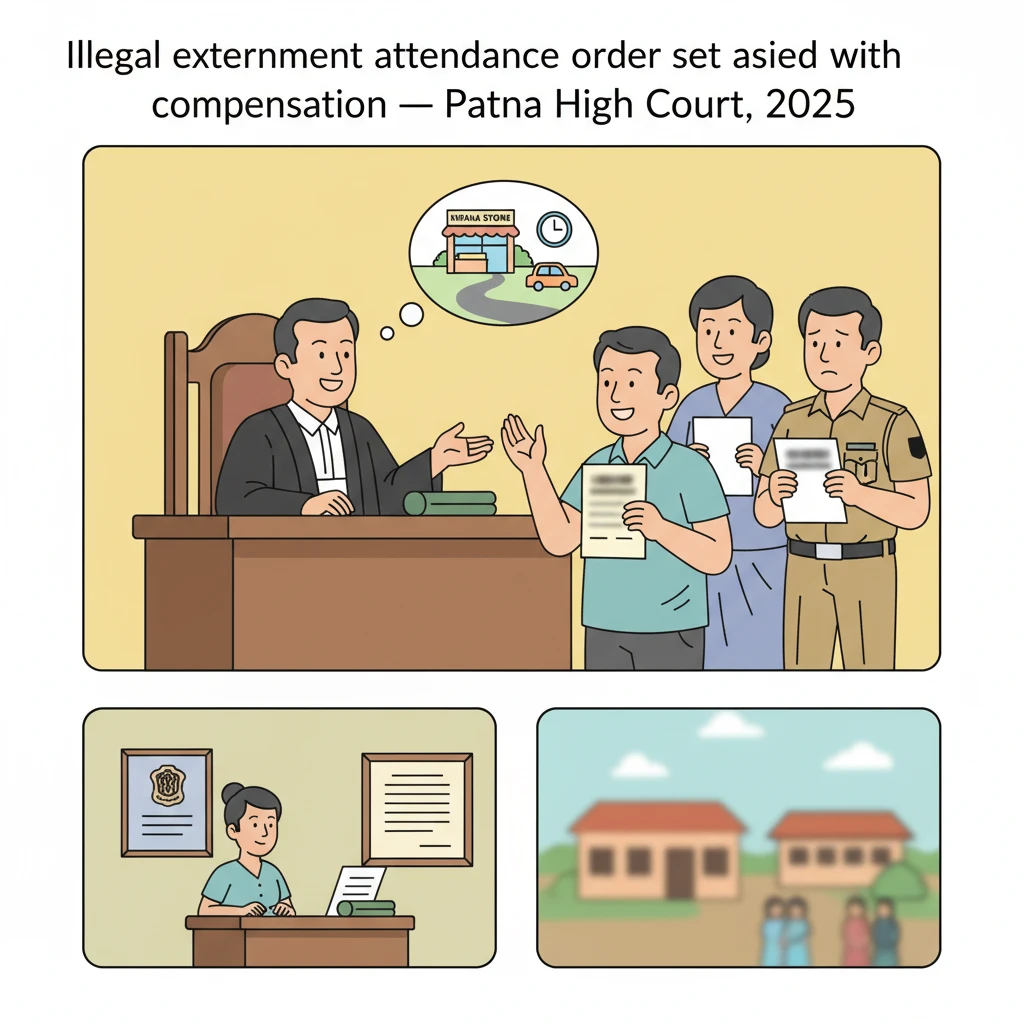
The petitioner is a resident of Nayatola Birgaon, under Mahishi (Jalai) police station, district Saharsa. He stated that he runs a kirana (grocery) shop. According to him, the externment order was based only on two criminal cases and on reports sent by local police officers.
The first case mentioned in the externment order was Mahishi P.S. Case No. 70 of 2023, dated 31.03.2023, registered under Sections 420, 467, 468, 471 of the Indian Penal Code and Sections 30(a), 41, 47 of the Bihar Prohibition and Excise Act. The petitioner told the Court that he had been falsely implicated, as liquor was allegedly found at a lonely place. In that case, the High Court had already granted him anticipatory bail on 30.10.2023 in Criminal Miscellaneous No. 39852 of 2023.
The second case was Mahishi P.S. Case No. 284 of 2024, registered under Sections 233, 292, 296 and 3(5) of the Bharatiya Nyaya Sanhita, 2023. The allegation in that case was that an orchestra programme had been organised in a government school campus.
The petitioner filed a show cause reply (Annexure P/2) before the District Magistrate, explaining these facts. He alleged that local political rivalry led to a report being sent against him by the Officer-in-Charge, Jalai Police Station, through the Sub-Divisional Police Officer, Sadar, Saharsa.
Despite this, the District Magistrate passed an order under Section 3 of the BCC Act, externing the petitioner outside the jurisdiction of Jalai Police Station to Basnahi Police Station in Saharsa district for two months. In the same order, the Magistrate also directed him to appear physically at Basnahi Police Station every day from 09:00 a.m. to 11:00 a.m. and from 05:00 p.m. to 08:00 p.m.
According to the petitioner, Basnahi Police Station is about 60 kilometres away from his residence one way. Because of this daily travel and attendance requirement, he said he was unable to run his kirana shop and had been rendered helpless in earning his livelihood.
He therefore approached the Patna High Court by filing Criminal Writ Jurisdiction Case No. 1667 of 2025. The State contested the writ petition and supported the externment order.
What the Court Examined and Decided
The Division Bench of the Patna High Court, comprising Hon’ble Mr. Justice Rajeev Ranjan Prasad and Hon’ble Mr. Justice Sourendra Pandey, heard the matter. The District Magistrate, Saharsa, also appeared through video conferencing when directed by the Court.
On 02.12.2025, the Court passed a detailed interim order recording its prima facie view. That order was reproduced in the final judgment dated 03.12.2025.
The petitioner’s counsel argued that Section 3 of the BCC Act allows the District Magistrate to pass orders under sub-sections 3(a) and 3(b) only if the twin conditions under Section 3(1) are satisfied. In simple terms, before restricting someone’s movement, the Magistrate must be satisfied that:
(i) the person is engaged in activities causing or likely to cause danger or harm to any person or property, and
(ii) such activities cannot be prevented except by removing the person from a specified place.
The petitioner’s counsel submitted that there was no material to show that the petitioner was causing or likely to cause any danger or harm to anyone, or that his activities could not be controlled without removing him from his locality.
The State’s counter affidavit claimed that the petitioner was engaged in “illegal activities” and that local people felt threatened. It stated that the externment order was passed after hearing him and based on a proposal of the Sub-Divisional Police Officer, Saharsa. Therefore, according to the State, the order was lawful.
When the matter was taken up, the High Court closely examined the two criminal cases referred to in the externment order. The Court noted that in the first case the petitioner had already been granted anticipatory bail by the High Court on 30.10.2023 and there had been no allegation of similar activity thereafter. In relation to the second case about an orchestra programme in a government school campus, learned SC-9 for the State fairly accepted that it was not an offence of such nature as to cause or likely to cause any danger or harm to person or property of any individual or the State.
The Court further recorded that the offences in the second case were punishable only with fine up to Rs. 1,000/-, and one of the offences carried a maximum imprisonment of six months. In this background, the Bench held that the conditions mentioned in clause (b)(i)(ii) of Section 3(1) of the BCC Act were not present at all when the District Magistrate passed the externment order.
Although the two-month externment period had already expired by the time of final hearing, the Court chose not to go deeper into the validity of the externment itself for that reason. Instead, it focused on the direction compelling the petitioner to mark his attendance twice daily at a police station 60 kilometres away from his residence.
The Court observed that “order of externment is one thing” but asking a person to report to a police station every day twice, for several hours, is “quite different and distinct”. Such an order, according to the Bench, had the effect of punishment, both physically and financially. A person under such a direction would not be able to do any work or even take a part-time job. This, the Court said, virtually interfered with his right to life under Article 21 of the Constitution without following the established procedure of law.
The Bench also noticed a disturbing trend: similar orders had been passed in other cases, requiring persons externed under Section 3 of the BCC Act to mark attendance even at police stations located 100 kilometres away from their residence. The Court stressed that this practice caused immense hardship and was arbitrary.
During the hearing, learned SC-9 for the State placed before the Court Rule 6 of the Bihar Control of Crime Rules, 1978. This Rule empowers the District Magistrate, while making an order under Section 3(3) of the BCC Act, to require the person to notify his movements or to report to the officer-in-charge of the police station “but not more than once in a day”. Rule 6 also requires, as a matter of principle, that such attendance should be at the police station nearest to the person’s residence.
Learned SC-9 candidly admitted that under this Rule, the petitioner could have been asked to mark attendance only once a day, not twice. The Court further recorded that, contrary to the spirit of the Rule, the police stations specified in some cases were much farther away than the nearest station.
The District Magistrate, Saharsa, who appeared through video conferencing, informed the Court that he had joined the district after the impugned order was passed by his predecessor. He assured that in future such orders would not be passed.
However, the Court held that in this case the order clearly violated Rule 6 and the principle of proportionality. The Bench stated that the negative covenant in Rule 6—“not more than once in a day”—could not be overridden by a Magistrate acting under Section 3(3) of the BCC Act.
The Court emphasised that, as a constitutional court, it could not remain a “silent and mute spectator” when a citizen’s life and liberty were curtailed without adherence to law. It found that the petitioner’s liberty had been illegally curtailed, forcing him to suffer hardship for two months.
Consequently, the Court held that the externment attendance direction was illegal and unsustainable. It set aside that part of the order requiring the petitioner to mark his attendance twice daily at Basnahi Police Station.
On the question of relief, the Bench moved beyond merely quashing the illegal direction. It directed the State Government to pay the petitioner compensation of Rs. 1,00,000/- and litigation costs of Rs. 10,000/-, to be paid within one month from the date of judgment.
Importantly, the Court relied on the principle laid down in K.K. Pathak @ Keshav Kumar Pathak Vs. Ravi Shankar Prasad and Others, reported in 2019 (1) PLJR 1051. In that case, the Patna High Court held that when the State is saddled with compensation because of misuse or excessive use of power by a State official, it is open to the State to recover that amount from the erring official. The Supreme Court had refused to interfere with that decision in S.L.P. (Cri) No. 003566/2019.
Applying this principle, the Bench directed the State Government to realise the compensation and cost amount, if it so chooses, from the erring officials “in accordance with law”. The Court also recorded that it had awarded compensation on the lower side, considering a request made by learned SC-9 for the State.
Finally, the Court instructed the Principal Secretary, Department of Home Affairs, Bihar, Patna, to bring this judgment to the notice of all District Magistrates in Bihar. The writ petition was then disposed of.
Why This Judgment Matters
This judgment has immediate practical significance for people in Bihar who face externment proceedings under the Bihar Control of Crimes Act.
First, the Patna High Court has clearly held that an externment order cannot be used to impose crushing, day-long attendance requirements at distant police stations. Any such direction must follow Rule 6 of the Bihar Control of Crime Rules, 1978 and cannot exceed one attendance per day, preferably at the nearest police station.
Second, the judgment reinforces that before restricting someone’s movement under the BCC Act, authorities must have real, concrete material showing that the person is causing or likely to cause harm and that removing him from the area is necessary. Minor or unrelated cases are not enough.
Third, the Court has given a strong message that when illegal orders cause hardship and violate a citizen’s fundamental rights, monetary compensation can be awarded. It also reminds the State that it may recover such amounts from the officials who misused or exceeded their powers.
For ordinary citizens, this decision shows that courts will scrutinise harsh administrative orders, especially those affecting livelihood and personal liberty, and will not hesitate to provide compensation where rights have been violated.
Legal Issues and Answers
- Issue: Could the District Magistrate, under Section 3(3) of the Bihar Control of Crimes Act, 2024, direct the petitioner to report twice daily to a police station 60 kilometres away from his residence?
Answer: No. The Patna High Court held that such a direction violated Rule 6 of the Bihar Control of Crime Rules, 1978 (which allows at most one attendance per day at the nearest police station), was disproportionate, arbitrary, and infringed the petitioner’s right to life and liberty under Article 21. - Issue: Were the statutory preconditions under Section 3(1)(b)(i)(ii) of the BCC Act satisfied to justify an externment order against the petitioner?
Answer: The Court found that, on the facts, these conditions were not present, since the offences relied upon were minor and not of a nature causing or likely to cause danger or harm to person or property. However, as the two-month externment period had already lapsed, the Court left this issue open for detailed consideration in an appropriate future case. - Issue: Is the State liable to compensate a person whose liberty has been curtailed by an illegal order, and can it recover such compensation from the responsible officials?
Answer: Yes. The Court directed the State to pay compensation and costs to the petitioner and, following the principle in K.K. Pathak @ Keshav Kumar Pathak Vs. Ravi Shankar Prasad and Others, held that the State may realise this amount from the erring officials in accordance with law.
Cases Cited by the Court
- K.K. Pathak @ Keshav Kumar Pathak Vs. Ravi Shankar Prasad and Others, 2019 (1) PLJR 1051. The Court noted that a challenge to this judgment in S.L.P. (Cri) No. 003566/2019 before the Supreme Court failed.
Case Details
Case Number: Criminal Writ Jurisdiction Case No. 1667 of 2025 (arising out of P.S. Case No. – Year-0, District Saharsa).
Case Title: Rakesh Kumar Yadav @ Rakesh Yadav v. The State of Bihar through the Principal Secretary, Department of Home Affairs, Bihar, Patna & Ors.
Citation: 2026 (1) PLJR 262.
Court: High Court of Judicature at Patna.
Coram: Hon’ble Mr. Justice Rajeev Ranjan Prasad; Hon’ble Mr. Justice Sourendra Pandey.
Date of Judgment: 03.12.2025.
Advocates:
- For the Petitioner: Mr. Diwakar Prasad Singh, Advocate.
- For the Respondents (State): Mr. Kinkar Kumar, S.C.-9; Ms. Vagishal Pragya, Advocate; Ms. Sushmita Sharma, Advocate.
Nature of the Case: Criminal writ petition challenging an externment order passed under Section 3 of the Bihar Control of Crimes Act, 2024, and the related reporting conditions.
Link to Judgment: Click here to read the full Patna High Court judgment.
If you found this explanation helpful and wish to stay informed about
how legal developments may affect your rights in Bihar,
you may consider following Samvida Law Associates for more updates.







