
Case Background
The two connected writ petitions were filed by constables posted at Rail Police Post, Hasanpur, in the rail district under Muzaffarpur. Both were working as members of the disciplined police force when a controversy arose from a video circulated on social media.
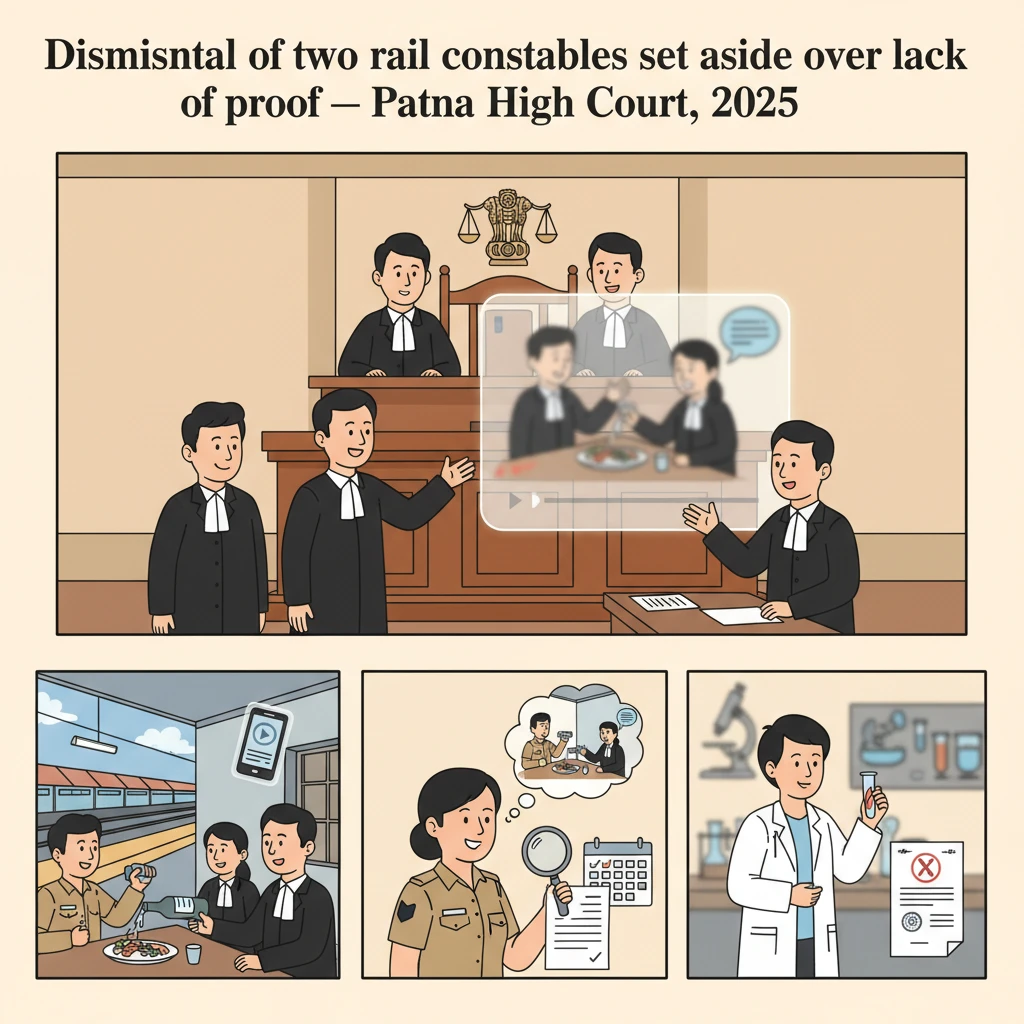
On 10.10.2019, a video went viral on WhatsApp showing a hall-like barrack situated behind Railway P.P., Hasanpur. In this video, DPC-334 Manoj Kumar Singh and one railway employee, Bhusan Kumar Nirmal, were seen sitting on chairs and eating food at a table. During the meal they picked up a bottle from under the table, poured some liquid into glasses and consumed it.
In the same video, the petitioner in CWJC No. 1208 of 2021, a constable, was seen sleeping in the room. The petitioner in CWJC No. 1528 of 2021, a driver constable, was seen talking to Sub-Inspector Baijnath Singh about a woman liquor smuggler named Renu Devi. There was no allegation that the petitioners themselves were seen drinking.
The viral video led the Deputy Superintendent of Police, Samastipur Rail, to conduct a preliminary enquiry. She submitted her report on 12.10.2019. Acting on this report, the Superintendent of Police, Rail, Muzaffarpur directed registration of a criminal case. Accordingly, Rail Samastipur (Hasanpur) P.S. Case No. 179 of 2019 was instituted on 16.10.2019 under Section 37(a) of the Bihar Prohibition and Excise Act, 2016.
On 12.10.2019, the blood and urine samples of the involved police personnel were collected and sent to the Forensic Science Laboratory (FSL), Muzaffarpur on 14.10.2019. The FSL submitted its report on 04.01.2020. In the meantime, the petitioners were placed under suspension and departmental proceedings were ordered.
Separate departmental enquiries were opened: Departmental Enquiry No. 16/2019 against the first petitioner and No. 14/2019 against the second. A memo of charge was issued to each, alleging misconduct and behaviour unbecoming of a member of a disciplined force, essentially on the basis that they were present in the room where liquor-like substance was allegedly consumed.
The charge-sheet annexed three documents: the suspension orders, the preliminary enquiry report of the Dy.S.P., and a compact disc containing the viral video. Two witnesses were listed: the Dy.S.P. Rail Police Samastipur who authored the preliminary enquiry, and Police Sub-Inspector Shiv Shankar Singh.
The petitioners filed detailed written statements denying the allegations. They stated that they had not consumed liquor, that Manoj Kumar Singh and Bhusan Kumar Nirmal were taking cold drinks, and that the video did not show them drinking or eating with those persons.
During the enquiry, both listed witnesses were examined and cross-examined. The Enquiry Officer submitted his report on 20.01.2020 holding the charges proved. Second show-cause notices were then issued to both petitioners, to which they replied. Despite their explanations, the Superintendent of Police, Rail, Muzaffarpur, passed orders dated 27.02.2020 (Memos No. 286 and 287) dismissing both petitioners from service.
Appeals were filed before the Additional Director General of Police, Law & Order, Bihar, Patna. These appeals were rejected by orders dated 26.05.2020 (Memos No. 173 and 172). Both petitioners then approached the Patna High Court under its civil writ jurisdiction, challenging the dismissal orders, the appellate orders, the enquiry reports and the charge memos.
What the Court Examined and Decided
The Patna High Court, presided over by Hon’ble Mr. Justice Harish Kumar, heard both writ petitions together, as they arose from the same incident, involved identical charges, and contained similar facts.
The petitioners argued that the charges were vague and unsupported by any concrete material. They highlighted that the viral video was 3–4 months old; they did not know who recorded or circulated it; and even in the video, one constable was only sleeping while the other was talking to the Sub-Inspector. Importantly, they were not seen consuming alcohol.
They also attacked the FSL report. According to them, the incident shown in the video had occurred 3–4 months before the enquiry started. Their blood and urine samples were collected only on 12.10.2019 and sent to the FSL on 14.10.2019. The FSL report dated 04.01.2020 detected ethyl alcohol in some urine samples (marked B2, B3, B4, B5), but not in several other samples (A1–A5, B1). The petitioners contended that even if alcohol was present in their urine on 12.10.2019, that could not possibly relate back to an incident several months earlier.
They further pointed out that the FSL report was not part of the original charge-sheet, no witness was examined to prove the report, and the enquiry officer relied heavily on this unproved document. The petitioners argued that the entire finding was based on suspicion due to their mere presence in the room and an improperly handled forensic report, not on actual evidence of misconduct.
The State defended the disciplinary process. It submitted that the proceedings were carried out under the Bihar Government Servants (Classification, Control & Appeal) Rules, 2005. The viral video, according to the State, tarnished the image of the police force and justified a preliminary enquiry, registration of an FIR, suspension and departmental inquiry. It asserted that the FSL report clearly indicated the petitioners had consumed liquor in a dry State and that their act was a grave violation of discipline. It also claimed that the petitioners had been given full opportunity to defend themselves.
After going through the records, the Court first noted the undisputed factual sequence. The preliminary enquiry report itself stated that the incident shown in the video had occurred 3–4 months before the video became viral and before the FIR was lodged on 12.10.2019. The report also admitted that the video did not show the petitioners consuming liquor. All accused had explained that Manoj Kumar Singh and Bhusan Kumar Nirmal were taking cold drinks, not alcohol.
The blood and urine samples were collected on 12.10.2019 and examined later. The FSL report recorded ethyl alcohol in some urine samples but not in others and formed the sole basis of the finding of guilt against the petitioners.
The Court carefully examined the evidence placed in the charge memo. Only three documents were listed there: suspension order, preliminary enquiry report, and the CD of the viral video. The FSL report was not listed as a relied-on document and no witness was produced before the Enquiry Officer to prove that report or explain its contents.
The Court then considered the oral evidence of the two departmental witnesses. Both witnesses merely stated that in the video two persons were consuming what appeared to be liquor and the petitioners were present in the room — one sleeping, the other sitting and talking. In cross-examination, they categorically admitted that the petitioners were not seen taking meals or consuming liquor. Even the bottle seen in the video did not appear to be a liquor bottle, and the persons supposedly consuming liquor were not shown talking with the petitioners.
Despite this, the Enquiry Officer held the petitioners guilty. He admitted that the witnesses could not prove consumption of liquor by the petitioners, but relied on the fact that during criminal investigation the petitioners had been made accused and their urine samples had tested positive for ethyl alcohol. On that basis, he concluded that they must have violated prohibition.
The Court held that such reasoning was contrary to settled law. Referring to the Supreme Court judgment in Roop Singh Negi v. Punjab National Bank (2009) 2 SCC 570, it reiterated that materials collected during criminal investigation, such as an FIR or investigation papers, cannot automatically be treated as evidence in departmental proceedings unless they are duly proved by examining witnesses.
The Court also quoted Sher Bahadur v. Union of India (2002) 7 SCC 142, where the Supreme Court held that evidence must establish a link between the charged officer and the alleged misconduct; mere suspicion or irrelevant material, however voluminous, does not amount to legal evidence.
Applying these principles, the Court found that the FSL report could not be linked to the incident in the viral video. Scientifically, alcohol is detectable in blood only up to about 12 hours after consumption and in urine up to 24–80 hours. Thus, a urine test done in October 2019 could not possibly provide proof about alleged consumption 3–4 months earlier.
The Court took pains to explain the basic forensic position: blood alcohol concentration reflects the level at the time of sample collection and is accepted only when collected, preserved and documented properly. Urine tests show recent consumption but not the exact time of intoxication and are more vulnerable to dilution and contamination. On this basis, the Court concluded that the FSL report could not substantiate the charge that the petitioners had consumed alcohol at the time of the earlier incident.
On the issue of electronic evidence, the Court relied on the Supreme Court decision in Arjun Panditrao Khotkar v. Kailash Kushanrao Gorantyal (2020) 7 SCC 1. That judgment makes it mandatory to produce a certificate under Section 65B(4) of the Evidence Act for electronic records like CDs or video clips. Without such a certificate, the video cannot be admitted in evidence.
The Court noted that in the departmental enquiry no Section 65B certificate was produced, the viral video clip in the CD was not proved through the maker or any authorised person, the mobile phone used for recording or circulating was never seized or exhibited, and no eyewitness of the alleged drinking incident was examined. Therefore, the video had no legal evidentiary value.
The Court drew support from its own earlier decisions in Bharat Prasad Yadav v. State of Bihar (CWJC No. 18331 of 2019) and Sonu Kumar v. State of Bihar (CWJC No. 17527 of 2019). In those cases, departmental dismissals based on viral liquor videos were set aside for want of legally admissible evidence and for failure to follow the procedure under the Evidence Act for electronic records.
Further, the Court reminded itself of the limits of judicial review but cited Kuldeep Singh v. Commissioner of Police (1999) 2 SCC 10. Under that decision, High Courts can interfere with departmental findings where the conclusions are perverse, based on no evidence, or such that no reasonable person could reach.
After re-examining the record, the Court held that the case against the petitioners was entirely built on suspicion about their presence in the room where two others supposedly consumed liquor. There was a specific finding by the Enquiry Officer that none of the witnesses or documents supported any allegation of actual consumption by the petitioners. The FSL report, which was the only basis used to sustain the charge, was unrelated in time to the incident, never supplied with the charge-sheet, and never proved through witnesses. The relying on such an unproved and scientifically irrelevant document rendered the findings unsustainable.
The Court also noticed a serious procedural flaw: the departmental Presenting Officer did not effectively present the case. It appeared that the Enquiry Officer himself acted like a Presenting Officer, which is contrary to the roles explained by the Supreme Court in State of Uttar Pradesh v. Saroj Kumar Sinha (2010) 2 SCC 772 and by this Court in Panchanan Kumar v. Bihar State Electricity Board (1996) 1 PLJR 401.
As for the appellate authority, the Court found that the appellate orders were completely non-speaking. They did not discuss any of the grounds raised by the petitioners and ignored the duties placed on the appellate authority under Rule 27 of the Bihar Government Servants (Classification, Control & Appeal) Rules, 2005.
In the final analysis, the Court held that both the disciplinary and appellate orders were “without evidence and perfunctory”, and therefore “wholly unjust, illegal and unsustainable”. It set aside Memo Nos. 286 and 287 dated 27.02.2020 (dismissal orders) and Memo Nos. 172 and 173 dated 26.05.2020 (appellate orders). Both writ petitions were allowed.
The Court directed that the petitioners be reinstated forthwith with all consequential benefits, to be paid within twelve weeks from the date of receipt or production of the judgment. The parties were left to bear their own costs, and pending applications were disposed of.
Why This Judgment Matters
This Patna High Court decision is important for government employees, particularly police personnel, working under Bihar’s prohibition regime. It clarifies that mere presence in a room where others may be drinking, or an unverified video clip, is not enough to dismiss someone from service.
The Court has emphasised that departmental punishment must be based on legal evidence, not on suspicion or public outrage over a viral video. Forensic reports must relate to the specific incident and be properly proved during the enquiry. Electronic evidence such as WhatsApp videos must satisfy the technical requirements of the Evidence Act.
The judgment also underlines that disciplinary and appellate authorities must apply their independent minds, follow the Rules of 2005, and give reasoned orders. When they fail to do so, the High Court can step in and restore the rights of employees wrongfully dismissed.
Legal Issues and Answers
- Issue: Could the petitioners be dismissed from service solely on the basis of a viral video and an FSL urine report allegedly indicating consumption of alcohol, despite no direct evidence of them drinking?
Answer: No. The Court held that neither the viral video nor the FSL report were legally admissible or sufficient to prove that the petitioners consumed liquor. The findings were based on suspicion and unproved documents, amounting to “no evidence”. - Issue: Were the departmental and appellate authorities justified in relying on unproved electronic and forensic evidence without following the procedure prescribed by law and the Bihar Government Servants (CCA) Rules, 2005?
Answer: No. The Court found serious procedural lapses, including failure to prove the video under Section 65B of the Evidence Act and non-production of witnesses to prove the FSL report. The disciplinary and appellate orders were therefore quashed as illegal and unsustainable. - Issue: What relief were the petitioners entitled to after the Court found the findings perverse and unsupported by evidence?
Answer: The Court directed their reinstatement forthwith with all consequential benefits, to be paid within twelve weeks.
Cases Cited by the Court
- Roop Singh Negi v. Punjab National Bank & Ors., (2009) 2 SCC 570
- Sher Bahadur v. Union of India & Ors., (2002) 7 SCC 142
- Arjun Panditrao Khotkar v. Kailash Kushanrao Gorantyal & Ors., (2020) 7 SCC 1
- Sonu Kumar v. The State of Bihar & Ors., CWJC No. 17527 of 2019
- Bharat Prasad Yadav v. The State of Bihar & Ors., CWJC No. 18331 of 2019
- Kuldeep Singh v. Commissioner of Police & Ors., (1999) 2 SCC 10
- State of Uttar Pradesh & Ors. v. Saroj Kumar Sinha, (2010) 2 SCC 772
- Panchanan Kumar v. The Bihar State Electricity Board & Ors., (1996) 1 PLJR 401
Case Details
Case Numbers: Civil Writ Jurisdiction Case No. 1208 of 2021; Civil Writ Jurisdiction Case No. 1528 of 2021
Case Title: Srikant Prasad v. The State of Bihar & Ors.; Bipin Kumar v. The State of Bihar & Ors.
Citation: 2026(1) PLJR 276
Court: High Court of Judicature at Patna
Coram: Hon’ble Mr. Justice Harish Kumar
Date of Judgment: 22.08.2025
Advocates for Petitioners (both cases): Mr. Ramakant Sharma, Senior Advocate; Mr. Rakesh Kumar Sharma, Advocate; Mr. Rabinder Kumar, Advocate
Advocates for State in CWJC No. 1208 of 2021: Md. Nadim Seraj, GP-5; Mr. Shailesh Kumar, AC to GP-5
Advocates for State in CWJC No. 1528 of 2021: Mrs. Babita Kumari, AC to SC-1
Nature of the Case: Writ petitions under civil writ jurisdiction challenging orders of dismissal from service and rejection of departmental appeals arising from disciplinary proceedings against police constables
Link to Judgment: https://patnahighcourt.gov.in/viewjudgment/MTUjMTIwOCMyMDIxIzEjTg==-946TVqyZ1Ws=
If you found this explanation helpful and wish to stay informed about how legal developments may affect your rights in Bihar, you may consider following Samvida Law Associates for more updates.







