
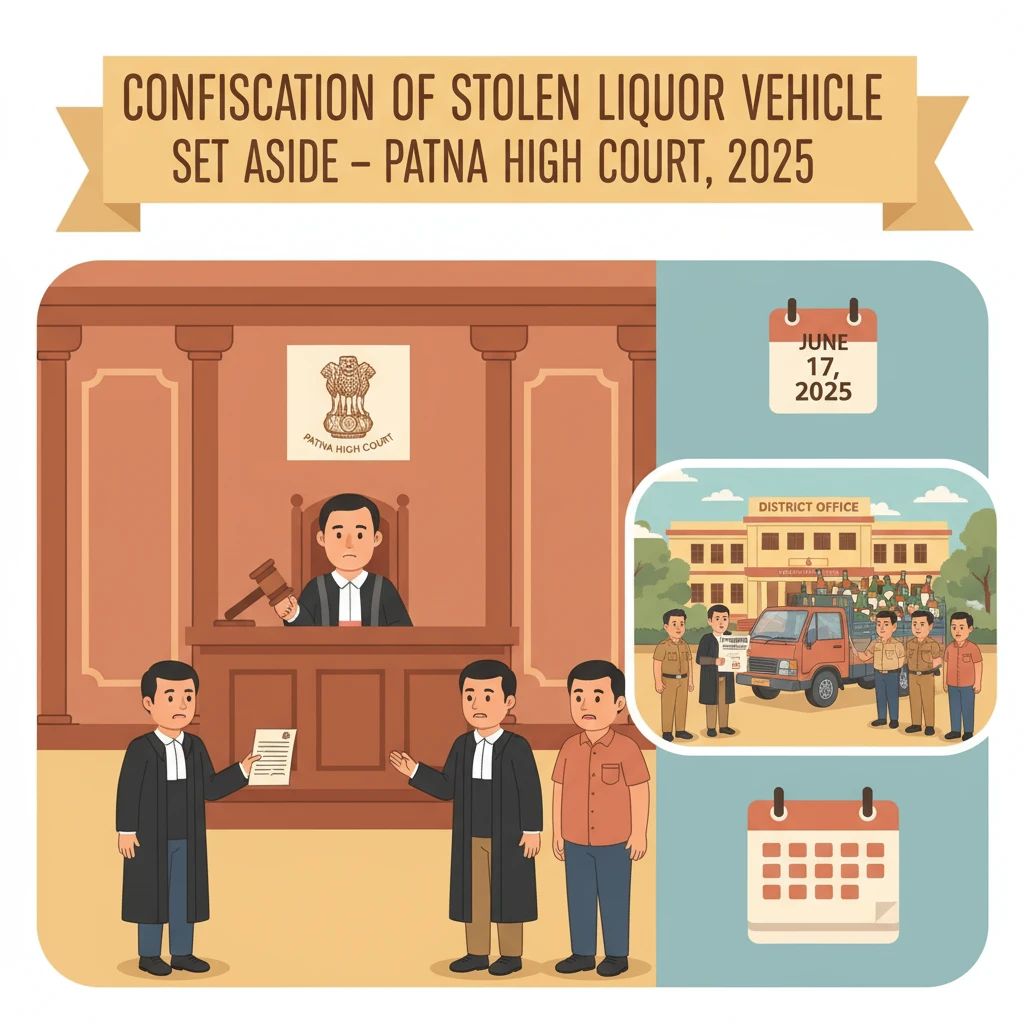
Case Background
The case arose from the seizure of a vehicle which was later found loaded with 405.840 litres of foreign liquor. Before this seizure, the owner of the vehicle, the writ petitioner, had lodged a First Information Report (FIR) alleging that his vehicle had been stolen.
The FIR, which is Annexure P/2 to the writ petition, gave rise to Phulwarisharif P.S. Case No. 5117060240643 of 2024. It was registered on 06.05.2024 for the offence under Section 379 of the Indian Penal Code, that is, theft.
About one month and ten days after the theft was reported, the same vehicle was seized while it was carrying foreign liquor. On the basis of this seizure, the excise authorities started proceedings under the Bihar excise and prohibition laws.
The District Panchayat Raj Officer, Siwan, acting as the Confiscating Authority, passed an order adverse to the petitioner. The petitioner was directed to fill Form-IV before the District Officer, Siwan, and to deposit a penalty amount. The District Officer was then to pass an appropriate order in accordance with law.
The confiscation order further stated that if the penalty amount was not deposited within fifteen days from the date of submission of the application, the District Magistrate would proceed to auction sale the vehicle. This meant that the petitioner risked losing his vehicle permanently through public auction.
Aggrieved by this, the petitioner filed an appeal before the Excise Commissioner, Bihar, Patna, which was registered as Excise Appeal No. 60 of 2025. On 17.06.2025, the Excise Commissioner dismissed the appeal and affirmed the order passed by the District Panchayat Raj Officer, Siwan.
Still dissatisfied, the petitioner approached the Patna High Court under its civil writ jurisdiction in CWJC No. 16421 of 2025. The challenge was directed primarily against the appellate order dated 17.06.2025, but the writ petition also questioned the underlying confiscation order of the District Panchayat Raj Officer, Siwan.
What the Court Examined and Decided
The matter was heard by a Division Bench of the Patna High Court comprising Hon’ble Mr. Justice Rajeev Ranjan Prasad and Hon’ble Mr. Justice Sourendra Pandey. The oral judgment was delivered on 18.11.2025 by Hon’ble Mr. Justice Rajeev Ranjan Prasad.
The petitioner’s counsel drew the Court’s attention to the registered theft case, namely Phulwarisharif P.S. Case No. 5117060240643 of 2024, under Section 379 of the Indian Penal Code. The petitioner’s consistent stand was that his vehicle had been stolen on 06.05.2024 and that he had immediately lodged an FIR about the theft.
The Court noted that the vehicle was later seized, about one month and ten days after the theft report, loaded with 405.840 litres of foreign liquor. This seizure formed the basis for treating the vehicle as being used in violation of prohibition laws.
The crucial point highlighted by the petitioner was a finding recorded by the Appellate Authority itself. From the appellate order, it was clear that in the theft case, the involvement of the petitioner was “not appearing/found.” In simple terms, the appellate authority accepted that there was no material suggesting the owner’s involvement in the theft of his own vehicle or in the subsequent transportation of liquor.
Despite this clear observation, the Appellate Authority still held that it could not be denied that the vehicle had been used in violation of prohibition laws. On this reasoning, the appellate authority refused to interfere with the confiscation order and retained the liability and penalty against the owner.
The petitioner’s counsel argued that this approach was legally unsustainable. He relied on a previous Division Bench decision of the Patna High Court in the case of Sunaina @ Suneina vs. The State of Bihar and others (CWJC No. 7920 of 2023). According to that judgment, when the owner of a vehicle is not involved in the commission of the alleged offence of transportation of liquor, the vehicle cannot be subjected to confiscation proceedings.
The core submission was that confiscation is a harsh measure and cannot be applied mechanically where the owner has taken reasonable steps, such as lodging an FIR for theft, and where there is no finding of his involvement in the excise offence.
On behalf of the State, learned counsel Mr. Saroj Kumar Sharma, AC to AAG-3, did not dispute the factual position recorded in the appellate order. He accepted that the Appellate Authority itself had noted that the petitioner did not seem to be involved in the theft of the vehicle.
The Court then considered the submissions and examined the material on record. It observed that the vehicle in question was stolen on 06.05.2024 and that the petitioner had lodged an FIR regarding the theft. Furthermore, the name of the petitioner had not been found involved in the theft case.
In this background, the Court held that both the Confiscating Authority and the Appellate Authority had erred in appreciating the case of the petitioner. Once it was accepted that the petitioner was not involved in the theft and there was no finding of his role in transporting liquor, it was wrong in law to proceed with confiscation against him.
The Division Bench specifically held that the case of the petitioner was fully covered by the earlier Division Bench judgment in Sunaina (supra). That precedent had already laid down that if the owner is not involved in the transportation of liquor, the vehicle cannot be confiscated under the prohibition laws.
Additionally, the Court recorded another fact placed before it by the petitioner’s counsel: the petitioner had no criminal antecedent of a similar nature. It was also informed that this was the first time that the vehicle in question had been seized in connection with transportation of illicit liquor. There was no dispute from the State side on this information.
Considering these circumstances, the Court concluded that allowing the confiscation to stand would amount to punishing an innocent vehicle owner, whose vehicle had been misused after being stolen. The Court was satisfied that the petitioner had been wrongly forced into litigation to protect his property.
Accordingly, the Court set aside the impugned orders passed by the Confiscating Authority and the Excise Commissioner. It directed that the petitioner’s vehicle be released within a period of three days from the date of receipt or communication of a copy of the High Court’s order.
Relief was not confined to release of the vehicle alone. Learned counsel for the petitioner pointed out another Division Bench decision of the Patna High Court in Khushboo Rani vs. The State of Bihar and others (CWJC No. 1860 of 2025). In that case, the Court had granted Rs. 10,000 as litigation cost to the petitioner who had to approach the Court despite having no role in the excise offence.
Taking guidance from the view expressed in Khushboo Rani (supra), the Division Bench in the present case granted a similar benefit. It allowed a sum of Rs. 10,000 (Rupees ten thousand) as cost of litigation to the petitioner.
This amount was directed to be paid by the State within one month from the date of the judgment. The Court also made it clear that it would be open for the State to realize this amount from the erring officials in accordance with law. This observation signalled that the responsibility for wrongful action might not ultimately fall on the public exchequer but could be recovered from officers found at fault.
Thus, the writ petition succeeded. The confiscation was annulled, the vehicle was ordered to be released promptly, and compensation by way of litigation cost was awarded to the petitioner.
Why This Judgment Matters
This judgment is important for vehicle owners in Bihar whose vehicles are stolen and later misused for carrying liquor or other contraband. It shows that the Patna High Court will not allow confiscation of such vehicles when the owner has no role in the offence.
The Court has reaffirmed that authorities must look at the owner’s involvement, not just the vehicle’s use. If there is a theft FIR and no evidence against the owner, the authorities cannot simply seize and auction the vehicle.
The decision also has a financial angle. By awarding litigation costs and allowing recovery from erring officials, the Court has sent a message that wrongful confiscation can have consequences for the administration.
For ordinary citizens, this means that if they promptly report theft and cooperate with the police, they have a strong defence against later attempts to confiscate their vehicles over excise offences committed by others.
Legal Issues and Answers
-
Issue: Can a vehicle be confiscated under prohibition laws when it was stolen from the owner, and there is no finding that the owner was involved in transporting liquor?
Answer: No. The Patna High Court held that, following its earlier Division Bench judgment in Sunaina, a vehicle cannot be subjected to confiscation proceedings if the owner is not involved in the alleged excise offence and has lodged an FIR for theft. -
Issue: Is the vehicle owner entitled to any monetary relief when he is forced to approach the High Court despite having no role in the excise offence?
Answer: Yes. Relying on the precedent in Khushboo Rani, the Court awarded Rs. 10,000 as litigation cost to the petitioner, payable by the State with liberty to recover it from erring officials.
Cases Cited by the Court
- Sunaina @ Suneina vs. The State of Bihar and others, CWJC No. 7920 of 2023 (Division Bench, Patna High Court) – relied upon to hold that vehicles of innocent owners cannot be confiscated.
- Khushboo Rani vs. The State of Bihar and others, CWJC No. 1860 of 2025 (Division Bench, Patna High Court) – relied upon for awarding litigation costs to a petitioner with no role in the excise offence.
Case Details
Case Number: Civil Writ Jurisdiction Case No. 16421 of 2025
Case Title: Ali Ashraf Siddique vs. The State of Bihar and others
Coram: Hon’ble Mr. Justice Rajeev Ranjan Prasad and Hon’ble Mr. Justice Sourendra Pandey
Citation: 2026(1) PLJR 190
Date of Judgment: 18.11.2025
Advocates: For the petitioner – Md. Nurul Hoda, Advocate, and Mr. Satish Chandra Mishra, Advocate; For the respondents – Mr. Saroj Kumar Sharma, AC to AAG-3
Nature of the Case: Writ petition challenging excise confiscation and appellate orders concerning seizure of a vehicle allegedly used in violation of prohibition laws
Link to Full Judgment: Click here to read the judgment on the Patna High Court website
If you found this explanation helpful and wish to stay informed about
how legal developments may affect your rights in Bihar,
you may consider following Samvida Law Associates for more updates.







