
Case Background
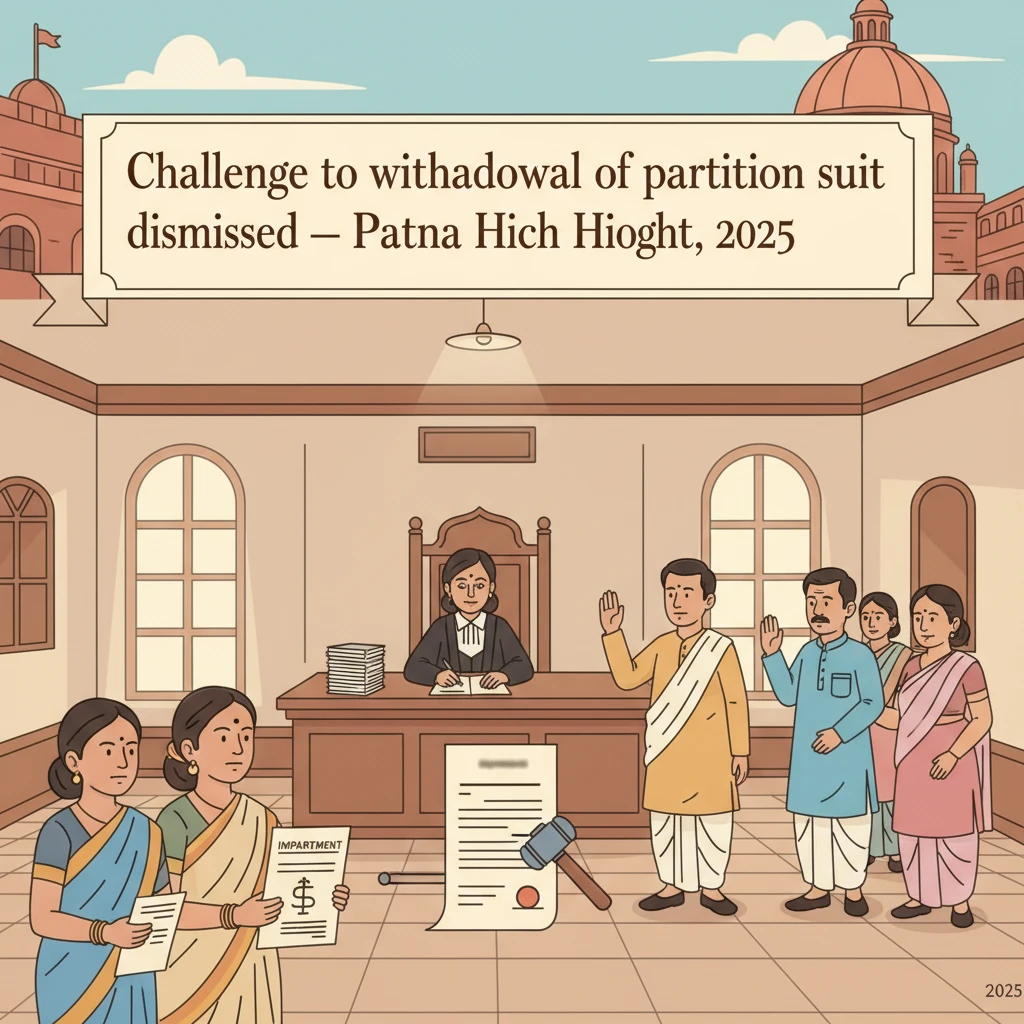
The dispute arises from a family partition case relating to ancestral property. A co-sharer had filed Partition Suit No. 42 of 2018/Partition Suit No. 588 of 2013 before the Court of Sub Judge XIV, Gaya.
According to the petitioners in the present case, the original partition suit was filed for partition of the father’s property without impleading the daughters as parties, even though they claimed to be co-sharers.
When the daughters came to know of the partition proceedings, they filed an intervenor petition under Order I Rule 10 of the Code of Civil Procedure, 1908 (CPC) before the Sub Judge XIV, Gaya. Through this petition, they sought to be added as parties to the suit.
They also desired that one of them be transposed as plaintiff in the partition suit. Their stand was that in a partition suit, all co-sharers are effectively plaintiffs, and the position of plaintiff and defendant is easily interchangeable.
However, before their intervenor petition could be decided, the original plaintiff in the partition suit filed an application under Order XXIII Rule 1 of the CPC seeking to withdraw the entire suit. On 16.10.2019, the Sub Judge XIV, Gaya allowed the plaintiff’s withdrawal petition and permitted the suit to be withdrawn unconditionally.
In view of the withdrawal of the suit, the trial court then dismissed the intervenor petition filed by the daughters under Order I Rule 10 CPC as having become infructuous.
Aggrieved by this sequence of events, the daughters, as intervenors/petitioners, approached the Patna High Court by filing Civil Miscellaneous No. 1720 of 2019 under its civil miscellaneous jurisdiction.
What the Court Examined and Decided
The Patna High Court, presided over by Hon’ble Mr. Justice S. B. Pd. Singh, heard the learned counsel for both sides at length. The central grievance placed before the Court was the order dated 16.10.2019 passed by the Sub Judge XIV, Gaya in Partition Suit No. 42 of 2018/588 of 2013.
The petitioners sought setting aside of that order on the ground that the trial court allowed the plaintiff’s withdrawal petition without first deciding their intervenor petition. They claimed this procedure was contrary to law and prejudicial to their rights as daughters and co-sharers.
In their pleadings and arguments, the intervenors/petitioners asserted that they were daughters and co-sharers in the property which was the subject-matter of the partition suit. They alleged that the father’s property was sought to be partitioned without making the daughters parties to the suit. They contended that this omission was done with mala fide intention to deprive them of their undisputed due share.
They further pointed out that they had filed an intervenor petition under Order I Rule 10 CPC to get themselves impleaded as parties to the partition suit. After impleadment, one of the daughters (who is petitioner here) wanted to be transposed as plaintiff because she was also seeking partition of the same property, similar to the original plaintiff.
The petitioners argued that in a partition suit “everybody is plaintiff” and the position of plaintiff and defendant is easily interchangeable, particularly when the suit has already made some progress. They contended that their petition for impleadment and transposition was filed earlier than the withdrawal petition and thus required to be adjudicated first.
They alleged that the subsequent withdrawal petition filed by the plaintiff was moved with mala fide intention to prevent consideration of the daughter’s prayer for transposition as plaintiff and thereby deprive the daughters of their share.
On the other hand, learned counsel for the defendants/respondents opposed the civil miscellaneous petition. The respondents’ stand was that the intervenors/petitioners cannot compel the plaintiff to contest the suit against his will. They submitted that the plaintiff is master of his suit and has an absolute right under law to withdraw it, subject to the provisions of Order XXIII Rule 1 CPC.
After considering the submissions of both sides and perusing the record, the Patna High Court examined the impugned order in detail.
The Court noted that the partition suit had been withdrawn on the basis of an application filed by the plaintiff/petitioner under Order XXIII Rule 1 CPC. The contesting defendants, who were co-sharers, had specifically stated that they had no objection to the withdrawal of the suit.
As recorded in the impugned order, the trial court had also verified that the plaintiff was physically present before the In-charge Court. The plaintiff had clearly stated that he was not willing to pursue the suit and wanted to withdraw it. He had signed in the margin of the suit and filed an affidavit in support of his withdrawal petition.
The trial court further recorded that the contents of the withdrawal petition were true to the plaintiff’s knowledge and were duly supported by an affidavit dated 03.07.2019 available on the record. On these facts, the Sub Judge XIV, Gaya came to the conclusion that the plaintiff wished to withdraw the suit unconditionally.
The trial court also recorded the principle that the plaintiff is master of his suit. If he is not willing to pursue his own suit, the court cannot compel him to continue with it. On this reasoning, the Sub Judge allowed the withdrawal petition under Order XXIII Rule 1 CPC and, in consequence, dismissed the intervenor’s petition under Order I Rule 10 CPC as infructuous in light of the withdrawal of the main suit.
The Patna High Court examined whether this approach suffered from any illegality or impropriety.
The High Court held that there is no provision in the procedural law which mandates that an intervenor’s petition under Order I Rule 10 CPC must be decided first, and only thereafter, the plaintiff’s withdrawal petition under Order XXIII Rule 1 CPC can be disposed of.
The Court specifically observed that even “In Cr.P.C. also, it is nowhere provided that a petition of the intervenor/petitioner under Order 1, Rule 10 will be decided first and then withdrawal petition under Order 23, Rule 1, filed on behalf of the plaintiff/petitioner will be disposed of.” Although the reference is to Cr.P.C. in the text, the core reasoning is that there is no such mandatory sequence provided in law.
The High Court emphasised that, in the facts of this case, no substantive right had accrued to the intervenors/petitioners up to 16.10.2019. Before any such right could arise in their favour, the plaintiff had already moved to withdraw the suit, and the trial court had allowed the withdrawal after due verification.
Therefore, the Court concluded that, once the plaintiff lawfully withdrew his suit, the intervenor application automatically became infructuous because there was no surviving proceeding in which they could be impleaded or transposed.
In this background, the High Court found no illegality or impropriety in the order of the Sub Judge XIV, Gaya dated 16.10.2019. The trial court had correctly recognised the plaintiff’s right as master of his suit and allowed the withdrawal petition.
Accordingly, the Patna High Court upheld the impugned order. Civil Miscellaneous No. 1720 of 2019 was dismissed. No further directions were issued, and the withdrawal of the original partition suit remained effective.
Why This Judgment Matters
This judgment of the Patna High Court is significant for family members, especially daughters, who may find themselves excluded from partition suits relating to ancestral property.
The decision makes clear that if a co-sharer who has filed a partition suit later chooses to withdraw it, the court cannot force that person to continue the case, even if other family members wish to participate.
For intervenors like daughters who were left out initially, this ruling shows that filing an impleadment application does not, by itself, create an automatic right to carry on the same suit once the original plaintiff withdraws. Until the court formally allows their impleadment, they do not acquire an independent right to the pending case.
However, the judgment does not bar such co-sharers from asserting their property rights in other legal proceedings. It simply holds that they cannot prevent the original plaintiff from withdrawing his own partition suit or insist that their application be decided first in every situation.
For lawyers and litigants, the ruling reinforces the settled notion that the plaintiff is the “master of the suit” and clarifies that, in absence of a specific legal bar, an impleadment petition filed by an intervenor does not freeze or override the plaintiff’s right to withdraw.
Legal Issues and Answers
-
Issue: Whether the trial court committed an error by allowing the plaintiff’s application under Order XXIII Rule 1 CPC to withdraw the partition suit without first deciding the intervenors’ application under Order I Rule 10 CPC seeking impleadment and transposition.
Answer: No. The Patna High Court held that there is no legal requirement that an intervenor’s application under Order I Rule 10 must be decided before a plaintiff’s withdrawal petition under Order XXIII Rule 1. The plaintiff is master of his suit and cannot be compelled to continue it. The intervenors had not acquired any right in the suit before its withdrawal, and their application became infructuous thereafter.
Cases Cited by the Court
- No prior judgments or case law have been cited or relied upon in the text of this judgment.
Case Details
Case Number: Civil Miscellaneous Jurisdiction No. 1720 of 2019
Case Title: Sri Raj Kumar Singh and another v. Rama Mukharjee and others
Court: High Court of Judicature at Patna
Coram: Hon’ble Mr. Justice S. B. Pd. Singh
Date of Judgment: 21.11.2025
Impugned Order: Order dated 16.10.2019 passed by Sub Judge XIV, Gaya in Partition Suit No. 42 of 2018/Partition Suit No. 588 of 2013
Citation: 2026(1) PLJR 188
Advocates for the Petitioners: Mr. Jitendra Kishore Verma, Advocate; Mr. Anjani Kumar, Advocate; Mr. Abhay Nath, Advocate; Ms. Kri. Shreya
Advocates for the Respondents: Ms. Nivedita Nirvikar, Senior Advocate; Ms. Shashi Priya, Advocate
Advocates for Respondent Nos. 2 & 3: Mr. P. N. Sahi, Senior Advocate; Mr. Manish Kumar No. 2, Advocate
Nature of the Case: Civil miscellaneous petition challenging an order of the Sub Judge allowing withdrawal of a partition suit and dismissing an intervenor application as infructuous
Link to Judgment: Click here to read the full judgment of the Patna High Court
If you found this explanation helpful and wish to stay informed about
how legal developments may affect your rights in Bihar,
you may consider following Samvida Law Associates for more updates.







