
Case Background
The case arose from an internal promotion examination in the East Central Railway, Hajipur.
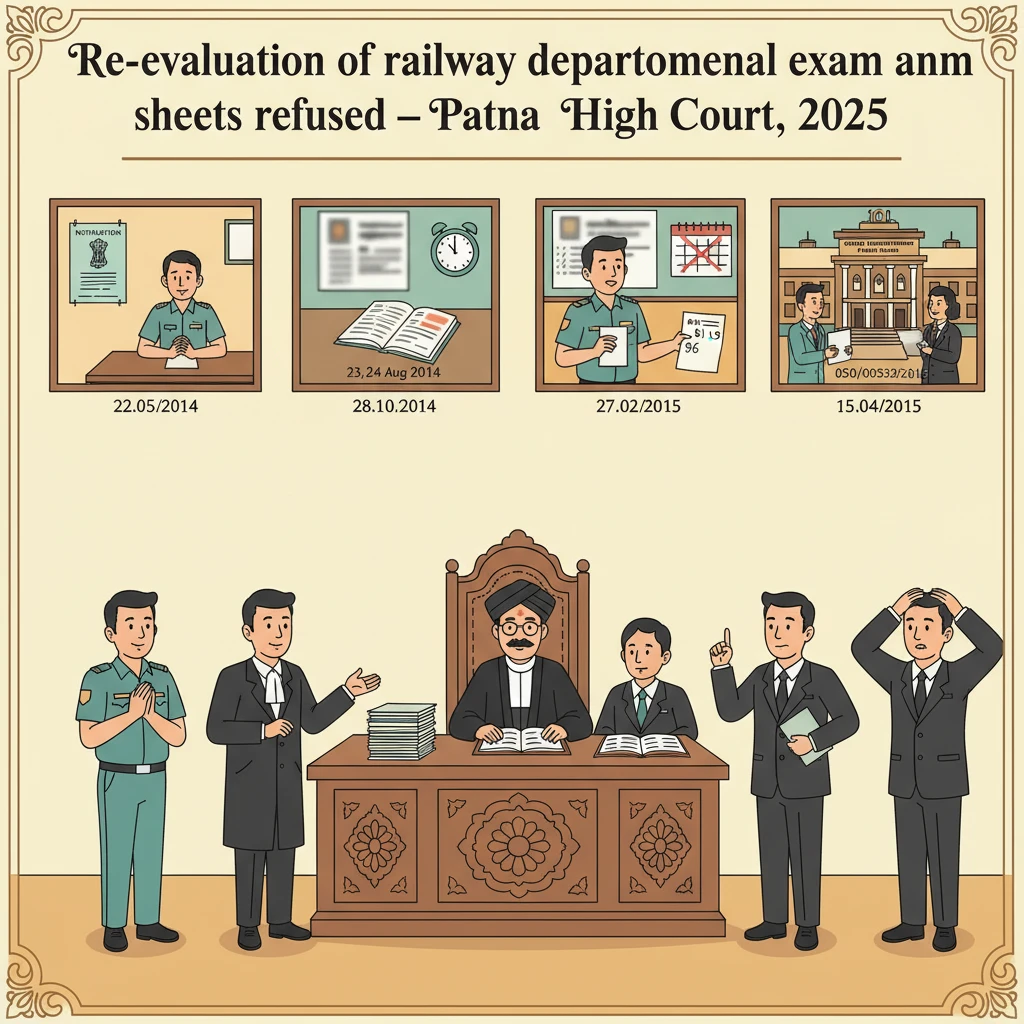
The petitioner was working as a Senior Section Officer (Accounts) in the Accounts Department. The office of the Financial Adviser and Chief Accounts Officer (FA & CAO), Hajipur issued a notification dated 22.05.2014 to conduct a Limited Departmental Competitive Examination (LDCE). This LDCE was meant to form a panel of Assistant Financial Advisors (Group-B) from eligible Group-C Accounts staff against 30% vacancies for the years 2010–2012.
The petitioner applied and was permitted to sit in the LDCE. The examination was held on 23 and 24 August 2014. The result was declared on 09.10.2014. The petitioner’s name did not appear in the list of successful candidates.
By letter dated 28.11.2014, the Railway authorities informed him that he had secured 81.13 marks in Paper 1 and 96 marks in Paper 2. Dissatisfied, the petitioner evaluated his own answers for Paper 1 using the model answers for that paper. He claimed to have found “glaring mistakes” in the evaluation of his Paper 1 answer book and felt that this incorrect assessment had led to his failure in the LDCE.
On 27.02.2015, the petitioner submitted an application to the FA & CAO, East Central Railway, Hajipur, explaining the alleged mistakes in the evaluation of Paper 1 and requesting re-evaluation. On 15.04.2015, he made another application to the General Manager, East Central Railway, Hajipur, again seeking re-evaluation of Paper 1.
When no decision was taken on these representations, the petitioner approached the Central Administrative Tribunal (CAT), Patna Bench, by filing O.A. No. 050/00332/2016. He sought directions to the Railway authorities to consider his applications, to re-evaluate his Paper 1, to declare his result afresh on the basis of enhanced marks, and then to grant him promotion as Assistant Financial Adviser (Group-B) in Pay Band-2 against the 30% quota with all consequential benefits.
By order dated 07.02.2024, the CAT dismissed his original application as being devoid of merit. The petitioner then filed the present writ petition before the Patna High Court challenging that CAT order.
What the Court Examined and Decided
The Patna High Court, exercising writ jurisdiction, examined whether it could direct re-evaluation of the petitioner’s LDCE answer sheet in the absence of any rule of the Railways allowing such re-evaluation.
On the factual side, there was no dispute that:
- The petitioner had failed in the LDCE because his Paper 1 marks were not high enough.
- He had made written representations seeking re-evaluation of Paper 1.
- The Railways had declined re-evaluation, stating that no such provision existed and that courts had held re-evaluation to be impermissible in such circumstances.
The respondents’ written statement before the CAT had clearly stated that there was no rule in Railways which provided for re-evaluation of answer sheets. They also stated that the petitioner’s answer scripts were evaluated with due care and diligence. Since the answers were subjective in nature, the evaluator, an officer of Senior Administrative Grade (SAG) rank, had applied his judgment and allotted marks accordingly.
The Railways further stated that they refused re-evaluation in light of judicial precedents, particularly the Supreme Court judgment dated 25.05.2010 in Civil Appeal No. 907 of 2006 (Himachal Pradesh Public Service Commission v. Mukesh Thakur and Another).
The CAT, relying on this legal position, held that there was no provision in Railways for re-evaluation, and following Mukesh Thakur, dismissed the original application on 07.02.2024.
Before the Patna High Court, the petitioner’s counsel argued that the Supreme Court judgment in Mukesh Thakur did not impose a total bar on re-evaluation. He relied on an order dated 21.04.2015 passed by a Co-ordinate Bench of CAT, Circuit Bench Ranchi (Patna Bench) in O.A. No. 773 of 2011 (Santosh Kumar v. Union of India and Others). In that case, the CAT had directed the Government to appoint an expert examiner to examine specific questions and answers raised in the candidate’s representation and to revise marks if improper assessment was found.
On that basis, the petitioner argued that re-evaluation of answer sheets was permissible and that the CAT’s order dated 07.02.2024, relying on Mukesh Thakur, should be set aside.
On the other hand, counsel for the Railways maintained that in the Railways there is no rule that provides for re-evaluation of answer sheets. Therefore, the administration could not undertake re-evaluation, and there was no legal basis for the Court to compel it.
The High Court carefully heard both sides and examined the record. It noted that the petitioner’s counsel was unable to show any provision, rule or regulation in the Railways that allowed re-evaluation of answer books.
The Court stressed that the legal position on this subject was settled. It relied on several Supreme Court and High Court decisions.
First, the Court referred to the Supreme Court decision in Himachal Pradesh Public Service Commission v. Mukesh Thakur and Another, reported in (2010) 6 SCC 759. The Court noted that this judgment categorically held that in the absence of any provision under the statute or statutory rules or regulations, courts should not generally direct re-evaluation of answer sheets.
Secondly, the Court quoted at length from the Supreme Court judgment in Pramod Kumar Srivastava v. Chairman, Bihar Public Service Commission and Others, reported in (2004) 6 SCC 714. In that case, the Supreme Court explained that where the relevant rules provide only for “scrutiny” (checking whether all answers were evaluated and marks totalled correctly) and not for re-evaluation, a candidate has no right to seek re-evaluation of his answers.
The Supreme Court in Pramod Kumar Srivastava held that in the absence of a rule allowing re-evaluation, a court cannot direct it. It also pointed out practical problems: many candidates might then seek re-evaluation; the process would delay final results and leave vacancies unfilled; disputes might arise if re-evaluated marks are lower than original marks. The Supreme Court also criticised the casual manner in which a single judge there had arranged re-evaluation outside the regular, uniform system of assessment.
The Patna High Court then referred to a Division Bench judgment of the same Court in Ravindra Kumar Singh v. High Court of Judicature at Patna and Others, reported in 2016 (1) PLJR 865. The passages reproduced emphasise that:
- To obtain relief under Article 226, a person must plead and establish that his rights were prejudicially affected.
- Candidates must show, with specific particulars, that they suffered discrimination or real prejudice due to errors in questions or model answers.
- The Court, in its writ jurisdiction, cannot itself take up the role of an examiner or selection board to examine discrepancies in question papers or evaluate answers.
- Courts should not entertain challenges that amount to “hair-splitting” of questions and answers after candidates have taken a chance in an examination and become unsuccessful.
The High Court further relied on the Supreme Court judgment in Ran Vijay Singh and Others v. State of Uttar Pradesh and Others, reported in (2018) 2 SCC 357. Quoting paragraphs 31 and 32, the Court highlighted that:
- Sympathy or compassion has no role in ordering re-evaluation.
- If an examination authority commits an error, all candidates are affected, not just one.
- Court interference with exam results leads to prolonged uncertainty, affects all candidates and the examination body, and harms public interest.
The Court then referred to the Supreme Court judgment in Vikesh Kumar Gupta and Another v. State of Rajasthan and Others, reported in (2021) 2 SCC 309. There, the Supreme Court reiterated that re-evaluation can be ordered only if rules allow it, and courts should not themselves assess question papers or answer keys. Academic matters are best left to expert bodies.
The High Court also cited Dr. NTR University of Health Sciences v. Dr. Yerra Trinadh and Others, reported in (2022) 18 SCC 716. In that case, the Supreme Court disapproved the practice of High Courts calling for answer scripts to see if re-evaluation is needed, especially where rules do not permit re-evaluation. The Supreme Court held that, even with digital evaluation systems, in the absence of any regulation for re-evaluation, courts should not order it and sympathy cannot justify such an order.
After reviewing this entire line of authority, the Patna High Court concluded that, without any rule, regulation or provision for re-evaluation of the petitioner’s answer sheet, it could not direct the Railways to re-evaluate his Paper 1.
The Court therefore found no infirmity in the CAT’s order dated 07.02.2024 in O.A. No. 050/00332/2016. The CAT had correctly applied the law in refusing to order re-evaluation. As a result, the High Court dismissed the writ petition as devoid of merit.
No further directions were issued regarding the petitioner’s promotion or exam result. The existing result of the LDCE and the non-selection of the petitioner remain in place.
Why This Judgment Matters
This judgment is significant for Railway employees and other government staff who appear in departmental examinations for promotion.
It clarifies that if the rules of the department do not contain any provision for re-evaluation of answer sheets, courts will not normally interfere to order re-evaluation, even if a candidate genuinely believes that his paper was wrongly checked.
The Patna High Court has aligned itself with repeated Supreme Court directions that courts should be slow to disturb examination results. This preserves certainty in recruitment and promotion processes and avoids long delays and widespread confusion.
For candidates, the judgment sends a clear message: before challenging exam evaluations, it is essential to check whether the relevant rules allow re-evaluation or at least scrutiny. If the rules are silent on re-evaluation, courts are unlikely to reopen answer books.
Legal Issues and Answers
-
Issue: Can the Patna High Court direct re-evaluation of a Railway departmental promotion examination answer sheet when Railway rules do not provide for re-evaluation?
Answer: No. Relying on Supreme Court precedents, the Court held that in the absence of any rule, regulation or statutory provision permitting re-evaluation, no direction can be issued for re-evaluation of answer sheets. -
Issue: Was the Central Administrative Tribunal’s order dated 07.02.2024 dismissing the petition for re-evaluation legally correct?
Answer: Yes. The Court found no infirmity in the CAT’s decision and upheld its order dismissing the original application.
Cases Cited by the Court
- Himachal Pradesh Public Service Commission v. Mukesh Thakur and Another, (2010) 6 SCC 759
- Pramod Kumar Srivastava v. Chairman, Bihar Public Service Commission and Others, (2004) 6 SCC 714
- Ravindra Kumar Singh v. The High Court of Judicature at Patna and Others, 2016 (1) PLJR 865
- Ran Vijay Singh and Others v. State of Uttar Pradesh and Others, (2018) 2 SCC 357
- Vikesh Kumar Gupta and Another v. State of Rajasthan and Others, (2021) 2 SCC 309
- Dr. NTR University of Health Sciences v. Dr. Yerra Trinadh and Others, (2022) 18 SCC 716
Case Details
Case Number: Civil Writ Jurisdiction Case No. 12499 of 2025
Case Title: Shambhu Nath Mishra v. Union of India & Others
Citation: 2026(1) PLJR 172
Court: High Court of Judicature at Patna
Bench (Coram): Hon’ble Mr. Justice Mohit Kumar Shah; Hon’ble Justice Smt. Soni Shrivastava
Date of Judgment: 25.11.2025
Advocates: Mr. Jayant Kumar Karn, Advocate for the petitioner; Mr. Vishwajeet Kumar Mishra, Advocate for the respondents
Nature of the Case: Writ petition under Article 226 of the Constitution of India challenging an order dated 07.02.2024 of the Central Administrative Tribunal, Patna Bench, in O.A. No. 050/00332/2016 regarding refusal to re-evaluate departmental promotion examination answer sheets.
Impugned Order: Order dated 07.02.2024 passed by the Central Administrative Tribunal, Patna Bench, in O.A. No. 050/00332/2016
Link to Judgment: Patna High Court Judgment CWJC No. 12499 of 2025
If you found this explanation helpful and wish to stay informed about how legal developments may affect your rights in Bihar, you may consider following Samvida Law Associates for more updates.







