
Case Background
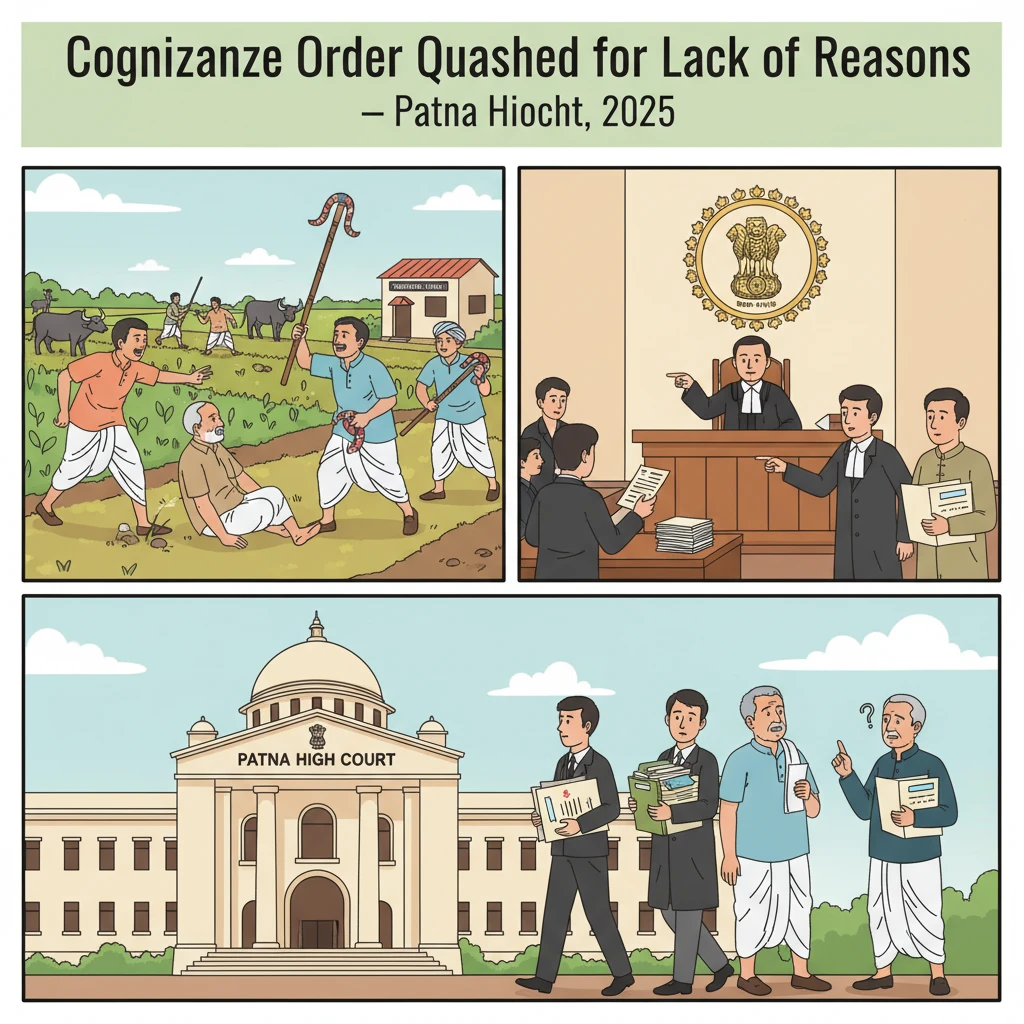
The case started from an incident on 01.07.2023 in a village under Noorsarai Police Station, District Nalanda. The informant and his father were working in their agricultural field. Four accused persons, including the present appellant, were grazing their buffaloes nearby.
According to the written report of the informant, the buffaloes of the accused entered the informant’s agricultural field. When the informant’s father tried to stop the buffaloes from entering the field, all the accused allegedly started abusing the informant by using his caste name. When this was protested, co‑accused Daroga Mahto allegedly assaulted the informant’s father on the head with a “khanti” attached to a lathi, causing injury.
It was further alleged that thereafter all the accused persons assaulted the informant’s father with lathis, due to which he became unconscious and fell down. On the alarm raised, nearby villagers gathered, and the accused persons allegedly fled.
On the basis of the written statement, Noorsarai P.S. Case No. 301 of 2023 was registered under Sections 341, 323, 307, 504, 506/34 of the Indian Penal Code (IPC) and Sections 3(1)(r)(s), 3(2)(v)(a) of the Scheduled Castes and Scheduled Tribes (Prevention of Atrocities) Act. Later, Section 302 IPC was added, indicating that the informant’s father had died and the case was now treated as one of murder.
After investigation, the Investigating Officer submitted a charge sheet against co‑accused Daroga Mahto @ Manoj Mahto. In the supplementary charge sheet No. 194 of 2024, some accused were sent up for trial, but the appellant and co‑accused Lakshman Mahto were not sent up. In effect, the Investigating Officer gave them a clean chit and did not include their names in the column of accused to be prosecuted.
Despite this, by order dated 24.02.2025, the learned Additional Sessions Judge‑VI‑cum‑Special Judge, SC/ST Court, Nalanda at Biharsharif, in Special SC/ST Case No. 136 of 2023, took cognizance under Sections 341, 323, 302, 504, 506/34 IPC and Sections 3(1)(r)(s), 3(2)(v) of the SC/ST Act against all the accused persons, including the appellant and co‑accused Lakshman Mahto. Summons were issued to them as well.
Feeling aggrieved, the appellant filed Criminal Appeal (SJ) No. 1222 of 2025 before the Patna High Court challenging the cognizance order dated 24.02.2025 in so far as it related to him.
What the Court Examined and Decided
The appeal came up before Hon’ble Mr. Justice Alok Kumar Pandey of the Patna High Court. The Court heard the learned counsel for the appellant, the learned Special Public Prosecutor for the State, and learned counsel for the informant (Respondent No. 2).
Counsel for the appellant first pointed out that the alleged incident occurred on 01.07.2023, but the FIR was lodged on 05.07.2023, after about four days. According to him, the reason for this delay was not explained in the materials placed before the Court. He also submitted that there was no specific allegation of overt act against the appellant in the prosecution story.
The main legal challenge raised by the appellant, however, related to the way in which the trial court took cognizance. Counsel submitted that the supplementary charge sheet No. 194 of 2024 had been filed against some accused persons but the appellant and co‑accused Lakshman Mahto were not sent up for trial. In such a situation, the trial court was certainly competent to differ from the police report and take cognizance against them as well, but it had to assign reasons for doing so.
Here, according to the appellant, the trial court simply took cognizance against him and issued summons without giving any reason for disagreeing with the Investigating Officer’s opinion. This, it was argued, made the order illegal.
To support this argument, the appellant relied upon the decision of the Patna High Court in S.M. Mahtab Ahmed vs. State of Bihar, reported in 2016 (4) PLJR 508. In paragraphs 8 and 9 of that decision, which were quoted in the present judgment, the earlier bench had clearly held that when an investigating agency, after thorough investigation, submits a final report exonerating an accused person, that report cannot be treated as waste paper.
In S.M. Mahtab Ahmed, the Court explained that although a Magistrate is legally competent to differ from the police report and take cognizance even against a person not sent up for trial, the Magistrate must assign succinct reasons for differing with the police report. If no reasons are given, the order of cognizance is liable to be set aside.
On the other side, counsel for the State and for the informant argued that the FIR clearly alleged that the appellant, along with the other accused persons, had assaulted the informant’s father, causing him to become unconscious and fall down. They also emphasised that all the accused persons were alleged to have abused the informant by calling him by his caste name, which brought the case under the SC/ST Act.
They submitted that the learned trial court, while passing the order of cognizance, had recorded a finding that from the perusal of the FIR, charge sheet and case diary, a prima facie case was made out against the accused persons, including the appellant, who were FIR‑named accused. According to them, the trial court had applied its judicial mind and found sufficient material to proceed against the appellant, co‑accused Lakshman Mahto and co‑accused Daroga Mahto @ Manoj Mahto under Sections 341, 323, 302, 504, 506/34 IPC and Sections 3(1)(r)(s), 3(2)(v) of the SC/ST Act. Therefore, they argued, there was no need for the High Court to interfere.
After hearing both sides and examining the record, the Patna High Court noted that the Investigating Officer, after due inquiry, had given a clean chit to the appellant and to co‑accused Lakshman Mahto. The charge sheet had been submitted only against co‑accused Daroga Mahto @ Manoj Mahto.
The High Court observed that the trial court had taken cognizance against all the accused persons, including the appellant. However, the trial court did not differentiate between the accused who had been charge‑sheeted and those against whom the Investigating Officer had given a clean chit.
Justice Pandey held that the appellant’s contention was “quite tenable and sustainable”. The law, as recognised in S.M. Mahtab Ahmed, requires that when a court differs from the opinion of the Investigating Officer, particularly in respect of persons not sent up for trial, the court must assign “succinct reason” explaining why it is taking a different view.
In the impugned cognizance order dated 24.02.2025, the trial court had not given any specific reason for disagreeing with the Investigating Officer’s decision to exonerate the appellant and co‑accused Lakshman Mahto. The High Court found that the relevant portion of the order was a non‑speaking order. While the trial court had mentioned that a prima facie case was made out from the FIR, charge sheet and case diary, it had not specifically discussed why, despite the clean chit, cognizance was being taken against the appellant.
The High Court described the impugned order as “nothing but nullity” because of this lack of reasoning. It held that the order was not sustainable in law.
Consequently, in paragraph 9 of the judgment, the Patna High Court quashed the cognizance order dated 24.02.2025. The matter was remanded to the concerned trial court to pass an appropriate order against those who had not been sent up for trial, this time after properly applying its mind and recording reasons if it chose to differ from the Investigating Officer.
Importantly, in paragraph 11, the High Court clarified that its order would have no effect in respect of accused Daroga Mahto @ Manoj Mahto, against whom the charge sheet had already been submitted. Thus, the prosecution against the charge‑sheeted accused would continue as before.
With these directions, the criminal appeal filed by the appellant was disposed of.
Why This Judgment Matters
This judgment from the Patna High Court is important for anyone facing criminal proceedings, especially in serious cases involving Sections 302 IPC and the SC/ST Act.
The decision makes it clear that when the police investigation ends in a clean chit for a person, a court cannot silently ignore that and still summon the person as an accused. The court may disagree with the police, but it must clearly explain why.
For accused persons, this ruling reinforces that they can challenge a cognizance order if the trial court has added them as accused without giving reasons, particularly when the Investigating Officer has not sent them up for trial.
For trial courts, the judgment is a reminder that they must pass speaking and reasoned orders while differing from a police report. Simply noting that a “prima facie” case exists is not enough when some persons have been given a clean chit.
For complainants and victims, the ruling does not stop courts from proceeding against non‑sent‑up accused. It only insists that the court must show, on the record, why it believes they should face trial despite the police view.
Legal Issues and Answers
- Issue: Can a trial court validly take cognizance and summon an accused who has been given a clean chit by the Investigating Officer, without assigning specific reasons for differing from the police report?
Answer: No. The Patna High Court held that while the trial court can differ from the police report, it must assign succinct reasons for doing so. In the absence of such reasons, the cognizance order is a non‑speaking order and is liable to be quashed. - Issue: What is the effect of quashing such a cognizance order on the prosecution against charge‑sheeted accused?
Answer: The High Court clarified that quashing the cognizance order for non‑sent‑up accused does not affect the proceedings against the accused who have been charge‑sheeted. The case continues against them.
Cases Cited by the Court
- S.M. Mahtab Ahmed vs. State of Bihar, 2016 (4) PLJR 508 — relied upon to hold that when a Magistrate differs from a final report exonerating an accused, the Magistrate must assign succinct reasons; otherwise the cognizance order is liable to be set aside.
Case Details
Case Number: Criminal Appeal (SJ) No. 1222 of 2025, arising out of Noorsarai P.S. Case No. 301 of 2023; Special SC/ST Case No. 136 of 2023.
Case Title: Pappu Mahto @ Ajit Prabhakar vs. The State of Bihar & Anr.
Coram: Hon’ble Mr. Justice Alok Kumar Pandey.
Date of Judgment: 24.11.2025.
Citation: 2026 (1) PLJR 54.
Advocates: Md Fazle Karim, Advocate for the appellant; Mrs. Usha Kumari 1, Special Public Prosecutor for the State; Mr. Ashutosh Singh, Advocate for the informant.
Nature of the Case: Criminal appeal (single judge) challenging an order of cognizance passed by the Special Judge, SC/ST Court, in a case under Sections 341, 323, 302, 504, 506/34 IPC and Sections 3(1)(r)(s), 3(2)(v) of the SC/ST Act.
Link to Judgment:file:///C:/Users/Adity/OneDrive/Documents/Vaktrita%20Final/case%201289.pdf
If you found this explanation helpful and wish to stay informed about
how legal developments may affect your rights in Bihar,
you may consider following Samvida Law Associates for more updates.







