
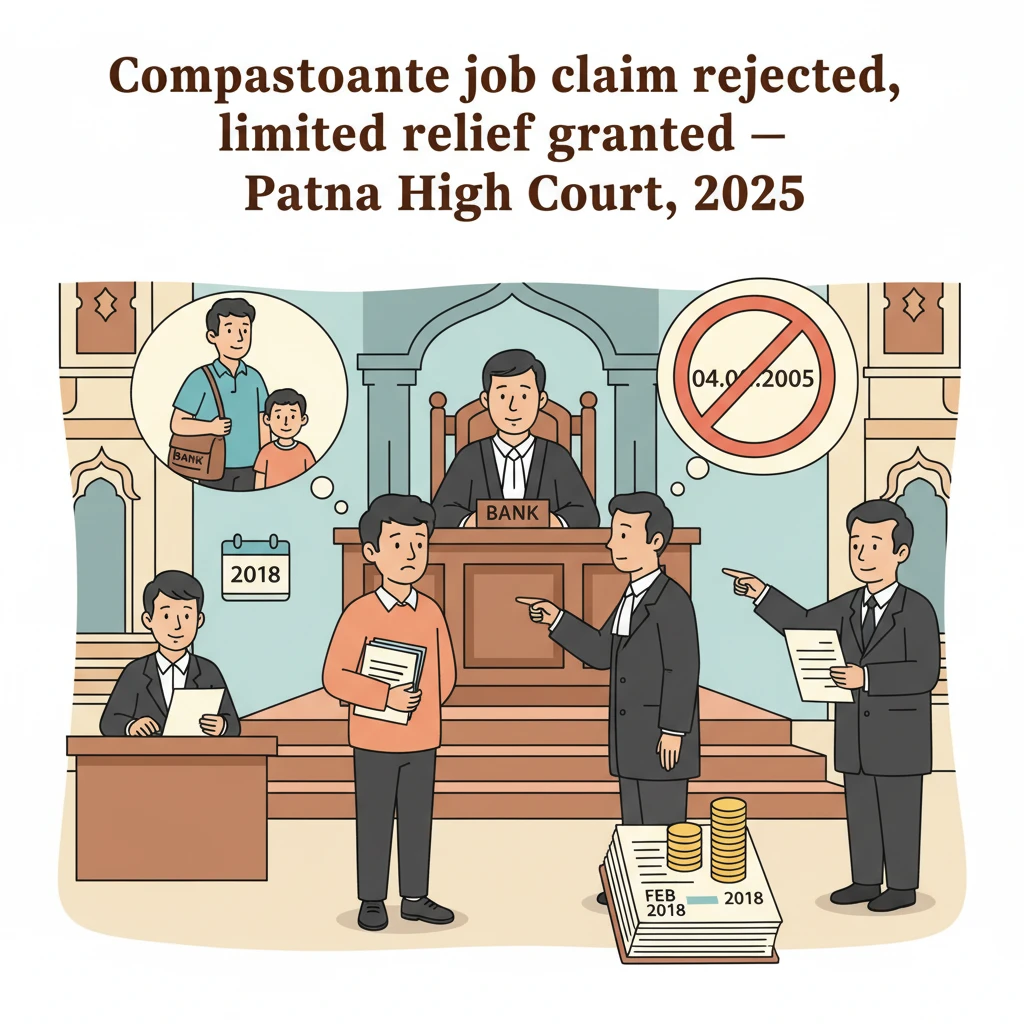
Case Background
The petitioner is the son of a messenger (sandesh wahak) who was working in the Anisabad Branch of State Bank of India in Patna. The petitioner’s father died in harness on 12.05.2003 while still in service. The petitioner’s mother had already predeceased his father.
At the time of his father’s death, the petitioner was a minor, about nine years old. According to the judgment, the petitioner attained majority on 06.08.2011. After becoming a major, he applied for appointment in the bank on compassionate ground on 14.08.2012.
When he did not receive any reply or relief, he kept sending further representations. The judgment notes that the last such representation was on 26.06.2018. There was still no positive response from the bank.
During this time, the petitioner was also receiving family pension from the bank under its scheme. This pension, as per the petitioner, was being paid to him up to January 2018 and was to continue until he reached the age of 25 years. He claimed that no family pension was paid for the period from February 2018 to July 2018.
Finding no solution from the bank, the petitioner approached the Patna High Court in Civil Writ Jurisdiction Case No. 20818 of 2018. He sought directions for compassionate appointment as messenger, payment of ex-gratia in lieu of such appointment, restart of family pension, payment of arrears, and all other consequential reliefs.
What the Court Examined and Decided
Justice Partha Sarthy heard the matter. The Court first recorded the main reliefs sought: compassionate appointment on the post of messenger, ex-gratia payment due to death of the employee, and release of family pension including arrears.
On compassionate appointment, the petitioner argued that at the time of his father’s death in 2003, State Bank of India had a valid scheme for compassionate appointments. Since his father died while in service, and there was a scheme in force then, his claim should be examined under that scheme irrespective of later changes.
The petitioner’s counsel pointed out that the bank had, after some time, withdrawn the compassionate appointment scheme with effect from 04.08.2005. Later, by a circular dated 13.05.2011, the bank introduced a new compassionate appointment scheme for exceptional cases. But the 2011 scheme itself clearly stated that it would not apply to cases where the employee had died before 04.08.2005. The petitioner therefore maintained that his case should be judged under the scheme which existed in 2003, when his father died.
The bank, on the other hand, opposed the writ. Its counsel pointed out that the petitioner had made his first application for compassionate appointment only in 2012, almost nine years after his father’s death. The bank had rejected his claim in 2018, stating that the compassionate appointment scheme had been discontinued from 04.08.2005. The bank argued before the Court that, apart from this withdrawal of the scheme, the claim should also be rejected because of gross delay and laches.
The bank further submitted that for ex-gratia payment in lieu of compassionate appointment, the petitioner had been required to furnish certain certificates and documents. A letter dated 15.12.2018 was sent to the petitioner asking him to provide those papers. Since the required documents were not supplied, the bank stated that his ex-gratia claim could not be processed.
Regarding family pension, the bank’s counsel referred to its counter affidavit and stated that the petitioner had been asked, by letter dated 08.01.2019 (Annexure R/3), to submit a life certificate. The bank maintained that on submission of the life certificate, arrears of family pension for the period from February 2018 to July 2018 would be paid.
The Court considered the factual timeline carefully. It noted that the petitioner’s father died on 12.05.2003, when the petitioner was a minor of about nine years. The petitioner attained majority on 06.08.2011. His first application for compassionate appointment was submitted on 14.08.2012, and another application was made in 2018.
The Court also recorded that the bank had discontinued the earlier compassionate appointment scheme with effect from 04.08.2005. The rejection of the petitioner’s application in 2018 was based on this discontinuation.
To decide whether such a late claim for compassionate appointment could be entertained, the Court relied on the Supreme Court’s decision in Umesh Kumar Nagpal v. State of Haryana and Others, (1994) 4 SCC 138. The judgment reproduced an important extract from that decision.
The Supreme Court, in that case, had explained that government jobs are normally to be filled through open advertisement and merit-based selection. Compassionate appointments are an exception to this rule. This exception is allowed only to help the family of a deceased employee to overcome a sudden financial crisis caused by the death of the sole breadwinner.
It emphasised that:
- Compassionate employment is not a right available to every family of a deceased employee.
- The authority must examine whether the family is actually left in financial distress.
- Compassionate job is intended only to help the family “tide over the sudden crisis” and not to give a permanent benefit many years later.
- Such jobs are restricted to lower-level posts, just to give some immediate support.
Taking guidance from this, the Patna High Court observed that in the present case, the father died in 2003, but the first application for compassionate appointment was filed more than nine years later, in 2012. By that time, the family had already managed to survive the immediate crisis for a considerable period.
The Court also noted that the writ petition itself was filed in 2018, after further lapse of time. In this background, the Court held that the core purpose of compassionate appointment — to provide immediate relief from sudden financial hardship — was not made out.
Therefore, in the opinion of the Court, the petitioner had not been able to establish any valid claim for compassionate appointment. The request for a direction to the bank to appoint him on compassionate grounds was found fit to be rejected.
On the issue of ex-gratia lump sum amount, the Court took a different approach. It acknowledged that the petitioner had received the bank’s letter dated 15.12.2018, during the pendency of this writ petition. In that letter, the bank had asked him to supply certain documents and certificates so that his ex-gratia claim could be processed.
Since this communication was sent while the case was already before the Court, Justice Partha Sarthy issued a direction instead of rejecting this part of the claim. The petitioner was directed to furnish all the required documents to the bank within six weeks.
The Court further directed that, once the documents are submitted, the bank must decide the petitioner’s application for ex-gratia payment within three months. If any amount is found payable, it must be released to the petitioner within that same three-month period. If, on examination, the bank finds that no ex-gratia is payable, it must pass a reasoned order and communicate it to the petitioner within that period.
On the question of unpaid family pension for the period from February 2018 to July 2018, the Court provided clear relief. It noted that the petitioner had been pursuing this writ application, and in this background, directed that the arrears of family pension for that period shall be paid to him within three months from the date he produces or the bank receives a copy of the Court’s order.
Importantly, the Court clarified that for this limited period of arrears (February 2018 to July 2018), the bank cannot insist on a life certificate as a pre-condition. In other words, payment for those months must be made without requiring the petitioner to submit a life certificate for that period.
With these findings and directions, the writ application was disposed of. The compassionate appointment claim was rejected, but directions were issued regarding ex-gratia processing and payment of family pension arrears.
Why This Judgment Matters
This judgment is significant for families of deceased bank employees and other government or public sector workers in Bihar and elsewhere. It reinforces that compassionate appointment is not a delayed guarantee of employment, but only an emergency support to help a family immediately after the earning member’s death.
If an application is made many years later, after the family has already managed to survive the crisis, courts are unlikely to interfere. The Patna High Court clearly applied the principle that compassionate jobs cannot be treated as a form of succession to public posts.
At the same time, the judgment shows that courts will ensure that dependants are not denied other benefits like ex-gratia compensation or family pension merely on procedural grounds, especially when the claimant is actively pursuing the matter. Here, the Court safeguarded the petitioner’s right to have his ex-gratia request considered and directed prompt payment of unpaid family pension.
For laypersons, the message is that applications for compassionate appointment should be made as early as possible after the death, and all required documents should be submitted promptly. However, even if a compassionate job is not granted, dependants may still have enforceable rights to ex-gratia and pension benefits, which courts are willing to protect.
Legal Issues and Answers
-
Issue: Whether the petitioner, who applied for compassionate appointment more than nine years after his father’s death in 2003, was entitled to a direction to be appointed in State Bank of India.
Answer: No. The Court held that compassionate appointment is meant only to help a family tide over the immediate financial crisis on the death of the breadwinner. The long delay and the time already passed since the death showed that the purpose of such appointment was not satisfied. -
Issue: How should the petitioner’s application for ex-gratia lump sum payment in lieu of compassionate appointment be dealt with by the bank.
Answer: The Court directed the petitioner to submit the documents sought by the bank within six weeks, and ordered the bank to decide the ex-gratia application within three months thereafter, either paying any amount found due or communicating a reasoned rejection. -
Issue: Whether the petitioner was entitled to arrears of family pension from February 2018 to July 2018 and whether a life certificate could be insisted upon for that period.
Answer: Yes. The Court ordered that arrears of family pension for that period be paid within three months from receipt or production of the order, and held that no life certificate would be required for payment of those specific arrears.
Cases Cited by the Court
- Umesh Kumar Nagpal v. State of Haryana and Others, (1994) 4 SCC 138 – relied upon to explain the purpose and limits of compassionate appointment.
Case Details
Case Number: Civil Writ Jurisdiction Case No. 20818 of 2018
Case Title: Rahul Kumar Singh v. State Bank of India & Ors.
Court: High Court of Judicature at Patna
Coram: Hon’ble Mr. Justice Partha Sarthy
Date of Judgment: 13.11.2025
Citation: 2026(1) PLJR 07
Advocates for Petitioner: Mr. Krishna Chandra, Advocate; Mrs. Prakritita Sharma, Advocate; Mr. Sriram Krishna, Advocate
Advocates for Respondents (State Bank of India): Mr. Anjani Kumar Mishra, Advocate; Mr. Ambarish Bhardwaj, Advocate; Mr. Sanjeev Kumar, Advocate; Mr. Kaushlendra Kumar Sinha, Advocate
Nature of the Case: Writ petition seeking compassionate appointment, ex-gratia payment, and family pension benefits.
Link to Judgment: Click here to read the full judgment of the Patna High Court
If you found this explanation helpful and wish to stay informed about
how legal developments may affect your rights in Bihar,
you may consider following Samvida Law Associates for more updates.







