
Case Background
The petitioner applied for appointment as a School Teacher for Class I to V under Advertisement No. 26 of 2023. The recruitment was conducted through the Bihar Public Service Commission for different categories, including Extremely Backward Class (Female), in which the petitioner applied.
For this post, candidates were required to have certain minimum educational and teacher training qualifications. The advertisement allowed eligibility, among others, for candidates having Graduation with Diploma in Elementary Education, or Graduation with at least 50% marks along with a B.Ed degree.
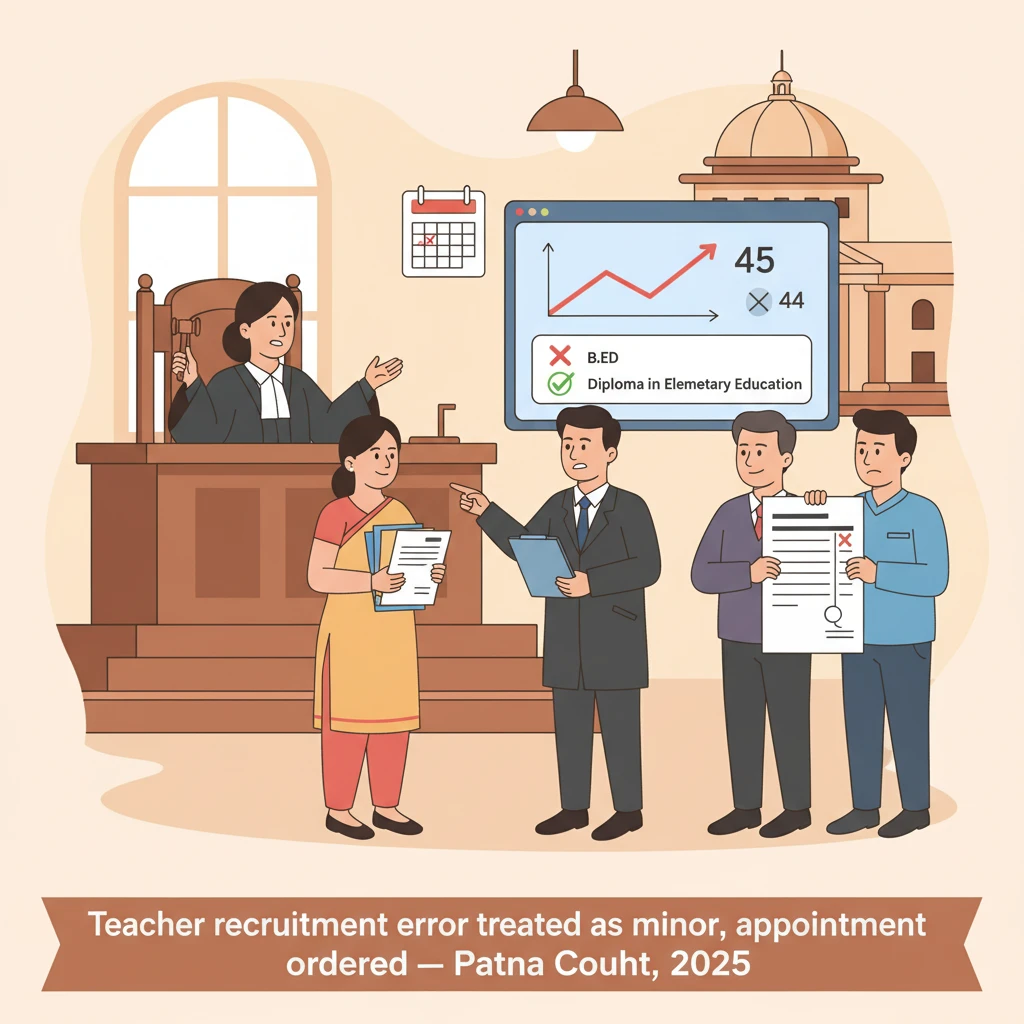
While filling the online application form for the Teachers Recruitment Examination 1 (TRE-1), the petitioner committed a mistake in one of the columns. In the column where the candidate had to choose one training qualification from options such as B.Ed, B.Ed-M.Ed, D.El.Ed, B.A.D, B.Sc.Ed or two-year Diploma in Elementary Education, she selected B.Ed. However, on the next page of the same online application, she clearly mentioned that she held a Diploma in Elementary Education (D.El.Ed) and uploaded both the D.El.Ed pass certificate and mark sheet issued by the Bihar School Examination Board.
The Commission accepted her application, issued her admit card with Roll No. 621894 and registration number, and permitted her to appear in the qualifying language paper and General Studies paper. The cut-off marks for the Extremely Backward Class (Female) category in General Studies were fixed at 44. As per the published result, the petitioner secured 45 marks in General Studies and 46 marks in the qualifying paper.
Despite having marks above the cut-off and having uploaded the correct qualification documents, the petitioner’s name did not appear in the list of successful candidates who were provisionally allotted districts. She then approached the Patna High Court in a writ petition seeking direction to treat her as a D.El.Ed candidate and to prepare a revised merit position for her under the EBC (Female) category.
What the Court Examined and Decided
The core dispute before the Patna High Court was whether the petitioner’s inadvertent selection of “B.Ed” in one column of the online form, despite otherwise disclosing and proving her D.El.Ed qualification, could justify exclusion from appointment, even though she had cleared the cut-off marks.
The petitioner’s counsel argued that the mistake was clearly inadvertent and trivial. He pointed out that in another part of the same online form the petitioner had correctly stated that she was a D.El.Ed holder. She had also uploaded the D.El.Ed certificate and mark sheet, which left no doubt regarding her actual qualification.
It was further contended that, under Clause 4(A) of Advertisement No. 26 of 2023, both categories of candidates—those with Graduation plus D.El.Ed and those with 50% Graduation plus B.Ed—were eligible to apply for the post of Teacher for Class I to V. Therefore, even if one treated her as a B.Ed candidate, she was still eligible on the face of the advertisement. The petitioner also filed applications with affidavits seeking rectification of the mistake, but these were not acted upon.
Heavy reliance was placed on the Supreme Court decision in Vashist Narayan Kumar v. State of Bihar & Ors., 2024 LiveLaw (SC) 1. In that case, the Supreme Court held that a trivial error in an application, which played no role in the selection process, should not be treated as a ground to deny a candidate the benefit of his merit, and that the State should not “make a mountain out of a molehill.” The petitioner argued that her case fell squarely within this principle, as her mistake had no impact on her performance or eligibility and she had already crossed the cut-off.
On the other hand, counsel for the Bihar Public Service Commission contended that the Commission could not be blamed for the petitioner’s mistake. The Commission argued that candidates had been repeatedly given opportunities to correct errors in their forms through public notices and a grievance portal, but the petitioner did not avail such opportunities. It was submitted that the recruitment processes for TRE-1 to TRE-3 had already been completed, and appointments had been made, so any intervention at this stage might disturb the finality of the process.
Referring to Clause 7(Kha) and Clause 11 of the advertisement, the Commission emphasized that the examination was to be conducted on the basis of information filled by candidates in their online forms. The Commission was to assume those details as true and prepare the merit list, while the appointing department would verify documents later. The Commission asserted that the Supreme Court judgment cited by the petitioner related to correction of date of birth and, according to them, was not applicable in the present case.
The State’s counsel supported the Commission’s stand. Referring to Clause 11, he argued that if the petitioner realised any mistake, she could have cancelled her earlier application and filed a new one within the permitted editing window. After payment of fees, the form could not be edited. According to the State, no correction could be allowed at such a late stage, as the terms of the advertisement had to be strictly followed.
The Court first noted the general legal position that strict adherence to the terms of an advertisement and eligibility criteria is important. It cited decisions of the Supreme Court in Tamil Nadu & Ors. v. G. Hemalathaa & Anr., (2020) 19 SCC 430 and State of Gujarat & Ors. v. Arvind Kumar T. T. Tiwary, (2012) 9 SCC 545, which make it clear that a candidate lacking basic eligibility cannot be appointed and that such deficiency cannot be cured later.
However, the Court then referred to T. Jaikumar v. A. Gopu & Anr., (2008) 9 SCC 403, where the Supreme Court held that allowing a candidate to participate in a selection process does not prevent the authority from later holding him ineligible if a defect is noticed. At the same time, the court or tribunal can examine whether the exclusion is based on a reasonable or arbitrary ground; if the reason is unreasonable or arbitrary, intervention is justified, and principles such as estoppel do not shield arbitrary actions.
Applying these principles, the Patna High Court turned to the specific facts and the wording of the advertisement. Clause 4 prescribed educational and training qualifications for Class I–V teachers and clearly recognized both D.El.Ed and B.Ed pathways as valid. The Court carefully examined the petitioner’s online form (Annexure P/5 series) and noted that all qualifications were placed in a single line, requiring candidates to choose one. The petitioner chose an option covering all training qualifications including B.Ed. But in the second column she had specifically declared that she had Graduation with 50% marks and B.Ed and, at the same time, also disclosed her Diploma in Elementary Education.
The Court was conscious that, under Clause 11, editing of the application was permitted only until payment of fees, and that the Commission relied on the declarations in the form. Yet the Court noted that it was not the Commission’s case that the petitioner failed to secure the cut-off marks for EBC (Female). Her marks were above the cut-off, and her documentary proof of D.El.Ed qualification was on record from the beginning.
To address the nature of such errors in online forms, the Court considered a closely similar case decided by the Delhi High Court in Kendriya Vidyalaya Sangathan v. Geetanjali Yadav, 2025 SCC Online Del 6420. There, a candidate for the post of Primary Teacher under OBC category had mistakenly selected “Graduation + B.Ed” instead of D.El.Ed/JBT/BTC in the online form because only two options were available, while she otherwise entered her D.El.Ed marks correctly. Despite scoring above the cut-off, she was not shortlisted. The Central Administrative Tribunal allowed her claim, and the Delhi High Court upheld that decision, relying on the principle that a minor technical entry in software design cannot override substantive eligibility and that such an error did not amount to misrepresentation.
The Patna High Court also revisited the principle laid down by the Supreme Court in Dolly Chhanda v. Chairman, JEE, (2005) 9 SCC 779, that every small breach of rules relating to submission of proof should not automatically result in rejection of candidature. The Court invoked the legal maxim “de minimis non curat lex” – the law does not concern itself with trifles – to underline that trivial mistakes should not defeat substantive justice.
Reinforcing this approach, the Court quoted paragraph 19 of the Supreme Court’s judgment in Vashist Narayan Kumar. There, the Supreme Court observed that a trivial error in the application form, which played no part in the selection process, should not lead to rejection of a deserving candidate. The Court also recognised ground realities like digital divide and the stressful conditions of applying from cybercafes, which can cause such mistakes.
After reviewing the entire record, the Patna High Court held that there was no suppression or misrepresentation by the petitioner. She had categorically disclosed her Diploma in Elementary Education and uploaded the relevant certificate and mark sheet. The mistaken selection of B.Ed in one column was held to be an inadvertent and trivial error. Since she had secured the cut-off marks and possessed the required eligibility, she could not be penalised for this minor mistake.
The Court further cited Collector, Land Acquisition, Anantnag v. Mst. Katiji, AIR 1987 SC 1353, where the Supreme Court emphasised that the judiciary is respected not for its power to legalise injustice on technical grounds, but for its ability to remove injustice. Guided by this, the Patna High Court chose a justice-oriented view over a rigid technical approach.
In conclusion, the Court found merit in the writ petition and allowed it. It directed the respondents to treat the petitioner’s educational qualification as Diploma in Elementary Education for the purpose of appointment to the post of School Teacher for Class I–V under the EBC (Female) category, on the basis of marks obtained by her in B.P.S.C. Teachers Recruitment Examination 1.
The Court clarified that if no post under Advertisement No. 26 of 2023 was available and such posts had been carried forward to another advertisement, the petitioner’s appointment should be adjusted against existing vacancies without disturbing the earlier merit list of selected candidates. For seniority and other benefits, she was to be treated as the last candidate under the EBC (Female) category for Advertisement No. 26 of 2023, except that she would not receive any actual financial benefit retrospectively.
Why This Judgment Matters
This judgment is significant for thousands of candidates who apply online for government jobs and fear losing opportunities due to small technical mistakes. The Patna High Court has made it clear that where a candidate is otherwise fully eligible, has produced correct documents, and has scored above the cut-off, a minor error in one part of the online form should not automatically destroy her prospects.
The decision also balances fairness with administrative convenience. While recruitment authorities must follow the terms of advertisements and cannot relax basic eligibility, they are reminded that they cannot hide behind technicalities when the mistake is trivial and does not affect the selection process.
For teacher recruitment in Bihar, especially under the Bihar Public Service Commission’s Teachers Recruitment Examinations, this case shows that courts are willing to protect meritorious candidates from being unjustly excluded on minor technical grounds, while still preserving the integrity of the final merit list and appointments already made.
Legal Issues and Answers
- Issue: Can a candidate who is otherwise eligible and has cleared the cut-off marks be denied appointment solely because of an inadvertent wrong selection of qualification (B.Ed instead of D.El.Ed) in one column of the online application form, when the correct qualification is clearly disclosed and documented elsewhere in the same form?
Answer: No. The Patna High Court held that such an error is trivial, involves no suppression or misrepresentation, and did not affect the selection process. The petitioner must be treated as a D.El.Ed candidate and considered for appointment on the basis of her marks. - Issue: Should strict adherence to the terms of the advertisement override the candidate’s substantive eligibility and performance in every case, even where the error is minor and technical?
Answer: The Court held that while eligibility rules must generally be strictly applied, courts can and should intervene where exclusion on technical grounds is unreasonable or arbitrary. Minor technical mistakes that do not impact eligibility or merit should not be allowed to cause injustice. - Issue: Can correction or relief be granted after completion of the recruitment process without disturbing the existing select list?
Answer: Yes. The Court directed that the petitioner be appointed against available vacancies, including carried-forward posts, without disturbing the earlier merit list, and that she be placed last in seniority in her category, without retrospective financial benefits.
Cases Cited by the Court
- Tamil Nadu & Ors. v. G. Hemalathaa & Anr., (2020) 19 SCC 430
- State of Gujarat & Ors. v. Arvind Kumar T. T. Tiwary, (2012) 9 SCC 545
- T. Jaikumar v. A. Gopu & Anr., (2008) 9 SCC 403
- Kendriya Vidyalaya Sangathan v. Geetanjali Yadav, 2025 SCC Online Del 6420
- Dolly Chhanda v. Chairman, JEE, (2005) 9 SCC 779
- Vashist Narayan Kumar v. State of Bihar & Ors., 2024 LiveLaw (SC) 1
- Collector, Land Acquisition, Anantnag v. Mst. Katiji, AIR 1987 SC 1353
Case Details
Case Number: Civil Writ Jurisdiction Case No. 7777 of 2024
Case Title: Khusboo Kumari @ Khushboo Kumari v. State of Bihar & Ors.
Citation: 2026 (1) PLJR 45
Court: High Court of Judicature at Patna
Coram: Hon’ble Mr. Justice Harish Kumar
Date of Judgment: 24-11-2025
Advocates for Petitioner: Mr. S.B.K. Mangalam, Advocate; Mr. Avinash Kumar, Advocate; Mr. Vikash Kumar Singh, Advocate; Mr. Kumar Gaurav, Advocate; Mr. Rishi Raj, Advocate
Advocate for State (Respondents): Mr. Prateek Kumar, AC to GA-11
Advocate for Bihar Public Service Commission: Mr. Zaki Haider, Advocate
Nature of Case: Writ petition (Civil) under Article 226 challenging non-consideration of candidature in teacher recruitment due to alleged error in online application form
Link to Judgment: Click here to read the full Patna High Court judgment
If you found this explanation helpful and wish to stay informed about how legal developments may affect your rights in Bihar, you may consider following Samvida Law Associates for more updates.







