
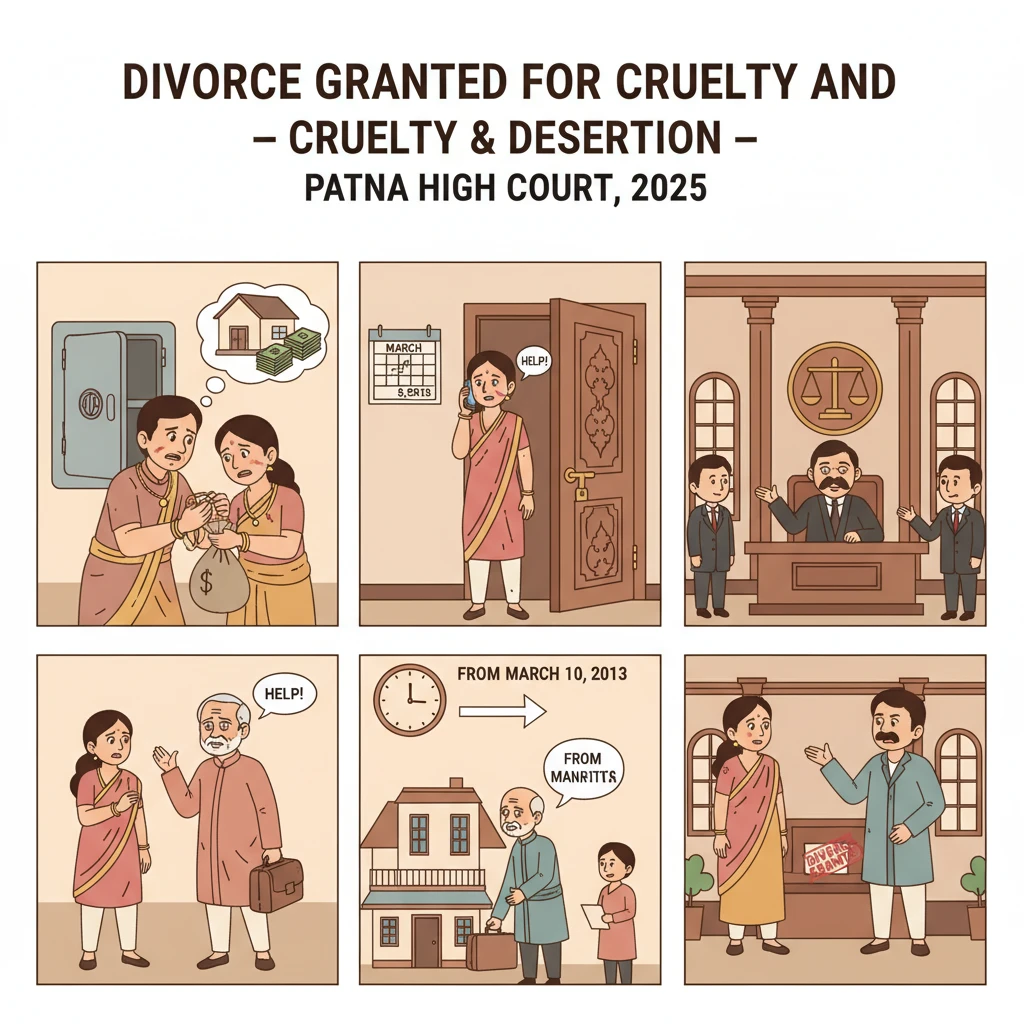
The Patna High Court set aside that order and granted divorce for cruelty and desertion.
The husband did not contest the appeal despite service of notice.
The marriage now stands dissolved, and the wife may separately seek alimony if she wishes.
Case Background
The appeal arose from a matrimonial dispute between a wife (appellant) and her husband (respondent). Their marriage was solemnised on 23.04.2000 at Kolkata according to Hindu rites and customs and was subsequently registered under the Special Marriage Act.
After marriage, the couple lived together as husband and wife, and a girl child was born from the wedlock. At the time of marriage, the wife’s father allegedly spent a substantial amount on articles given with her.
With time, serious disputes surfaced between the couple. The wife alleged consistent cruelty, dowry-related pressure, and physical and mental torture. According to her, on 08.03.2013 she was brutally assaulted and locked in a room. She then called her father, and from 10.03.2013 she began living in her parental home.
The wife filed Matrimonial Case No. 93 of 2014 before the Principal Judge, Family Court, Purnea seeking dissolution of marriage on the grounds of cruelty and desertion. The husband appeared and filed a written statement, denying the allegations and asserting that he never demanded dowry or ill-treated her.
During the trial, the wife produced two witnesses: her father (P.W. 1) and herself (P.W. 2). The husband, despite filing a written statement, did not examine any witness or produce any document in support of his defence.
After trial, the Family Court held that the wife had not proved her case and dismissed the divorce petition by judgment and decree dated 11.09.2018.
Aggrieved by this dismissal, the wife filed Miscellaneous Appeal No. 896 of 2018 before the Patna High Court under Section 19(1) of the Family Courts Act, 1984, challenging the Family Court’s judgment and decree.
On 14.05.2019, the High Court issued notice to the husband. Notices were validly served on multiple occasions, but the husband chose not to appear and contest the appeal. The Court, therefore, heard the matter in the husband’s absence, based on the record and the submissions of the wife’s counsel.
What the Court Examined and Decided
The Division Bench of the Patna High Court, comprising Hon’ble the Acting Chief Justice and Hon’ble Mr. Justice S. B. Pd. Singh (authoring the judgment), examined whether the wife was entitled to a decree of divorce and whether the Family Court’s judgment was sustainable in law.
The Court identified two main points for determination:
(i) Whether the appellant (wife) was entitled to the relief sought in her appeal.
(ii) Whether the judgment of the Principal Judge, Family Court, Purnea in Matrimonial Case No. 93 of 2014 was just, proper, and sustainable in law.
The wife’s case before the Family Court, reiterated in appeal, was that after about a year of marriage the husband’s behaviour changed. She alleged that he developed an eye on her jewellery, took it from her on the pretext of keeping it in a bank locker, gradually misused and sold it, and continuously pressured her to extract money from her father.
She further alleged that as she was the only daughter, her parents kept meeting these demands for some time, but when they could not continue, the husband began torturing and assaulting her for non-fulfilment of these demands.
According to her evidence, the husband did not treat her with the respect due to a wife, contacted her only for sexual pleasure, and repeatedly went to her father’s house to ask for money. She stated that he failed to fulfil his marital obligations, insulted and assaulted her, and made false allegations to malign her image, thereby causing deep mental agony. She claimed the harassment intensified, and on 08.03.2013 she was beaten with an intention to kill and locked in a room. From 10.03.2013, she started residing at her parental home, and the husband completely deserted her.
The husband’s written statement took a contrary stand. He denied all allegations of dowry demand and cruelty. He claimed that the wife’s father had deposited Rs. 25 lakhs in their joint account and later withdrawn Rs. 16 lakhs to purchase a flat. When he raised a concern that such heavy transactions could attract income tax scrutiny, a dispute allegedly arose, and the wife left with jewellery, passbook, cheque book, and ATM card. He also claimed that he was still willing to live with her with dignity.
However, beyond this written statement, the husband did not step into the witness box nor did he produce any supporting evidence. The High Court specifically noted that despite filing a written statement, he did not examine a single witness or produce any document to substantiate his version or to counter the wife’s evidence.
On the other hand, the Court had the testimony of the wife and her father. The wife deposed about the ill-treatment, financial pressures, assault on 08.03.2013, and her permanent return to her parental home on 10.03.2013. She also stated that the husband made no genuine effort to take her back.
The Court noted that although the husband had filed Matrimonial Case No. 6 of 2016 under Section 9 of the Hindu Marriage Act for restitution of conjugal rights, that case was filed two years after the wife’s divorce petition. It was dismissed on 28.02.2022 for default due to his non-appearance. The High Court treated this as an indication that the Section 9 petition was filed with mala fide intent, mainly to frustrate the wife’s divorce claim, and that the husband was not genuinely interested in resuming cohabitation.
On the legal standard of cruelty, the Court referred to the decisions of the Supreme Court in:
(a) Narain Ganesh Dastane v. Sucheta Narain Dastane, AIR 1975 1534, emphasising that cruelty must be assessed from the perspective of its impact on the particular spouse, and that the Court deals with real, not ideal, spouses.
(b) Samar Ghosh v. Jaya Ghosh, (2007) 4 SCC 511, where the Supreme Court listed illustrative instances of mental cruelty, including sustained abusive treatment, long separation, studied neglect, and behaviour that makes it impossible for the spouses to live together.
The Patna High Court underlined that cruelty under matrimonial law is not defined in fixed words in the Hindu Marriage Act, 1955, but is understood to mean conduct creating in the mind of the other spouse a reasonable apprehension that it is harmful or injurious to live with the other party.
Applying these principles, the Court observed that the parties had been living separately for about five years. This long separation had practically broken the matrimonial bond beyond repair. The Court held that there was no realistic chance of the couple living together again and that the marriage had become unworkable. Continuing such a marriage would be a source of misery rather than a protection of the sanctity of marriage.
On cruelty, the Court concluded that the wife had successfully proved her case. The allegations of physical assault, sustained mental torture, financial pressure, and the husband’s conduct, when read with the long period of separation and his failure to contest or show genuine willingness to resume marital life, satisfied the test of cruelty.
On desertion, the Court relied on the wife’s uncontroverted testimony that she was assaulted on 08.03.2013, left the matrimonial home on 10.03.2013, and had been living with her parents since then. The husband made no real attempt to bring her back. Filing and then allowing the Section 9 case to be dismissed for default reinforced the inference that he had put a permanent end to cohabitation.
The Court held that both elements of desertion were present: factum of separation and intention to end cohabitation permanently, for more than the statutory minimum period. The husband’s conduct thus amounted to desertion, giving the wife an additional ground for divorce.
The High Court also noted that before it, the husband ignored validly served notices and multiple opportunities to appear. His continued absence showed he was not interested in pursuing the matter or in the relationship. In such circumstances, the Court deemed it proper to rely on the wife’s evidence.
Ultimately, the Bench found that the Family Court failed to consider the long separation, the evidence of cruelty and desertion, and the legal principles settled by the Supreme Court. The Family Court’s dismissal of the wife’s divorce petition was therefore held to be unsustainable.
The High Court set aside the Family Court’s judgment and decree dated 11.09.2018 in Matrimonial Case No. 93 of 2014. It dissolved the marriage between the appellant-wife and the respondent-husband by a decree of divorce.
The Court clarified that the wife had limited her prayer in this appeal only to dissolution of marriage. It expressly stated that if she wishes to claim permanent alimony, she is at liberty to file an appropriate application before the appropriate forum. The Registry was directed to prepare the decree of divorce accordingly, and the Miscellaneous Appeal No. 896 of 2018 was allowed. Any pending interlocutory applications were disposed of.
Why This Judgment Matters
This judgment is significant for spouses, especially women, who suffer prolonged cruelty and desertion but struggle to prove their case when the other side does not participate properly in the proceedings.
The Patna High Court recognised that long, continuous separation, coupled with evidence of abuse and neglect, can itself show that the marital bond has broken down beyond repair. The Court was willing to grant divorce where the evidence of the complaining spouse was unchallenged and credible, and the other spouse chose not to appear or lead any evidence.
It also shows that merely filing a restitution of conjugal rights case, and then allowing it to be dismissed for default, will not help a spouse who otherwise deserts the other. Courts will look at actual conduct, not just the filing of cases, to judge intention.
For readers in Bihar and beyond, this decision clarifies that one does not have to stay in a marriage that has become a source of cruelty and has effectively ended in practice. It also reassures that higher courts can correct errors where a Family Court overlooks long separation and clear evidence of cruelty and desertion.
Legal Issues and Answers
- Issue: Was the wife entitled to a decree of divorce on the grounds of cruelty and desertion?
Answer: Yes. The Patna High Court held that she had proved cruelty and desertion, and granted a decree of divorce. - Issue: Was the Family Court’s dismissal of the divorce petition legally sustainable?
Answer: No. The High Court found that the Family Court failed to appreciate the evidence, the long separation, and the settled legal principles, and therefore set aside its judgment and decree dated 11.09.2018.
Cases Cited by the Court
- Narain Ganesh Dastane v. Sucheta Narain Dastane, AIR 1975 1534
- Samar Ghosh v. Jaya Ghosh, (2007) 4 SCC 511
Case Details
Case Number: Miscellaneous Appeal No. 896 of 2018
Case Title: Soma Raha @ Soma Aich @ Soma Aice @ Soma Raha Aich v. Partho Sarthi Raha
Coram: Hon’ble the Acting Chief Justice; Hon’ble Mr. Justice S. B. Pd. Singh
Citation: 2025 (4) PLJR 513
Date of Judgment: 18.09.2025
Originating Case: Matrimonial Case No. 93 of 2014, Principal Judge, Family Court, Purnea
Relevant Statutes: Section 19(1) of the Family Courts Act, 1984; Hindu Marriage Act, 1955 (grounds of cruelty and desertion); Section 9 of the Hindu Marriage Act (referred to in relation to the husband’s restitution case); Special Marriage Act (marriage registration mentioned)
Advocates: For the appellant-wife: Mr. Mukesh Kumar Jha, Advocate; Mr. Bhola Prasad, Advocate. For the respondent-husband: None appeared.
Nature of the Case: Miscellaneous Appeal under Section 19(1) of the Family Courts Act against dismissal of a divorce petition (matrimonial case) by the Family Court.
Link to Judgment: file:///C:/Users/Adity/OneDrive/Documents/Vaktrita%20Final/case%201264.pdf
If you found this explanation helpful and wish to stay informed about
how legal developments may affect your rights in Bihar,
you may consider following Samvida Law Associates for more updates.







