
Case Background
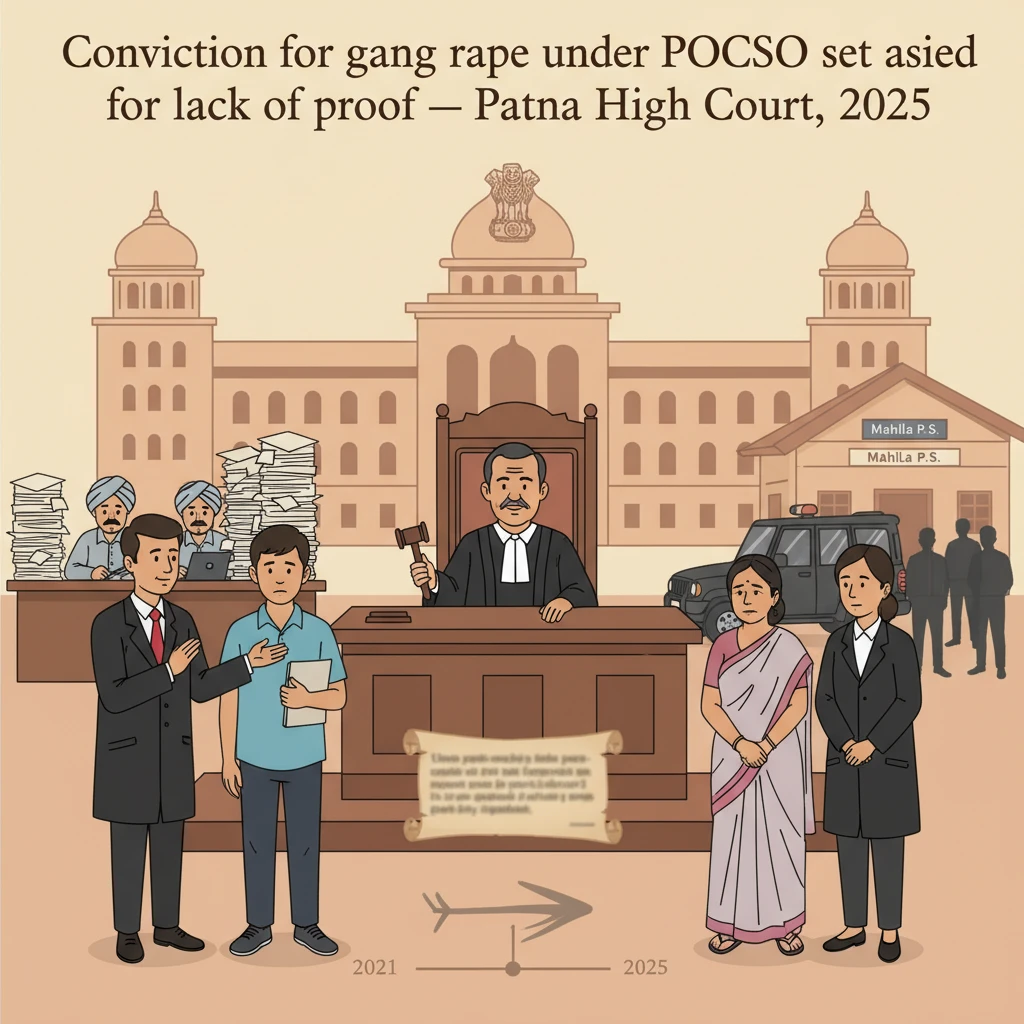
This case arose out of Mahila P.S. Case No. 40 of 2021, registered in the district of Samastipur on 14.06.2021. The written information was given by the mother of the alleged victim (examined as PW-2). She stated that she lived in village Simri, Ward No. 11, under Vidyapati Nagar Police Station, Samastipur.
According to the written information, on 19.05.2021 at about 3:45 a.m., she went to the field near her house to ease herself, along with her mother-in-law (Most Panwati Devi, not examined), her minor daughter referred to as ‘X’ (PW-1, the victim), and another minor daughter ‘Y’ (PW-3). She alleged that four named accused — Raushan Kumar, Gaurav Kumar (the appellant), Rupesh Kumar and Kundan Kumar — were waiting there with a pre-plan.
She stated that the accused pointed a pistol at her and threatened to blow her head if she raised alarm. She alleged that all four accused then forcibly took away her minor daughter in a Scorpio vehicle, kidnapped her with the intention of committing gang rape and for prostitution, and that from 19.05.2021 to 21.05.2021 they repeatedly raped her.
The informant also alleged that due to pressure on the guardians and social pressure, the girl was left or thrown back at home at about 10:00 p.m. on 21.05.2021. She further stated that whenever she went to the police or for treatment, the accused and their guardians and associates armed with weapons threatened to kill her entire family. The written information carried her thumb impression, but nobody identified that thumb impression on the document.
On this written information, Mahila P.S. Case No. 40 of 2021 was registered under Sections 376(DA), 363, 341, 323, 504, 506 and 34 IPC, Sections 8 and 10 of the POCSO Act, and Section 27 of the Arms Act.
After investigation, the police submitted Charge-sheet No. 117/2021 dated 16.11.2021. A supplementary charge-sheet No. 65/2022 dated 31.10.2022 was then filed under Sections 376(DA), 363, 341, 323, 504, 506, 34 IPC and Sections 4 and 6 of the POCSO Act against the appellant, keeping investigation pending against Raushan Kumar.
On 11.11.2022, the trial court took cognizance under Sections 376(DA), 363, 341, 504, 506, 34 IPC and Sections 4 and 6 of the POCSO Act. On 21.11.2022, charges were framed against the appellant under Sections 363, 376(DA), 341, 504, 506/34 IPC and Sections 4 and 6 of the POCSO Act. The appellant pleaded not guilty and claimed trial.
The trial court, by judgment dated 25.01.2024 in T.R. No. 111 of 2024, convicted the appellant under Sections 376D, 363, 341, 504, 506 IPC and Section 6 of the POCSO Act. By order dated 30.01.2024, it sentenced him to rigorous imprisonment for 20 years and a fine of Rs. 50,000/- under Section 6 POCSO, with six months’ further rigorous imprisonment in default.
The appellant then filed Criminal Appeal (DB) No. 246 of 2024 before the Patna High Court challenging the conviction and sentence. The appeal was heard by a Division Bench comprising Hon’ble Mr. Justice Rajeev Ranjan Prasad and Hon’ble Mr. Justice Sourendra Pandey. Respondent No. 2 (the informant mother) did not appear despite service of notice.
What the Court Examined and Decided
The appellant’s counsel argued that the trial court had gravely erred in appreciating the evidence. Several key points were raised: the inordinate delay of 26 days in lodging the FIR with no proper explanation; the failure to prove where the alleged rape took place; and the medical examination report which, according to the defence, completely ruled out sexual assault.
The State, through the Additional Public Prosecutor, supported the conviction. It was argued that the appellant and others raped a minor girl, that the victim (PW-1) and the informant (PW-2) supported the story of the 19.05.2021 occurrence, and that the delay was due to threats given by the accused. It was also argued that the victim was examined only on 15.06.2021, nearly a month later, so absence of injuries would not be decisive.
The High Court carefully re-examined the entire record. It first focused on the delay in lodging the FIR. The Court noted that the victim allegedly returned home at 10:00 p.m. on 21.05.2021, yet the written application to Mahila Police Station was submitted on 14.06.2021, about 26 days after the incident. During trial, PW-2 admitted that the incident was on 19.05.2021 and that kidnapping occurred at 3:45 a.m. that day. She claimed she went to Vidyapati Nagar Police Station, which did not register the case, though she said they received her written report.
PW-2 also stated she did not remember the exact date of lodging the case, and that Mahila Police Station was delaying registration, causing the delay. She further said the case was lodged after about one and a half months of the occurrence and even contradicted herself by saying she had not gone to the local police station (Vidyapati Nagar PS). The Investigating Officer (PW-4) stated in cross-examination that PW-2 had not given any reason for the delay in lodging the FIR. On this basis, the High Court concluded that there was a delay of 26 days and there was no satisfactory explanation, which created serious doubt about the prosecution story.
To support its approach, the Court referred to the Supreme Court decisions in Meharaj Singh (L/Nk.) v. State of U.P. (1994) 5 SCC 188 and Chotkau v. State of U.P. (2023) 6 SCC 742. These judgments explain that unexplained delay in lodging the FIR can lead to embellishment, coloured versions, or exaggerated stories, and that courts look at such delay carefully, though delay by itself is not always fatal. Applying these principles, the High Court treated the unexplained delay as a serious infirmity.
The Court then examined inconsistencies in the victim’s own statements. In the FIR, PW-2 stated that she, her mother-in-law, and both daughters went to ease themselves together. However, in her Section 164 Cr.P.C. statement dated 16.06.2021, PW-1 said she went to the field after being awakened by her sister, and did not mention that her mother and grandmother accompanied them. During trial, PW-1 changed her version and said she had gone with her mother, grandmother, and sister. The High Court found this inconsistency material and held that it created a “dent” in her evidentiary value.
The victim also gave contradictory statements about the dates and duration of the alleged assault. In court, she said the accused took her on 19.05.2021 and dropped her on 20.05.2021, and that her mother informed the police on 21.05.2021. In her Section 164 statement, she had stated that the accused did “wrong” with her on 20.05.2021 and 21.05.2021 and then threw her at her house on the night of 21.05.2021. The Court noted that these contradictions on crucial aspects of the occurrence weakened her testimony.
The High Court also looked at the investigation. The IO (PW-4) admitted that she could not ascertain where the abducted girl was taken. She did not examine any person living around the place of occurrence. All witnesses examined were family members of the informant; no independent witness supported the case. Thus, the place of occurrence where the alleged rape happened between 19.05.2021 and 21.05.2021 remained unproved.
A very important factor for the Court was the medical evidence. The victim (PW-1) had alleged repeated rape by four persons over about three days. However, the doctor (PW-6), Dr. Pratibha Kumari, in her medical report (Exhibit P2/PW-6), recorded that there was no external injury on the whole body or breasts, no external or internal injury over the perineum, the vagina and vulva appeared healthy, and the hymen was old, healed and ruptured. On radiological and physical findings, she assessed the victim’s age between 17–18 years and clearly opined that there was “no sign of sexual assault at the time of examination.”
In cross-examination, PW-6 further stated that she examined the victim’s clothes and found no signs of sperm or any evidence of sexual assault on them. The Court held that this medical evidence completely ruled out the prosecution story of repeated sexual assault by four persons for three days.
The Court next assessed the supporting witnesses. PW-3, the victim’s sister, claimed to be an eye-witness to the abduction and said her sister was taken at gunpoint and later thrown back at 10:00 p.m. on 21.05.2021. She said her sister told her about abduction, rape, and attempted sale. However, she could not say where her sister was treated. She denied the defence suggestion that the victim had a friendship with accused Raushan Kumar and that a Panchayati had taken place when he refused to marry her.
PW-5, the victim’s maternal uncle, was only a hearsay witness. He said the victim was treated by one Dr. R.K. Shah, but no prescription was produced, and the doctor was not examined. The High Court also took note that the grandmother, who was alleged to be present at the time of abduction and would have been a crucial eye-witness, was not examined without any explanation. The Court held that withholding such an important witness without reason allowed an adverse inference against the prosecution.
On the issue of age, the trial court had relied on an age certificate marked as Exhibit P3, said to be issued by the Bihar School Board, and held that the victim’s date of birth was 15.10.2006, making her below 15 on the date of occurrence and rendering consent immaterial. However, the High Court re-examined this. PW-6’s medical assessment placed the victim’s age between 17–18 years. Relying on Rajak Mohammad v. State of H.P. (2018) 9 SCC 248, the Court held that age based on radiological examination is not exact and margin of error must be allowed, and benefit of doubt goes to the accused.
The Court also referred to the Delhi High Court’s judgment in Court on its own Motion v. State of NCT of Delhi, Crl. Ref. 2/2024; 2024 SCC OnLine Delhi 4484, where it was held that for sexual assault cases based on bone age, the upper side of the age range should be taken, with an additional margin of two years. It further referred to the Supreme Court judgment in P. Yuvaprakash v. State, 2023 SCC OnLine SC 846, which discussed Section 94(2) of the Juvenile Justice (Care and Protection of Children) Act, 2015 and the hierarchy of documents for age determination.
In this case, just before conclusion of arguments, the prosecution filed a School Leaving Certificate (SLC) from U.M.S., Balbhadarpur Simri, Vidyapati Nagar, Samastipur, seeking to mark it as Exhibit-3. The trial court marked it as Exhibit-3, but the High Court noted that this certificate was not proved through any witness and was only taken on record when presented. The Court also observed that it was a School Leaving Certificate issued by a Headmaster, not a date of birth certificate from the School or an examination board within the meaning of Section 94(2) of the JJ Act.
The Court held that this SLC could not be accepted as proper documentary proof of age under Section 94(2), especially when the medical age was 17–18 years, and taking into account the permissible two-year margin of error, the upper extremity of age could go up to 20 years. Therefore, the prosecution failed to firmly establish that the victim was a “child” under the POCSO Act.
Putting all this together — unexplained delay, contradictory statements of the victim, absence of independent witnesses, withholding of a key eye-witness, and a medical report ruling out sexual assault — the High Court concluded that the prosecution had not proved its case beyond reasonable doubt. It also held that the trial court had wrongly applied the POCSO Act in the absence of reliable proof of minority.
Accordingly, the High Court set aside the judgment of conviction dated 25.01.2024 and the order of sentence dated 30.01.2024, and acquitted the appellant of all charges by giving him the benefit of doubt. As the appellant was in custody, the Court directed that he be released forthwith, if not wanted in any other case. The appeal was allowed, and the trial court records ordered to be sent back.
Why This Judgment Matters
This judgment is important for both accused persons and complainants in sexual offence cases in Bihar and beyond. The Patna High Court has shown that even in serious allegations like gang rape and POCSO offences, the prosecution must still prove every key fact with reliable evidence. Mere allegations, especially when delayed and inconsistent, will not sustain a conviction.
For families of alleged victims, it underscores the need to report promptly, give consistent statements, and ensure that important witnesses and documents are properly presented and proved in court. For accused persons, it reaffirms that benefit of doubt and the presumption of innocence remain central, and that courts will closely scrutinize delay, contradictions, and medical evidence.
The decision also clarifies that for applying the POCSO Act, the prosecution must strictly follow the legal framework for proving age, as laid down in the Juvenile Justice Act and Supreme Court case law. Unproved certificates or late-produced documents are not enough.
Legal Issues and Answers
- Issue: Whether the prosecution had proved beyond reasonable doubt that the appellant kidnapped and committed gang rape on the victim, attracting Sections 376D, 363, 341, 504, 506 IPC and Section 6 of the POCSO Act.
Answer: No. The Patna High Court held that unexplained delay in FIR, material contradictions in the victim’s statements, absence of independent witnesses, withholding of a key eye-witness, and the medical report ruling out sexual assault together created serious doubt. The appellant was acquitted on benefit of doubt. - Issue: Whether the victim’s age was proved so as to attract the POCSO Act and treat her as a child in law.
Answer: No. The Court found that the age determination based on medical evidence placed her between 17–18 years, with a two-year margin of error taking the upper limit to 20 years. The late-produced School Leaving Certificate was not proved as per Section 94(2) JJ Act. Thus, minority was not firmly established. - Issue: Whether the delay of 26 days in lodging the FIR, without satisfactory explanation, affected the credibility of the prosecution case.
Answer: Yes. Relying on Supreme Court judgments including Meharaj Singh and Chotkau, the Court held that such unexplained delay raised serious doubts about the prosecution narrative and contributed to the finding that the conviction could not be sustained.
Cases Cited by the Court
- Meharaj Singh (L/Nk.) v. State of U.P., (1994) 5 SCC 188
- Chotkau v. State of U.P., (2023) 6 SCC 742
- Jafarudheen v. State of Kerala, (2022) 8 SCC 440 (referred through quotation in Chotkau)
- Rajak Mohammad v. State of H.P., (2018) 9 SCC 248
- Court on its own Motion v. State of NCT of Delhi, Crl. Ref. 2/2024, 2024 SCC OnLine Delhi 4484
- P. Yuvaprakash v. State, 2023 SCC OnLine SC 846
- Rishipal Singh Solanki v. State of Uttar Pradesh, (2021) 12 SCR 502 (referred within P. Yuvaprakash)
- Sanjeev Kumar Gupta v. State of Uttar Pradesh, (2019) 9 SCR 735 (referred within P. Yuvaprakash)
- Abuzar Hossain @ Gulam Hossain v. State of West Bengal, (2012) 9 SCR 224 (referred within P. Yuvaprakash)
Case Details
Case Number: Criminal Appeal (DB) No. 246 of 2024; arising out of Mahila P.S. Case No. 40 of 2021, District Samastipur
Case Title: Gaurav Kumar @ Gaurav Singh v. The State of Bihar & Anr.
Citation: 2025 (4) PLJR 474
Court: High Court of Judicature at Patna
Coram: Hon’ble Mr. Justice Rajeev Ranjan Prasad; Hon’ble Mr. Justice Sourendra Pandey
Date of Judgment: 10.09.2025 (uploaded 25.09.2025)
Advocates:
- For the Appellant: Mr. Bhola Prasad, Advocate; Mr. Ujjwal Kumar, Advocate; Mr. Vijya, Advocate
- For the State/Respondent No. 1: Mr. Binod Bihari Singh, Additional Public Prosecutor
- For Respondent No. 2 (informant): No appearance, despite service
Nature of Case: Criminal appeal (Division Bench) against judgment of conviction and order of sentence passed by the Additional District & Sessions Judge-VI-cum-Special Judge, POCSO Act, Samastipur, in T.R. No. 111 of 2024.
Trial Court Details: Additional District & Sessions Judge-VI-cum-Special Judge, POCSO Act, Samastipur; conviction judgment dated 25.01.2024 and sentence order dated 30.01.2024.
Link to Full Judgment: Click here to read the original judgment on the Patna High Court website
If you found this explanation helpful and wish to stay informed about
how legal developments may affect your rights in Bihar,
you may consider following Samvida Law Associates for more updates.







