
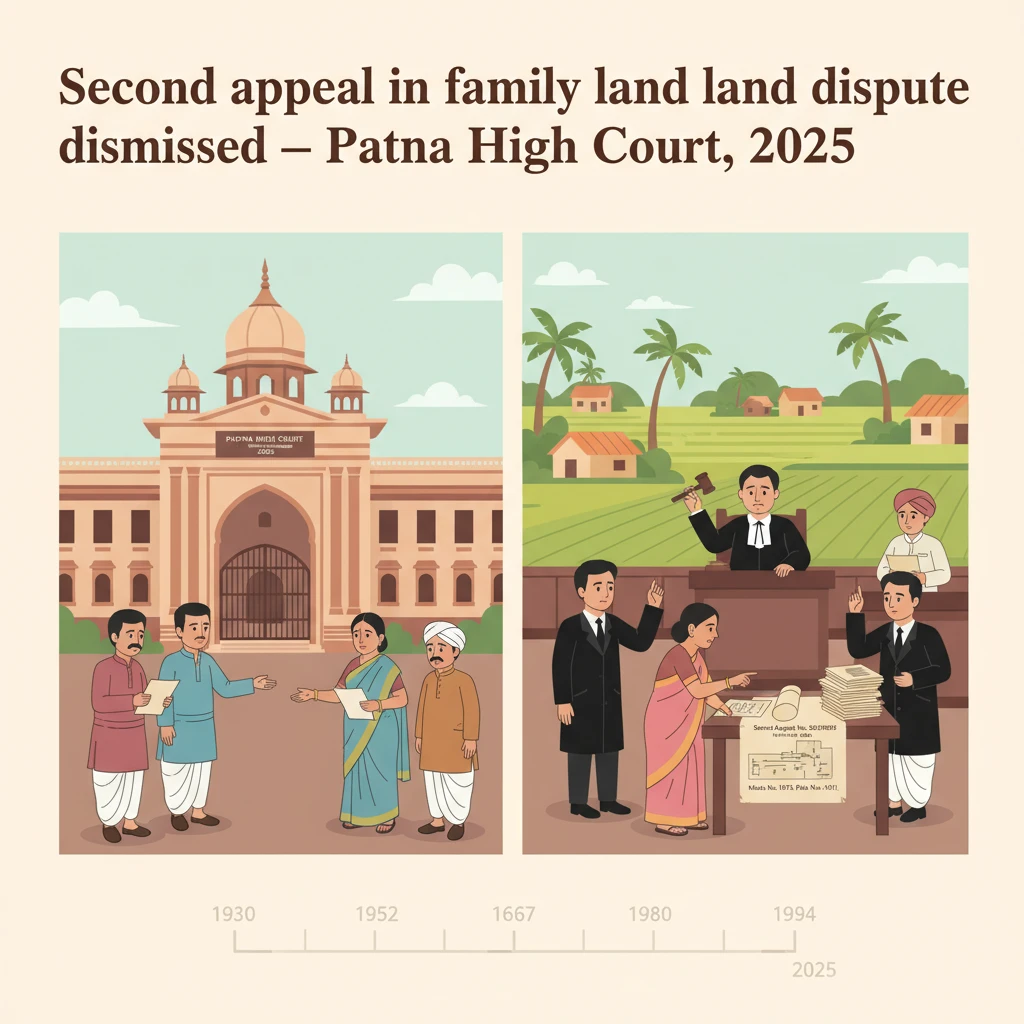
Case Background
This case concerns agricultural land in Village Madhubani, Tola-Dariyapur, Thana No. 176, Anchal Areraj, District East Champaran, recorded under Khata No. 1072, Plot No. 9211 with an area of 5 katha 7 dhur.
The original plaintiff, a woman, filed Title Suit No. 313 of 1994 before the Munsif, Sadar, Motihari. She sought a declaration of her title and confirmation of possession over this land, along with a permanent injunction to stop the defendants from entering or disturbing her possession.
The Trial Court dismissed the suit on 25.09.2012, disbelieving the plaintiff’s claim. The plaintiff then filed Title Appeal No. 62 of 2012 before the Additional District Judge-VI, Motihari, East Champaran.
On 10.06.2015, the first Appellate Court reversed the Trial Court’s judgment and decreed the suit in favour of the plaintiff. The defendants, feeling aggrieved, came to the Patna High Court in Second Appeal No. 283 of 2015.
The second appeal was heard by Hon’ble Mr. Justice Khatim Reza, who delivered a CAV judgment on 26.05.2025.
What the Court Examined and Decided
The dispute arises from a complex family history of landholding within the descendants of one Ismail Khan. He had five sons: Rahmatullahh Khan, Karamtullahh Khan, Md. Taqi Khan, Khurshid Khan and Imam Khan. The land in question originally belonged to this joint family.
According to the plaintiff, the land in Plot No. 9211 was first under the cultivating possession of a bataidar, Sadakat Khan, whose name was recorded as sikmidar in the Khatiyan published on 02.04.1917. During survey operations on 03.02.1916, Karamtullah Khan mortgaged the suit land to Babar Ali Khan for Rs. 34, and this was recorded in the Khatiyan. Later, on 05.12.1918, Karamtullah redeemed the mortgage and took back the land.
After the survey, Sadakat Khan left cultivation, and the land came back into the cultivating possession of the Khatiyani raiyats. Taqi Khan died 3–4 years after the survey, issueless, and his share was partitioned among his four brothers.
The plaintiff’s root of title starts from an alleged oral sale. She claimed that Rahmatullah Khan and Khurshid Khan orally sold 1 bigha of land, including the suit land, to Bibi Kaniza Khatoon, wife of their brother Karamtullah Khan, for Rs. 95. They put her in possession and later executed a deed on stamp paper on 01.07.1930 in proof of this oral sale, showing that the land was already in their separate possession and that both vendors and Kaniza belonged to the same family.
The plaintiff further stated that Kaniza died in 1933, and her husband died one year prior. After her death, her two sons, Mazharuddin Khan and Zafir Khan, came into possession of the suit land and partitioned it, with 2 katha 13½ dhur from the south falling to Zafir’s share.
Subsequently, according to the plaintiff, Mazharuddin executed a Bai Moquasa deed dated 14.11.1952 (Exhibit 4) in favour of his wife, Monazirun, in lieu of dower, transferring 16 katha 2 dhur including 2 katha 14 dhur of Plot No. 9211. Monazirun then possessed this land and later sold 6 katha 13 dhur of Plot No. 9094 to Zamirullah Khan on 08.01.1974, and Zamirullah sold a portion further on 11.10.1983.
As to the suit plot, the plaintiff asserted that Zafir Khan executed a registered sale deed dated 03.03.1967 (Exhibit 7A) in favour of Qasim Khan, and for the remaining share, Monazirun executed another registered sale deed dated 17.03.1967 (Exhibit 7) in Qasim’s favour. With these two deeds, Qasim Khan allegedly came into possession of the entire 5 katha 7 dhur in Plot No. 9211.
On 25.09.1980, Qasim Khan executed a Bai Moquasa deed in favour of his wife, the plaintiff, transferring 5 katha 7 dhur of Plot No. 9211 in lieu of dower. The plaintiff claimed that she has since been in peaceful possession, with Jamabandi No. 1903 created in her name.
The dispute intensified when defendant Nos. 3 and 4 initiated a proceeding under Section 144 Cr.P.C. in Case No. 396/M/1994. In that proceeding, Qasim Khan was first party and Faizuddin Khan was second party, and the S.D.M., Areraj, passed an order against Qasim. The plaintiff was not a party to that case but said she remained in possession and alleged that the defendants attempted to dispossess her on 27.11.1994, leading to the civil suit.
The defendants, however, attacked the plaintiff’s story at the very root. They denied that Taqi Khan died issueless and said that Taqi died leaving behind his four brothers. They pleaded that Karamtullah died in 1925 and Bibi Kaniza died in 1926, long before the alleged oral sale and the unregistered deed dated 01.07.1930.
They admitted that Khata No. 1072 was prepared in the names of Rahmatullah, Karamtullah, Imam and Taqi and that Plot No. 9211 measured 5 katha 7 dhur, and that Taqi’s share was partitioned amongst his brothers. But they strongly denied any oral sale to Kaniza in 1930, calling the deed forged and fabricated, insisting that Kaniza was never in possession.
The defendants also gave their own detailed version of the partition and later transfers, including that part of the land went to Bibi Soghra Khatoon and that Bibi Ummul Khatoon and Nasima Khatoon came into possession of the entire disputed plot on the basis of a sale deed dated 22.06.1963 and by virtue of being Rahmatullah’s daughters. They asserted that Jamabandi No. 1903 only arose out of Jamabandi No. 512 in the name of Shibgatullah Khan and that the plaintiff derived nothing from Shibgatullah.
The Trial Court, after examining pleadings and evidence, dismissed the suit, effectively accepting the defendants’ stand and not acting on the unregistered deed of 1930 and the plaintiff’s chain of title.
On appeal, the first Appellate Court re-examined the entire evidence. It accepted the plaintiff’s chain of title from Kaniza down to the plaintiff through the Bai Moquasa and registered sale deeds. It decreed the suit in favour of the plaintiff, declaring her title and confirming her possession.
In the second appeal, the Patna High Court framed two substantial questions of law, both focused on whether the Trial Court and the first Appellate Court should have framed an explicit issue regarding the date/year of death of Bibi Kaniza Khatoon, and whether the first Appellate Court’s findings were perverse in the absence of a specific reasoned finding on that date.
The appellants argued that their case was that Kaniza died in 1926, making any unregistered deed dated 01.07.1930 in her favour impossible. They complained that the courts below had not framed an issue on her date of death and had ignored defence evidence. They claimed that since she had no right, her successors and the plaintiff could not derive any title.
The respondents pointed out that both sides had led evidence on the date of death even without a formal issue. PW-1, a grandson of Kaniza, clearly stated that his grandmother died in 1933, with his grandfather dying a year earlier. PW-8, a nephew of Kaniza, aged about 90, also specifically stated that he had seen Rahmatullah, Khurshid and Kaniza, and that Kaniza died in 1933, with her husband dying one year earlier, in his presence.
On this crucial point, the High Court noted that these prosecution witnesses were not cross-examined by the defendants on the year of death. On the other hand, the defence witnesses, including DW-2, DW-15 and DW-16, did not give any clear evidence in their chief examination about the date or year of Kaniza’s death.
The High Court therefore held that there was no real dispute raised in evidence about the date of Kaniza’s death. On the evidence, 1933 was accepted. Since parties had gone to trial knowing that the timing of her death was in issue, and they had led evidence on it, the absence of a separate framed issue on that point did not prejudice anyone.
To support this, the Court relied on Supreme Court decisions, particularly:
- Nedunuri Kameswaramma v. Sampati Subba Rao, AIR 1963 SC 884, where the Supreme Court held that absence of a specific issue is not fatal if parties understood the controversy, led full evidence, and no one was prejudiced.
- Baini Prasad (Dead) Through LRs v. Durga Devi, 2023 (6) SCC 708, and
- Beereddy Dasaratha Rami Reddy v. Manjunath & Anr., AIR 2022 SC 65, where it was reiterated that mere omission to frame an issue does not vitiate the trial where parties go to trial fully aware of each other’s case.
The High Court observed that Exhibits 4, 7, 7A and 7B (registered deeds relating to transfer to and from Qasim Khan and Monazirun) were never challenged in any civil court, nor was any counter-claim filed in the suit. The plaintiff had specifically pleaded the year of death of Kaniza, and PW-1 and PW-8, close relatives, supported it without cross-examination.
In contrast, the defendants did not produce convincing evidence on the date of death and did not effectively counter the plaintiff’s witnesses. Hence, the High Court concluded that there was no reason to interfere with the appellate court’s acceptance of the plaintiff’s chain of title.
The Court also noted that the so‑called substantial questions of law were in truth questions of fact. A second appeal under the Code of Civil Procedure lies only on substantial questions of law, not on re-appreciation of facts.
Finding no legal error, perversity, or patent illegality in the first Appellate Court’s judgment, the High Court affirmed that judgment and decree, holding that the substantial questions of law framed “do not arise” in the case.
The second appeal was accordingly dismissed, with no order as to costs, and pending interlocutory applications were disposed of.
Why This Judgment Matters
This decision is important for families in Bihar and elsewhere who inherit agricultural land through several generations and then face disputes within the family.
First, the Patna High Court has made it clear that in a second appeal, it will not reopen pure questions of fact, especially where two courts have already examined the evidence. Parties cannot expect to relitigate factual disputes, such as dates of death or possession, in the High Court under the label of “substantial question of law.”
Second, the judgment shows that even if the Trial Court or Appellate Court has not framed a separate written issue on a particular point, the case will not fail if the parties actually fought on that point and led evidence, and if no one was prejudiced. What matters is whether both sides understood the dispute and had a fair chance to prove their case.
For landholders, especially women claiming title through dower deeds (Bai Moquasa) and family transfers, the decision shows that registered sale deeds and consistent possession carry strong weight. Where such documents are not challenged in time and no counter-claim is filed, it becomes difficult later for other family members to defeat that title merely through oral denial.
Finally, the judgment reinforces that detailed family evidence, such as testimony of elderly relatives about deaths and possession, can be crucial. If such evidence is not cross-examined, the Court is likely to accept it as true.
Legal Issues and Answers
- Issue: Was it necessary for the Trial Court to frame a specific issue on the date/year of death of Bibi Kaniza Khatoon, and did non-framing of this issue prejudice either party?
Answer: No. The High Court held that both parties went to trial knowing this was in dispute and led evidence on it. There was no prejudice, and mere omission to frame a separate issue did not vitiate the proceedings. - Issue: Were the first Appellate Court’s findings in favour of the plaintiff perverse for not giving a separate, detailed finding with reasons on the date/year of death of Kaniza Khatoon?
Answer: No. The High Court found that the appellate findings were based on evidence, including unchallenged testimony about the death year and unchallenged registered documents. There was no perversity or legal error warranting interference in second appeal. - Issue: Did any substantial question of law arise so as to justify interference with the appellate decree?
Answer: No. The Patna High Court held that the questions raised were purely factual and could not be treated as substantial questions of law. The second appeal was dismissed.
Cases Cited by the Court
- Nedunuri Kameswaramma v. Sampati Subba Rao, AIR 1963 SC 884 – cited to hold that absence of a specific issue is not fatal where parties know the case and lead evidence.
- Baini Prasad (Dead) Through Legal Representatives v. Durga Devi, 2023 (6) SCC 708 – relied on for the principle that non-framing of issues is not fatal when the matter has been fully tried.
- Beereddy Dasaratha Rami Reddy v. Manjunath & Anr., AIR 2022 SC 65 – cited for the proposition that mere omission to frame an issue does not vitiate the trial when parties have contested fully with evidence.
Case Details
Case Number: Second Appeal No. 283 of 2015
Case Title: Sabir Ali Khan & Ors. v. Mahmoood Sani & Ors.
Citation: 2025(3) PLJR 874
Coram: Hon’ble Mr. Justice Khatim Reza
Advocates:
For the appellants (defendants): Mr. Shabbir Ahmad, Advocate.
For the respondents (plaintiff side): Mr. Vinod Kr. Singh, Advocate, assisted by Mr. Asit Kumar Jha, Advocate.
Nature of the case: Second appeal in a title suit seeking declaration of title, confirmation of possession and permanent injunction over agricultural land.
Date of High Court Judgment: 26.05.2025
Lower Court Details:
Title Suit No. 313 of 1994, decided by Munsif Sadar, Motihari, East Champaran on 25.09.2012 (suit dismissed).
Title Appeal No. 62 of 2012, decided by Additional District Judge-VI, Motihari, East Champaran on 10.06.2015 (appeal allowed, suit decreed).
Link to Judgment: Click here to view full judgment of Patna High Court
If you found this explanation helpful and wish to stay informed about
how legal developments may affect your rights in Bihar,
you may consider following Samvida Law Associates for more updates.







