
Case Background
The dispute began with the Bihar Government’s decision to appoint Panchayat Shiksha Mitras on a contractual basis with reservation for women.
On 11.08.2004, vide Resolution No. 1458, guidelines were issued for appointment of Panchayat Shiksha Mitras, providing 50% reservation for female candidates.
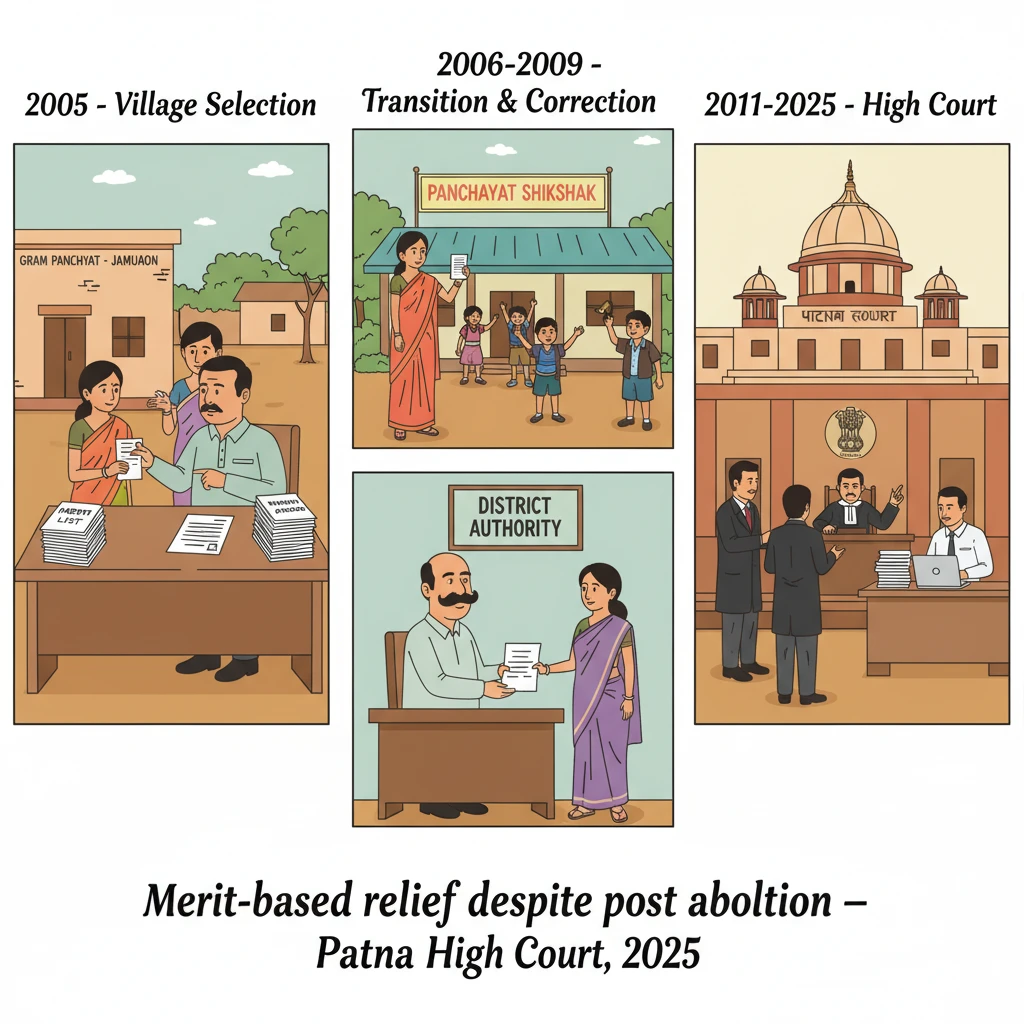
On 07.04.2005, rules of recruitment were issued in compliance with these guidelines. In 2005, both the appellant, Rita Kumari, and the contesting respondent, Rima Kumari (respondent no. 8), applied for selection as Shiksha Mitra in Jamuaon Gram Panchayat, Piro, District Bhojpur.
Both participated in the selection process for the post of Shiksha Mitra. However, respondent no. 8 was selected and appointed due to a wrong calculation of marks in the merit chart.
Later, by a policy decision effective from 01.07.2006, the post of Shiksha Mitra was abolished. Those already working as Shiksha Mitra were automatically treated as Panchayat Teachers. Respondent no. 8 thus became a Panchayat Teacher with effect from the abolition date.
On 18.12.2009, the district authority examined the matter and directed that the appellant be appointed as Panchayat Teacher in place of respondent no. 8, presumably after finding the earlier selection to be erroneous.
However, on 30.06.2011, the District Appellate Authority cancelled the appellant’s appointment. Ultimately, respondent no. 8 was treated as finally appointed.
In 2011, the appellant challenged this before the High Court in a writ petition. She was directed to file an appeal before the State Appellate Authority. She did so, but the State Appellate Authority also dismissed her appeal.
In 2018, the appellant filed Civil Writ Jurisdiction Case No. 3428 of 2018 before the Patna High Court challenging the orders of the appellate authority. On 02.09.2019, a learned Single Judge dismissed the writ petition, mainly relying on a Full Bench decision in Kalpana Rani vs. State of Bihar, which had upheld abolition of the Shiksha Mitra post.
Aggrieved, the appellant filed the present Letters Patent Appeal No. 1286 of 2019 before the Division Bench of the Patna High Court.
What the Court Examined and Decided
The Division Bench, comprising Hon’ble Mr. Justice P. B. Bajanthri and Hon’ble Mr. Justice Alok Kumar Pandey, heard the matter at length. During the hearing, the Court repeatedly sought assistance from State officials to understand the recruitment scheme, reservations, and roster details for Shiksha Mitra/Panchayat Shikshak posts.
On 08.04.2025, the Court recorded that despite earlier orders and even summoning an officer, there was no effective assistance from the State. The Court noted that although the post of Shiksha Mitra had been abolished with effect from 01.07.2006, the appellant’s grievance related to events before abolition.
The Bench observed that people who were working as Shiksha Mitra/Panchayat Shikshak on 01.07.2006 were accommodated and continued as teachers. Therefore, prima facie, the appellant’s right, if she was wrongly denied selection earlier, still subsisted.
The Court directed the State to clarify:
• Whether the post of Shiksha Mitra/Panchayat Shikshak was created by executive order or by rules under Article 309 of the Constitution.
• Whether recruitment was district-wise and whether Articles 14 and 16 (equality and equality of opportunity in public employment) had been properly followed, including the roster points.
On 06.05.2025, the Deputy Secretary, Education Department, Ajay Satish Bhengra, was present and a counter affidavit was filed on behalf of respondent no. 2 (District Magistrate, Bhojpur) along with relevant documents, including the 11.08.2004 resolution and 07.04.2005 guidelines.
The Court then carefully examined the recruitment process and, particularly, the comparative merit of the appellant and respondent no. 8 based on the official merit chart.
The guidelines for award of marks showed that candidates were to be given weightage based on their marks in Intermediate and Graduation, with different slabs (30%–60%, 60%–75%, and above 75%), and additional weightage for training or physical training qualifications from recognized institutions.
From the comparative merit chart of female candidates of Jamuaon Gram Panchayat, the Court found a specific error in favour of respondent no. 8. Her Intermediate marks placed her in the 30%–60% category, which entitled her to 10 marks. However, she was wrongly awarded 15 marks, which belonged to the higher 60%–75% category.
On the other hand, the appellant had secured more than 60% marks in Intermediate and was entitled to 15 marks under the guidelines. The Court found that due to this wrong calculation in the merit chart, the appellant, though more meritorious, was denied selection, and respondent no. 8 was wrongly selected as Shiksha Mitra.
The Court thus held it was undisputed that the appellant was more merited than respondent no. 8 when weightage marks were correctly applied.
In the meantime, the State had abolished the post of Shiksha Mitra with effect from 01.07.2006, and this abolition had been upheld by a Full Bench of the Patna High Court in Kalpana Rani vs. State of Bihar, reported in 2014(2) PLJR 665. The learned Single Judge had relied on this Full Bench decision to dismiss the appellant’s writ petition, without examining the merits of the selection.
The Division Bench clarified that the issue before it was not the validity of the abolition itself. That had already been settled by the Full Bench. The question here was different: how to treat a more merited candidate whose right had arisen before abolition and who was denied appointment due to official error.
The Bench held that the Full Bench decision in Kalpana Rani did not apply to this factual situation. The present lis related to a competition between two candidates—appellant and respondent no. 8—for a post existing before 01.07.2006. Since respondent no. 8, being in service on the date of abolition, had been accommodated as a teacher under the relevant rules, the abolition could not be used to defeat the appellant’s rightful claim based on higher merit.
The Court reasoned that deciding the case only on the basis of abolition, without examining merit, would create discrimination between the appellant and respondent no. 8. One less meritorious candidate had enjoyed continuation and eventual absorption as a teacher, while the more meritorious candidate had been kept out solely on account of errors by the authorities.
On this reasoning, the Court rejected the argument advanced on behalf of the State that the Full Bench judgment was binding and prevented the Division Bench from granting relief. The Division Bench clarified that it was not questioning or disagreeing with the Full Bench; instead, it was holding that the Full Bench ruling on abolition did not bar adjudication of pre-abolition selection disputes on their own merits.
The Court added that if abolition had automatically ended respondent no. 8’s employment, it might not have examined the merits so deeply. However, because respondent no. 8 had been accommodated as a teacher and continued in service, the appellant’s claim could not be shut out.
The Division Bench therefore set aside the Single Judge’s order dated 02.09.2019 in CWJC No. 3428 of 2018 and allowed the writ petition filed by the appellant.
As a consequential relief, in paragraph 6 of the judgment, the Court directed the concerned authority to:
• Formally appoint the appellant to the post of Shiksha Mitra/Panchayat Shikshak with retrospective effect, i.e., from the date on which respondent no. 8 was appointed.
• Thereafter pass a formal order accommodating the appellant as a teacher on account of abolition of the Shiksha Mitra post, and extend all service benefits.
The Court, however, made a clear distinction between notional and monetary benefits. It held that:
• The appellant would not be entitled to any monetary benefits for the intervening period.
• She would be entitled only to notional service benefits (such as seniority and continuity) for that period.
• These directions were to be complied with within six months.
The Court further held that if she was not appointed within two months from 30.07.2025, she would then become entitled to arrears of pay from 01.10.2025 until the date of appointment.
At the end, when the learned Advocate General submitted that respondent no. 8 had been absorbed as a teacher under specific rules for absorption of Shiksha Mitra/Panchayat Shikshak, the Court held that the appellant too was entitled to the benefit of those rules, with retrospective effect. The reason was that she had been kept out only due to mistakes by the authorities, despite being more merited.
The Court clarified that whatever benefit had been extended to respondent no. 8 from the date of her selection and appointment till date, the appellant was entitled to corresponding notional benefits.
The Letters Patent Appeal was thus allowed, and all pending interlocutory applications were disposed of.
Why This Judgment Matters
This judgment of the Patna High Court is important for candidates who lose out in government recruitment due to wrong calculation of marks or other official mistakes.
The Court made it clear that abolition of a post after selection cannot be used as a shield to deny justice to a more meritorious candidate whose right arose earlier.
Where a less meritorious person is allowed to continue and is absorbed as a regular teacher, a more meritorious candidate, wrongly kept out, is entitled to be placed in the same position at least notionally.
For low-income aspirants and contractual teachers, this judgment sends a clear message: if there has been a genuine error in selection, they can still approach the Court for correction, even years later, so long as the mistake can be shown from official records.
At the same time, the Court balanced equities by denying back wages for the past period, but ensuring service benefits and future salary protection, thereby safeguarding public funds while correcting injustice.
Legal Issues and Answers
- Issue: Whether abolition of the post of Shiksha Mitra/Panchayat Shikshak with effect from 01.07.2006 bars adjudication of a pre-abolition selection dispute on merits between two competing candidates.
Answer: No. The Patna High Court held that abolition and its affirmation in Kalpana Rani have no bearing on the present case, which concerns who was more meritorious before abolition. The appellant’s claim had to be decided on merits. - Issue: Whether a more meritorious candidate, wrongly denied selection due to erroneous calculation of marks, can claim appointment and consequential benefits when a less meritorious candidate has already been absorbed as a teacher.
Answer: Yes. The Court held that the appellant, being more meritorious, is entitled to appointment as Shiksha Mitra with retrospective effect, subsequent accommodation as teacher, and notional service benefits similar to those granted to respondent no. 8. - Issue: Whether the learned Single Judge was justified in dismissing the appellant’s writ petition solely relying on the Full Bench decision in Kalpana Rani without examining the factual merits.
Answer: No. The Division Bench set aside the Single Judge’s order, holding that the Full Bench ruling on abolition did not dispense with the need to examine the correctness of the individual selection and comparative merit.
Cases Cited by the Court
- Kalpana Rani vs. State of Bihar, 2014(2) PLJR 665 (Full Bench, Patna High Court) – cited regarding abolition of Shiksha Mitra posts and upheld policy decision of the State.
Case Details
Case Number: Letters Patent Appeal No. 1286 of 2019 in Civil Writ Jurisdiction Case No. 3428 of 2018
Case Title: Rita Kumari vs. The State of Bihar & Ors.
Citation: 2025(3) PLJR 882
Court: High Court of Judicature at Patna
Coram: Hon’ble Mr. Justice P. B. Bajanthri, Hon’ble Mr. Justice Alok Kumar Pandey
Date of Judgment: 30.07.2025
Advocates:
For the Appellant: Mr. Dileep Kumar Jha, Advocate; Mr. Parma Nand Singh, Advocate
For the State: Mr. Ashutosh Ranjan Pandey, AAG-15; Mr. S.S. Tiwary, AC to AAG-15
For Respondent No. 8: Mr. Amit Shrivastava, Senior Advocate; Mr. Girish Pandey, Advocate; Mr. S.M. Sudhanshu, Advocate
Nature of the Case: Letters Patent Appeal against dismissal of a writ petition challenging selection and appointment to the post of Shiksha Mitra/Panchayat Shikshak, and seeking correction of merit-based appointment and consequential absorption as Panchayat Teacher.
Link to Full Judgment: Click here to read the full judgment of the Patna High Court
If you found this explanation helpful and wish to stay informed about
how legal developments may affect your rights in Bihar,
you may consider following Samvida Law Associates for more updates.







