
Case Background
This case arose from a matrimonial dispute between a husband and wife whose marriage was solemnized on 03.12.2004 according to Hindu rites and customs. The husband filed Divorce Case No. 36 of 2012 before the Principal Judge, Family Court, Vaishali at Hajipur under Section 13(1) of the Hindu Marriage Act, 1955, seeking dissolution of the marriage.
According to the husband, after marriage the wife initially stayed at her matrimonial home for about three months. He claimed that during this period her behaviour and attitude showed that she was not ready to accept the culture and dignity of his family. He alleged that she went back to her parental home in March 2005, returned in July 2005, stayed for about six months and again allegedly broke family traditions and showed detachment towards his family members.
The husband further alleged that the wife used to leave for her parental home without informing or seeking permission from him or his family members. He accused her of cruel behaviour towards him and other family members, including his aged father. He claimed that due to her conduct, his father fell into deep depression and died prematurely, as the husband was his only son.
He also stated that the wife did not care for her ailing father-in-law and did not attend to the husband when he suffered an accident in 2010 in which both his upper limbs and back were fractured. Another allegation was that the wife refused to establish conjugal relations and that the marriage was not consummated.
According to the husband, the wife failed to discharge her matrimonial obligations, caused him mental torture and harassment, and ultimately left his company and society in September 2007 to live in her parental home. He asserted that the matrimonial relationship had irretrievably broken down and there was no hope of restoration.
The wife appeared in the divorce proceedings and filed a written statement. She denied all allegations of cruelty and misconduct. Instead, she claimed that she was the one who was mentally and physically tortured at her matrimonial home due to non-fulfilment of dowry demands. She alleged that in December 2007 she was forced to leave the matrimonial house and take shelter at her parental home. According to her, the divorce case was filed on false and concocted grounds only to oust her from the life of the husband.
After trial, the Principal Judge, Family Court, Vaishali at Hajipur, by judgment and decree dated 27.01.2018, allowed the husband’s petition under Section 13(1) of the Hindu Marriage Act, 1955. The Family Court held that the wife had treated the husband with mental cruelty and also accepted the ground of desertion. The marriage solemnized on 03.12.2004 was dissolved on these grounds.
Aggrieved by this decision, the wife filed Miscellaneous Appeal No. 236 of 2018 before the Patna High Court challenging the judgment and decree of the Family Court.
What the Court Examined and Decided
Before the Patna High Court, the appellant-wife argued that the Family Court had erred both in law and on facts in allowing the divorce petition. Her counsel submitted that the case was wrongly decided on the ground of cruelty.
The wife contended that she was actually the victim of cruelty at her matrimonial home and had only taken legal steps to protect her rights. She had filed cases regarding cruelty and dowry demand against the husband and his family members. According to her, these legal actions were mistakenly treated by the Family Court as acts against the husband, instead of being seen as remedies available to her under law.
She also challenged the finding of desertion. She argued that she had not deserted the husband; rather, she had been compelled to leave the matrimonial home due to the conduct of the husband and his family.
The appellant further brought to the notice of the High Court that she had filed Maintenance Case No. 191 of 2012 under Section 125 of the Code of Criminal Procedure before the Principal Judge, Family Court, Vaishali at Hajipur. In that proceeding, by order dated 27.03.2017, she had been granted interim maintenance of Rs. 6000/- per month. This showed that she had been asserting her legal rights and seeking support from the husband.
Another important grievance raised by the wife was that the Family Court had not made adequate efforts to reconcile the matter between the parties, as is normally expected in matrimonial cases. She also pointed out that no decision had been taken regarding permanent alimony at the time of passing the divorce decree.
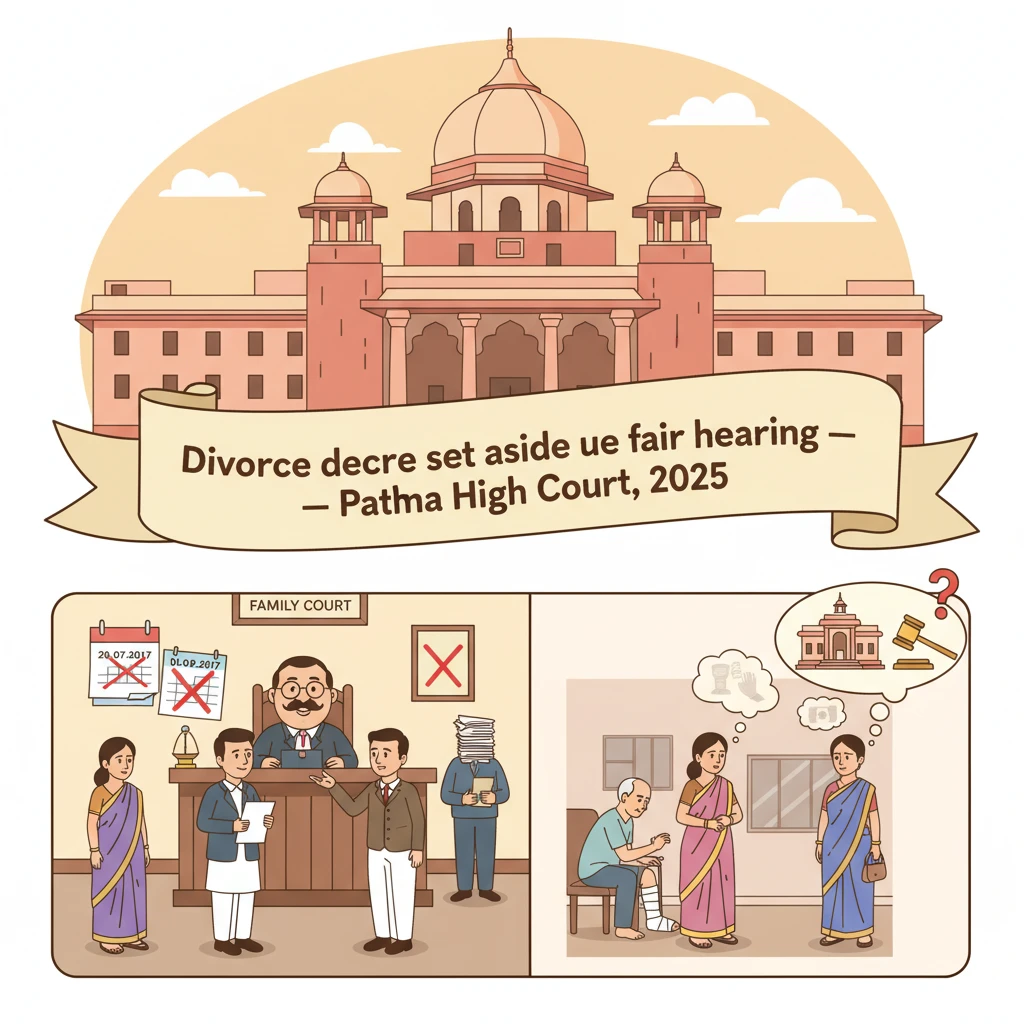
The Patna High Court, however, did not go into the merits of the allegations of cruelty and desertion in detail. Instead, the Bench focused on whether the Family Court had given proper and sufficient opportunity to the wife to present her case and evidence.
The High Court examined the lower court records. It noted that after issues were framed, the evidence of the applicant/respondent-husband commenced and continued till 16.06.2017, when his evidence was closed.
On the next date, 28.07.2017, no one appeared on behalf of the wife (opposite party/appellant). Thereafter, on the following date, 01.09.2017, the Family Court passed an order closing the evidence of the wife as well. Thus, her evidence was shut without being recorded.
Later, on 21.12.2017, a petition was filed before the Family Court to recall the order closing her evidence. The record showed that this recall petition was rejected by order dated 19.01.2018. The case then proceeded to judgment, which went in favour of the husband.
The Patna High Court also noted another important aspect. It observed from the Family Court records that notice had not been directly served on the wife, and only a paper publication had been issued.
In this context, the appellant-wife explained that she belonged to a poor family and that, at the relevant time, the corona pandemic was in vogue. She argued that these circumstances made it difficult for her to properly follow the case and respond to a mere paper publication.
The High Court found this argument to be reasonable and justified for the purpose of ensuring proper and complete adjudication of the case. The Bench emphasized that, for a fair decision, the evidence and pleadings of both sides must come on record. In this case, the wife’s evidence was never actually recorded due to the closure order, and her attempt to recall that order was rejected.
Considering these facts, the Court accepted the contention that the wife had not been given sufficient opportunity to lead her evidence. It held that adequate opportunity should have been granted to her to support her pleadings, but this was not done by the Family Court.
On this basis, the High Court came to the conclusion that the judgment and decree dated 27.01.2018 of the Family Court could not be sustained. It did not affirm or reject the findings on cruelty and desertion on merits; instead, it focused on the procedural unfairness.
Accordingly, the Patna High Court set aside the judgment and decree passed in Divorce Case No. 36 of 2012. The matter was remanded back to the Principal Judge, Family Court, Vaishali at Hajipur with specific directions.
The High Court directed the Family Court to decide the case afresh on merits after granting opportunity to both parties to adduce their evidence. It further directed that the matter should be concluded within three months from the date of receipt of a copy of the High Court’s order.
The parties were also directed to co-operate in the matter so that the case could be decided within the stipulated time. Any pending interlocutory applications in the High Court were disposed of in view of the remand.
In summary, the Patna High Court’s decision in this appeal restored the divorce case back to the trial stage, ensuring that both husband and wife would now have a full and fair chance to present their versions before the Family Court.
Why This Judgment Matters
This judgment is important because it shows that in matrimonial cases the courts must give both husband and wife a fair chance to speak and to bring their evidence. Even if serious allegations like cruelty and desertion are made, the decision cannot stand if one side is not properly heard.
Here, the Family Court granted divorce after closing the wife’s evidence when she was absent on a couple of dates. The Patna High Court made it clear that such closure, without ensuring proper service and opportunity, is not acceptable.
For people involved in similar disputes, especially those from poor or vulnerable backgrounds, this decision signals that higher courts can intervene if a trial court proceeds too quickly or without properly hearing both sides.
The judgment also underlines that notice through paper publication alone may not be enough in all circumstances, particularly during exceptional situations like the corona pandemic. Courts must be sensitive to the practical difficulties faced by litigants.
Practically, this decision protects the rights of spouses, especially wives, who might otherwise lose their marital status without ever placing their side of the story on record. It reinforces that procedure and fairness are as important as the final outcome in family disputes.
Legal Issues and Answers
- Issue: Whether the judgment and decree of divorce passed by the Family Court could be sustained when the wife was not given sufficient opportunity to adduce her evidence.
Answer: No. The Patna High Court held that the wife was not given proper opportunity, set aside the decree, and remanded the case for fresh decision on merits after hearing both sides. - Issue: Whether closure of the wife’s evidence and refusal to recall that order, in the circumstances of the case, was justified.
Answer: No. The Court found that non-service of notice except by paper publication, coupled with her circumstances, made the closure of evidence improper and required a remand. - Issue: Whether the High Court should finally decide the grounds of cruelty and desertion in this appeal.
Answer: The Court chose not to decide these grounds on merits and instead remanded the matter so that the Family Court could adjudicate afresh after recording evidence from both parties.
Cases Cited by the Court
- No earlier cases or precedents are cited or relied upon in the text of this judgment.
Case Details
Case Number: Miscellaneous Appeal No. 236 of 2018
Case Title: Reena Singh @ Chunni @ Rina Kumari vs. Rakesh Singh
Citation: 2025(3) PLJR 855
Court: High Court of Judicature at Patna
Coram: Hon’ble Mr. Justice P. B. Bajanthri; Hon’ble Mr. Justice S. B. Pd. Singh (CAV Judgment per Hon’ble Mr. Justice S. B. Pd. Singh)
Date of Judgment: 06.08.2025
Counsel for Appellant: Mr. Shyameshwar Kumar Singh (for the appellant-wife)
Counsel for Respondent: Mr. Rajiv Prashant (for the respondent-husband)
Nature of the Case: Miscellaneous Appeal against a decree of divorce passed by the Principal Judge, Family Court, Vaishali at Hajipur in Divorce Case No. 36 of 2012 under Section 13(1) of the Hindu Marriage Act, 1955.
Impugned Order: Judgment and decree dated 27.01.2018 of the Principal Judge, Family Court, Vaishali at Hajipur dissolving the marriage on grounds of cruelty and desertion.
Final Outcome in Appeal: Judgment and decree of divorce set aside; matter remanded to Family Court for fresh decision on merits after giving both parties opportunity to lead evidence, to be completed within three months from receipt of the High Court order.
Related Proceedings Mentioned: Maintenance Case No. 191 of 2012 under Section 125 CrPC before Principal Judge, Family Court, Vaishali at Hajipur; interim maintenance of Rs. 6000/- per month granted to the wife by order dated 27.03.2017.
Link to Judgment:https://patnahighcourt.gov.in/viewjudgment/MiMyMzYjMjAxOCMxI04=-EgQNLz97axQ=
If you found this explanation helpful and wish to stay informed about how legal developments may affect your rights in Bihar, you may consider following Samvida Law Associates for more updates.







