
Case Background
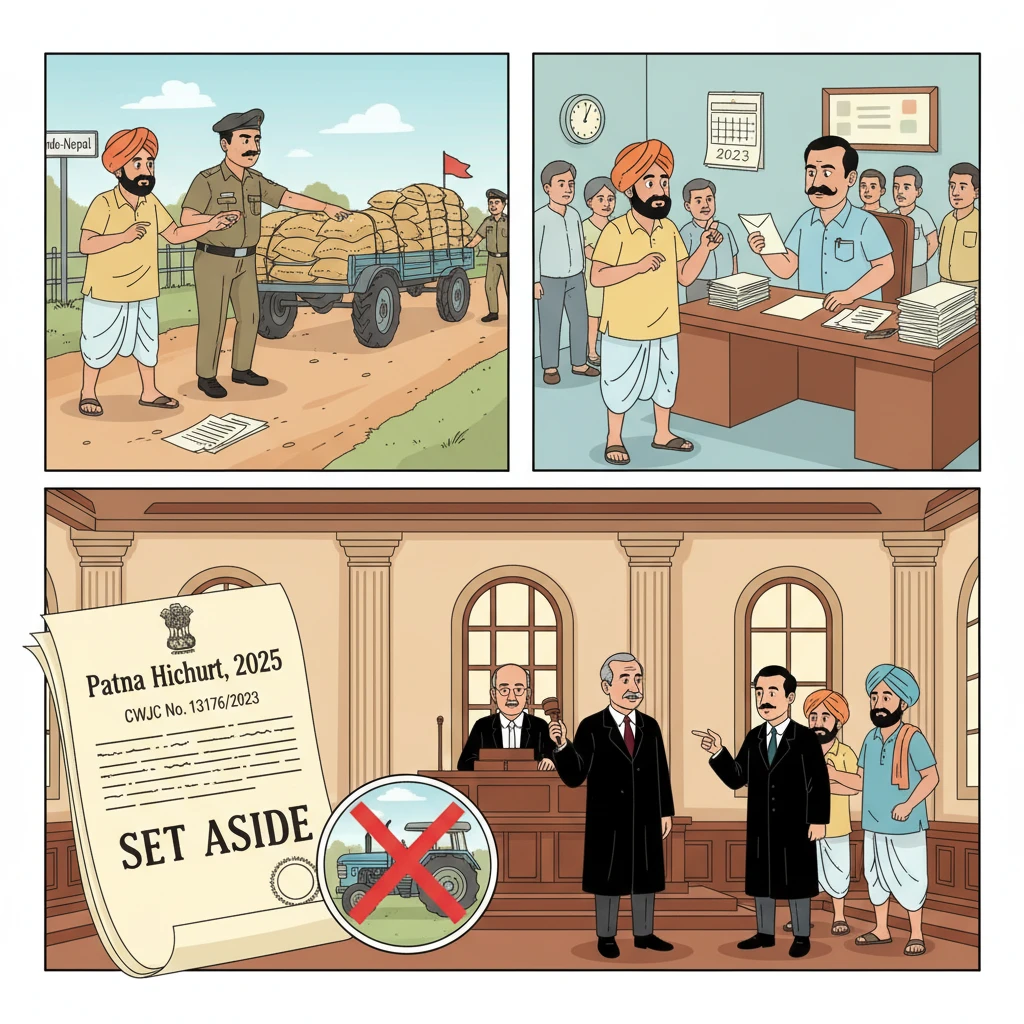
The petitioner is a resident of village Basantpur in West Champaran, Bihar. On 21.04.2023, 35 bags of wheat, each weighing 55 kilograms, being carried on a tractor with trolley, were seized near the Indo-Nepal border by personnel of the Sashastra Seema Bal (SSB), 47th Battalion, Bihar.
The seizure was made by one Sunil Dutt Gaurola, an Assistant Sub-Inspector (ASI) of the SSB, and the wheat was handed over to the Assistant Commandant, ‘A’ Coy, 47th Battalion, SSB, Bihar. A seizure memo was prepared and later brought on record in the writ proceedings. The memo recorded that the seizure was for violation of various sections of the Customs Act, 1962 and the Foreign Trade (Development and Regulation) Act, 1992.
The petitioner claims he was transporting wheat from Basantpur, Mainatand to Bettiah on the strength of valid GST documents. He addressed a letter (Annexure P/9) to the Deputy Commissioner, Customs, Motihari, seeking release of the wheat and alleging that the ASI, who had no jurisdiction under Section 110 of the Customs Act, stopped him, demanded “pleasantries”, manhandled him when he refused, and seized the tractor and wheat.
No effective action was taken by the Customs authorities on this representation. The petitioner therefore filed Civil Writ Jurisdiction Case No. 13176 of 2023 before the Patna High Court challenging the seizure memo dated 21.04.2023 and seeking provisional release of the wheat and vehicle.
While the writ petition was pending, the Customs authorities proceeded with adjudication. An order-in-original bearing No. 107/CUS/DC/MTH/2023-24 dated 22.12.2023 was passed by the Deputy Commissioner, Customs (P) Division, Motihari, confiscating the wheat valued at Rs. 46,200 and the vehicle valued at Rs. 3,20,000 under Sections 113 and 115 of the Customs Act, 1962, and imposing redemption fines.
This adjudication order and the subsequent e-auction of the wheat were later brought on record by the respondents through a supplementary counter affidavit. The petitioner, in turn, filed an interlocutory application in the writ case seeking to amend the reliefs to challenge the adjudication order, the e-auction, and to claim the seizure value of the goods.
By order dated 13.05.2025, the High Court allowed the amendment and directed that the statements and prayers in the interlocutory application form part of the writ petition. Respondent Nos. 4 to 6 (Customs authorities) also filed a counter affidavit to the interlocutory application.
What the Court Examined and Decided
During the hearing on 23.06.2025, counsel for the petitioner confined submissions specifically to the seizure of the wheat and the subsequent confiscation and auction proceedings. The Court examined two broad aspects: first, the legality of the seizure memo under Section 110 of the Customs Act, and second, the legality and fairness of the adjudication and auction process carried out during pendency of the writ petition.
On the seizure memo, the Court noted that the memo prepared on 24.01.2023 (under the signature of an officer signing for the Assistant Commandant, ‘A’ Coy, 47th Battalion, SSB, Bihar) contained the signatures of two witnesses from village Basantpur. The “reason for seizure” in the memo was stated only in a very general manner, by listing alleged violations of Sections 7, 11, 46, 47/50 and 51 of the Customs Act, 1962, read with Section 3(2) of the Foreign Trade (Development and Regulation) Act, 1992 and a reference to the Ministry of Finance.
The petitioner’s core argument was that Section 110 of the Customs Act requires the “proper officer” to have “reason to believe” that goods are liable to confiscation and that such reasons must be specifically recorded. Merely writing section numbers is not sufficient compliance. He relied on three Patna High Court decisions: M/s Ashoke Das vs. Union of India (CWJC No. 4918 of 2021, decided on 19.02.2025), Jayesh Agarwal vs. Union of India (CWJC No. 7085 of 2022, decided on 24.02.2025), and A.S. Trading and Company vs. Union of India (CWJC No. 17756 of 2024, decided on 25.04.2025), where similar seizure memos had been quashed.
The petitioner further argued that the seizure itself was without jurisdiction, as Notification No. 99/2014-CUSTOMS (N.T.) issued under Section 6 of the Customs Act entrusts functions under Sections 100, 102, 106, 107 and 110 to officers of SSB of Inspector and Sub-Inspector rank, and not to Assistant Sub-Inspectors. Therefore, an ASI was not competent to exercise powers under Section 110.
The Court recorded that the learned Additional Solicitor General, appearing for the Union of India and Customs, did not dispute that seizure memos in the same format had been quashed earlier, and that merely listing sections did not satisfy Section 110. It was also not disputed that the law laid down in M/s Ashoke Das regarding seizure memos would govern this case as well.
The ASG attempted to argue that the seizure was actually effected by the Assistant Commandant of the 47th Battalion, SSB. However, when the Court examined the letter by the ASI to Customs and the proforma of “inspected goods”, it became clear that the ASI himself had intercepted the tractor, arrested the driver, seized the wheat, and handed over the goods to Customs. The proforma was prepared by the ASI, and the names of SSB personnel involved were vaguely referred to as “enclosed Annexure-B” with no such annexure on record. The seal of the Assistant Commandant was present with an initial signature “for Assistant Commandant”, but that did not change the fact that the ASI had actually carried out the seizure.
The Court quoted Section 110 of the Customs Act in detail and reiterated that having “reason to believe” and recording such reasons is a sine qua non for a valid seizure. Since it was admitted that the seizure memo did not contain any such reasons, and in view of prior binding precedents, the Court held that the seizure memo was illegal.
The seizure memo (Annexure P/6 to the writ petition and Annexure B to the respondents’ counter affidavit) was therefore quashed, in so far as it related to the 35 bags of wheat of 55 kgs each.
The Court then turned to the second issue: the adjudication and auction that took place during the pendency of the writ petition.
The records showed that the petitioner had appeared on 03.10.2023 in response to summons and filed a petition stating that he was given only two days to appear, which he said violated natural justice. He also informed the Superintendent, Customs (P) Division, Motihari, that he had already challenged the seizure memo before the Patna High Court in CWJC No. 13176 of 2023 and requested that action be taken only after the outcome of that case.
On 12.12.2023, the petitioner again submitted a letter to the Deputy Commissioner, Customs (P) Division, Motihari, reiterating that the seizure was by an ASI of SSB whose competency he had challenged in the High Court. This letter reached the adjudicating authority on 13.12.2023.
When the High Court specifically asked the ASG and the officers present what order had been passed on the letter dated 12.12.2023, there was no answer and no order could be shown on record. Instead, the adjudication order stated that the petitioner (Noticee No. 1) had not appeared in personal hearings on 09.11.2023, 06.12.2023, and 14.12.2023 and had not submitted anything in his defence. The High Court found this observation to be incorrect in light of the 12.12.2023 letter, which squarely raised the issue of the seizing officer’s competency.
The adjudication order also recited that a voluntary statement of Noticee No. 1 had been recorded under Section 107 of the Customs Act before a “competent authority” of the SSB, in which he allegedly admitted trying to take wheat from India to Nepal without documents. However, the Court pointed out that the records did not disclose who recorded this statement, nor their name or designation. The order vaguely claimed that the Seizure Memo and panchnama were prepared by SSB and that goods and conveyance were intercepted by SSB, without stating whether the officer was of the authorised rank.
The Court further looked at the internal computer sheet produced by Customs showing key steps in the file. Entries were found up to 27.09.2023 and then again on 04.10.2023, when draft show cause notices were prepared and uploaded. Later dates like 26.12.2023, 23.01.2024, 12.07.2024, 11.09.2024, 07.05.2025 and 20.06.2025 were shown, but there was no mention of 22.12.2023, the date on which the confiscation order was actually passed.
The ASG submitted that a copy of the confiscation order was dispatched to the petitioner by speed post on 03.01.2024. However, as recorded in the interlocutory application, the petitioner maintained that he was never apprised of the adjudication order or the auction. The respondents, in their supplementary counter affidavit dated 09.05.2025, for the first time claimed that notices for personal hearing had been issued and that a copy of the order had been sent on 03.01.2024.
The High Court noted that the writ petition had already been taken up for consideration on 16.10.2023, when respondents sought time for filing counter affidavit. This meant that before passing the adjudication order on 22.12.2023, the matter was clearly sub judice before the High Court. Despite this, the Deputy Commissioner proceeded to decide the case, and even after the High Court’s order dated 07.02.2024 directing release of the vehicle and food grains subject to conditions, the Court was not informed that an adjudication order had already been passed or that e-auction had taken place.
In that earlier order dated 07.02.2024, the Court, on a concession recorded from the respondents, had directed the Deputy Commissioner, Customs (P) Division, Motihari to release the vehicle and food grains to the petitioner on furnishing sufficient security and subject to conditions, and made clear that the release would be subject to the final outcome of the writ petition. It was only later that the respondents disclosed that the wheat had already been auctioned.
From the second supplementary counter, the Court noted that the petitioner was given an option under Section 125 of the Customs Act to redeem the goods and conveyance on payment of redemption fines (Rs. 7,000 for goods and Rs. 25,000 for the vehicle). The tractor was ultimately released on payment of Rs. 5,000 penalty in April 2024. But the 35 bags of wheat were e-auctioned under MSTC/PTN/Customs notice dated 01.02.2024 for Rs. 31,678, without disclosure of the actual sale and delivery dates.
The Court then referred to Section 125(3) of the Customs Act, which clearly provides that where a fine in lieu of confiscation is imposed, the option to pay the fine remains open for 120 days from the date the option is given, unless an appeal is pending. In this case, Customs themselves claimed to have dispatched the adjudication order on 03.01.2024, but proceeded to auction the wheat within 29 days, far short of the statutory 120-day period.
The Court held that selling the seized goods within 29 days of dispatch of the confiscation order was a direct violation of Section 125(3), and was also contrary to principles of natural justice. The Court observed that once the matter was before the High Court and was adjourned at the instance of the respondents for filing counter affidavit, the authorities “were not required to act in haste”. Taking such steps in hot haste, particularly during pendency of the writ petition, indicated unfairness and could amount to mala fide exercise of power.
On a cumulative assessment, the Court found multiple grounds to hold the confiscation and adjudication order bad in law. The order dated 22.12.2023 passed by the Deputy Commissioner, Customs (P) Division, Motihari, was quashed.
As for relief, the Court noted that the wheat had been sold for Rs. 31,678, less than its seizure value of Rs. 46,200. Given that the sale itself was in clear breach of the law and took place during the pendency of the writ petition, the Court directed the respondents to pay the petitioner the full seizure value of Rs. 46,200 with interest at 6% per annum from the date of seizure until payment. The Court also awarded litigation costs of Rs. 5,000, to be paid within six weeks from receipt or production of a copy of the judgment.
In the result, the writ application was allowed.
Why This Judgment Matters
This judgment of the Patna High Court sends a clear message to border and Customs authorities that they must strictly follow legal procedures when seizing goods and conducting adjudication.
First, the Court reaffirmed that seizure memos must show real “reasons to believe” why goods are liable to confiscation. Simply listing some sections of law is not enough. This is important for ordinary traders and transporters because it protects them from arbitrary seizure by officers.
Second, the Court highlighted that only properly authorised officers can exercise powers under Section 110 of the Customs Act. Lower-rank officers cannot assume those powers simply by putting the seal or name of a higher officer.
Third, the judgment shows that authorities cannot rush to pass confiscation orders and auction goods while a related case is pending before the High Court. They must act fairly, give the person a real opportunity to respond, and respect statutory timelines such as the 120 days under Section 125(3) for payment of redemption fine.
For small farmers, transporters, and local traders near border areas, this decision offers reassurance that the courts will intervene where seizure and auction appear hasty, unfair, or without legal basis. It also clarifies that if goods are wrongly sold, authorities can be ordered to pay full value with interest and litigation costs.
Legal Issues and Answers
- Issue: Was the seizure of 35 bags of wheat by an Assistant Sub-Inspector of SSB and the seizure memo compliant with Section 110 of the Customs Act, 1962?
Answer: No. The Patna High Court held that the seizure memo did not record the required “reason to believe” and that such generic mention of sections is inadequate. Following its earlier precedents, the Court quashed the seizure memo as it related to the wheat. - Issue: Was the adjudication (confiscation) order dated 22.12.2023 and subsequent e-auction of wheat legal and valid, particularly during pendency of the writ petition?
Answer: No. The Court found that the adjudication order was passed in hot haste, without proper consideration of the petitioner’s written defence, and that the e-auction held within 29 days of dispatch of the order violated Section 125(3) of the Customs Act and principles of natural justice. The confiscation order was quashed and the authorities were directed to pay the full seizure value with interest and costs.
Cases Cited by the Court
- M/s Ashoke Das vs. Union of India & Ors., CWJC No. 4918 of 2021, disposed of on 19.02.2025 (Patna High Court).
- Jayesh Agarwal vs. Union of India, CWJC No. 7085 of 2022, disposed of on 24.02.2025 (Patna High Court).
- A.S. Trading and Company vs. Union of India, CWJC No. 17756 of 2024, disposed of on 25.04.2025 (Patna High Court).
Case Details
Case Number: Civil Writ Jurisdiction Case No. 13176 of 2023
Case Title: Fariyad Alam vs. The Union of India & Ors.
Citation: 2025(3) PLJR 671
Court: High Court of Judicature at Patna
Coram: Hon’ble Mr. Justice Rajeev Ranjan Prasad and Hon’ble Mr. Justice Ashok Kumar Pandey
Date of Judgment: 24.06.2025
Advocates for Petitioner: Ms. Archana Meenakshee, Advocate; Mr. Rohit Singh, Advocate; Mr. Ranaveer Prawar, Advocate
Advocates for Respondent Union of India/Customs: Dr. K.N. Singh, ASG; Mr. Anshuman Singh, Senior Standing Counsel; Mr. Alok Kumar, Central Government Counsel; Mr. Shivaditya Dhari Sinha, Advocate
Nature of Case: Writ petition under civil writ jurisdiction challenging seizure memo, confiscation/adjudication order, and auction of seized goods under the Customs Act, 1962.
Link to Judgment: Click here to view the full judgment of the Patna High Court
If you found this explanation helpful and wish to stay informed about
how legal developments may affect your rights in Bihar,
you may consider following Samvida Law Associates for more updates.







