
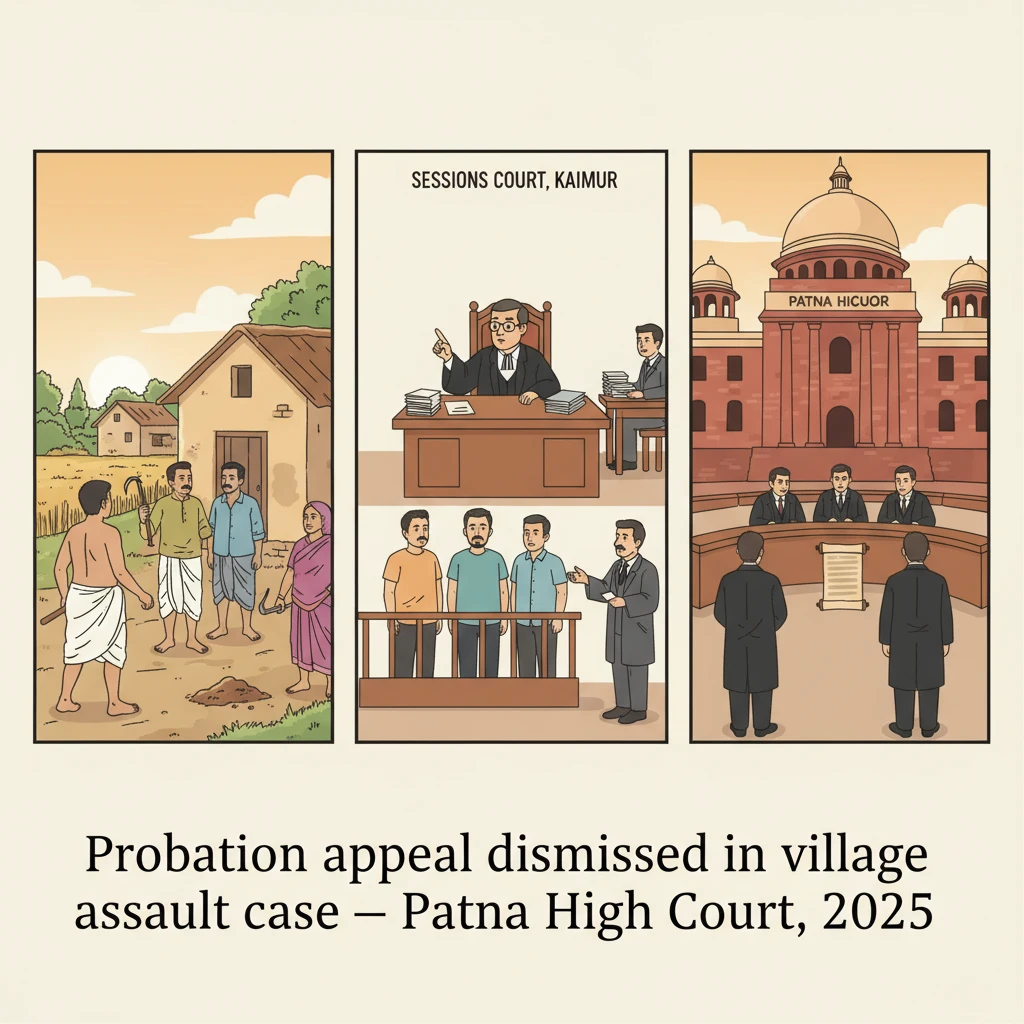
Case Background
This criminal appeal arose from a village dispute in District Kaimur (Bhabua), Bihar. The informant, who later became the victim in the case, lodged a fardbeyan that led to registration of Durgawati P.S. Case No. 155 of 2009.
According to the fardbeyan, around 5:00 a.m., the informant was returning home after attending the call of nature. At that time, the appellants, who are from the same family, allegedly caught him, dragged him inside their house, tied him, and assaulted him with lathis. One accused, Sunil Gupta, was alleged to have hit the informant on the head with the edge of a tangi, causing a bleeding injury, along with other injuries.
The alleged motive mentioned in the fardbeyan was that the accused persons suspected the informant of defecating at their doorway (darwaja). On this basis, an FIR was lodged.
After investigation, the police submitted charge-sheet under Sections 323, 324, 307, 341, 342 and 504 read with Section 34 of the Indian Penal Code. The case was committed to the Court of Sessions on 22.09.2010 and registered as Sessions Trial No. 386 of 2010 before the Adhoc Additional District Judge-I, Kaimur.
The trial court ultimately convicted the appellants under Sections 323, 325, 341 and 504 read with Section 34 of the IPC. However, instead of sending them to jail, the trial court applied Section 4 of the Probation of Offenders Act, 1958. The appellants were directed to furnish personal bonds of Rs. 5,000/- each, to maintain peace for three years, and to keep away from any dispute with the informant during that period.
Aggrieved, the appellants filed the present Criminal Appeal (SJ) No. 49 of 2014 before the Patna High Court under Section 11(2) of the Probation of Offenders Act, challenging both the judgment of conviction and the order of sentence dated 24.09.2013.
What the Court Examined and Decided
The appeal was heard by Hon’ble Mr. Justice Ramesh Chand Malviya. The appellants were represented by an amicus curiae, Mr. Sanjeev Kumar, and the State was represented by Ms. Anita Kumari Singh, learned APP.
The prosecution examined seven witnesses before the trial court. These included:
PW-1 Murahu Sah, PW-2 Arvind Gupta, PW-3 Anil Kumar Gupta, PW-4 Sunil Gupta (the informant/victim), PW-5 Bageshwari Kunwar, PW-6 Vishwanath Sharma (Investigating Officer), and PW-7 Dr. Shanti Kumar Manjhi. PW-1 and PW-5 were declared hostile.
On behalf of the appellants, the learned amicus argued that the conviction and sentence were not sustainable in law or on facts. It was submitted that:
PW-2 and PW-3 were real brothers of the informant and had tried to project themselves as eye-witnesses. They claimed that their presence at the time of the assault saved the informant from further injuries. However, the injury on the head was sufficient to cause loss of physical balance and the informant had first been taken to the nearest hospital and then referred to B.H.U.
The defence highlighted that the medical evidence did not support the allegation of a sharp-cut injury from a tangi. The doctor did not find any sharp-edged cut injury but only injuries caused by a hard blunt object. One head injury was found grievous, and two other injuries were simple with swelling and abrasion on the leg and finger, which are non-vital parts.
It was further argued that PW-2 and PW-3 claimed to have witnessed the occurrence in the presence of their father, yet the father was not examined. They also did not claim to have tried to save the victim, which was described as unnatural in such circumstances. Therefore, it was submitted that they were not genuine eye-witnesses.
The defence also suggested that the injuries might have been sustained due to a sudden fall on the bank of the river, where stones and hard soil were scattered, while the victim had gone to attend the call of nature. It was also stressed that the parties were co-villagers and neighbours, and there was admitted enmity between them as per the informant’s own statement.
On this basis, counsel submitted that, even if the prosecution case was assumed to be true, the incident took place in the heat of the moment. In such a situation, according to the defence, this was a fit case for clean acquittal, and the trial court erred in convicting the appellants under Sections 323, 325, 341 read with 34 of the IPC.
The appellants also expressed apprehension that the three-year probation order could be misused by the informant and his family. They feared that any future false accusation might be treated as a violation of their bond, which could harm their career prospects, including government or private employment or even contesting for public office.
On the other hand, the learned APP supported the trial court’s judgment and order. She argued that the prosecution had proved its case beyond reasonable doubt and that there was no illegality or infirmity in the conviction or the sentence. Therefore, the appeal deserved to be dismissed.
The Patna High Court carefully examined the entire evidence, including the testimonies and the medical report. A key issue was whether the ingredients of Section 307 IPC (attempt to murder) were made out. The Court noted that, although there was an allegation that Sunil Gupta used a tangi, the evidence showed that he did not repeat the blow or use the sharp part of the tangi, even though he was in a position to do so.
From this, the Court concluded that the intention of the accused was not to kill the informant. Therefore, the charge under Section 307 or Section 307 read with 34 IPC was not proved against the appellants.
However, the Court found that the evidence clearly established that the appellants had caught the informant, taken him inside the house, confined him and beaten him. The informant was also abused. On this basis, the Court held that the charges under Sections 323 read with 34 and 341 read with 34 IPC were rightly proved.
Regarding the nature of injuries, the doctor (PW-7) had found two wounds to fall in the category of grievous hurt. Therefore, the Court held that the appellants were also guilty under Section 325 read with 34 IPC.
The High Court then examined the conviction under Section 504 IPC (intentional insult with intent to provoke breach of peace). For this, the Court referred to the Supreme Court judgment in Fiona Shrikhande v. State of Maharashtra, (2013) 14 SCC 44: (2014) 1 SCC (Cri) 715, which lays down the essential ingredients of Section 504:
- There must be an intentional insult;
- The insult must be such as to give provocation to the person insulted; and
- The accused must intend or know that such provocation is likely to cause the person to break public peace or commit any other offence.
The Supreme Court had clarified that mere abuse is not enough. The background, circumstances, manner, and likely impact on public peace must be considered.
Applying this law, the Patna High Court observed that in the present case there was no mention of any specific abusive words used by the appellants. Without such specific mention, the Court held that the essential ingredients of Section 504 IPC were not established.
Accordingly, the Court acquitted the appellants of the offence under Section 504 read with 34 IPC. At the same time, it held that the prosecution had successfully proved the charges under Sections 323, 325 and 341 read with Section 34 IPC beyond all reasonable doubt.
The conviction of the appellants was therefore upheld and only modified to the extent of removing Section 504. The appeal was dismissed. The order under the Probation of Offenders Act, requiring each appellant to furnish a personal bond of Rs. 5,000/- to maintain peace for three years and avoid any dispute with the informant, remained in force subject to this modification.
Before closing the case, the Court directed the Secretary, Patna High Court Legal Services Committee to pay Rs. 5,000/- to the amicus curiae, Mr. Sanjeev Kumar, as honorarium. The office was directed to process the payment and to send back the trial court records along with a copy of the judgment for necessary compliance.
Why This Judgment Matters
This judgment of the Patna High Court is important for villagers and ordinary citizens involved in local disputes that turn violent.
First, it shows that even if parties are neighbours and there is longstanding enmity, the Court will rely on medical evidence and credible witness testimony to fix responsibility for physical assaults.
Second, the Court made a clear distinction between attempt to murder and causing grievous hurt. Even where a dangerous weapon like a tangi is mentioned, the Court will look closely at how it was used and whether there was an intention to kill.
Third, for the offence of intentional insult under Section 504 IPC, the Court reaffirmed that mere allegation of abuse is not enough. There must be clear, specific material to show the type of insult and its likely effect on public peace.
Finally, this decision confirms that orders under the Probation of Offenders Act can be upheld even when the accused fear future misuse. Once guilt is proved beyond reasonable doubt, a probation bond to maintain peace is seen as a lenient alternative to jail, not as a punishment that can simply be set aside due to apprehensions.
Legal Issues and Answers
-
Issue: Whether the conviction of the appellants under Sections 323, 325 and 341 read with Section 34 IPC was justified on the evidence.
Answer: Yes. The Patna High Court held that the prosecution had proved beyond reasonable doubt that the appellants wrongfully restrained, confined and assaulted the informant, causing two grievous injuries and other simple injuries. -
Issue: Whether the appellants could be held guilty of attempt to murder under Section 307 IPC or Section 307 read with Section 34 IPC.
Answer: No. The Court held that the intention to kill was not made out, as the accused did not repeatedly use the tangi or its sharp edge despite being able to do so. -
Issue: Whether the conviction under Section 504 read with Section 34 IPC (intentional insult with intent to provoke breach of peace) could be sustained.
Answer: No. Relying on Fiona Shrikhande v. State of Maharashtra, the Court held that there was no specific mention of abusive words or conduct sufficient to fulfil the ingredients of Section 504 IPC, and therefore acquitted the appellants of this charge.
Cases Cited by the Court
- Fiona Shrikhande v. State of Maharashtra, (2013) 14 SCC 44: (2014) 1 SCC (Cri) 715.
Case Details
Case Number: Criminal Appeal (SJ) No. 49 of 2014, arising out of Durgawati P.S. Case No. 155 of 2009, Sessions Trial No. 386 of 2010.
Case Title: Sandeep Gupta @ Sandeep Kumar Gupta and Ors v. State of Bihar and Anr.
Coram: Hon’ble Mr. Justice Ramesh Chand Malviya.
Citation: 2025 (2) PLJR 870.
Advocates: Mr. Sanjeev Kumar, Amicus Curiae for the appellants; Ms. Anita Kumari Singh, APP for the State (respondents).
Nature of the Case: Criminal appeal under Section 11(2) of the Probation of Offenders Act, 1958, challenging conviction and sentence for offences under the Indian Penal Code.
Date of Patna High Court Judgment: 02.05.2025.
Link to Judgment: Click here to read the full Patna High Court judgment
If you found this explanation helpful and wish to stay informed about
how legal developments may affect your rights in Bihar,
you may consider following Samvida Law Associates for more updates.







