
2. Simplified Explanation of the Judgment
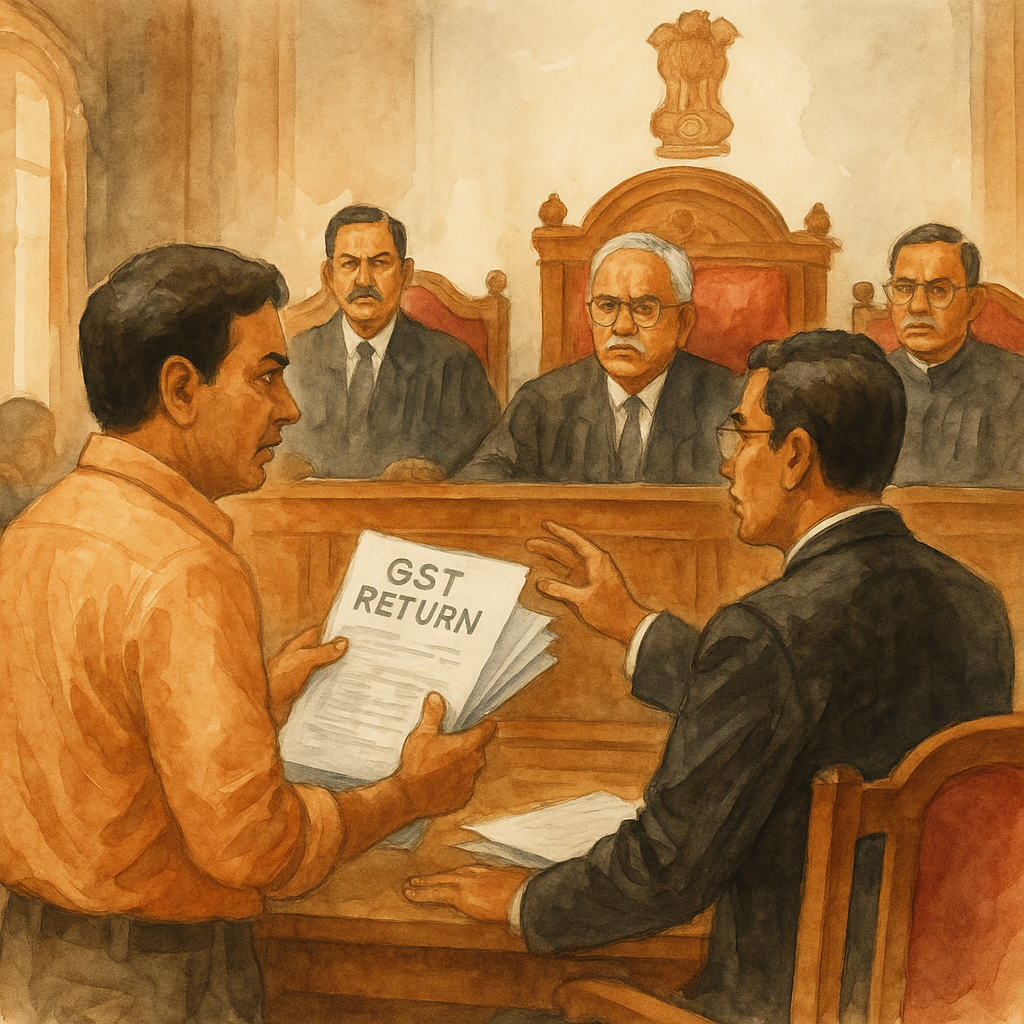
This case arises from a challenge by a registered GST dealer (petitioner) against tax demand and interest orders passed by the State tax authorities and subsequently affirmed in appeal. The business was subjected to proceedings under the GST regime, resulting in a demand of interest calculated on the gross tax liability without giving credit for Input Tax Credit (ITC), and orders were passed without issuing a proper show cause notice or affording adequate hearing.
The petitioner approached the Patna High Court questioning two sets of orders:
- The original orders dated 25.02.2020 passed by the Assistant Commissioner of State Taxes (Assessing Authority), in Form GST DRC-07, whereby interest was imposed on the gross amount without adjusting available ITC, and allegedly without any show cause notice or meaningful opportunity of hearing.
- The appellate orders dated 10.08.2021 passed by the Additional Commissioner of State Taxes (Appeals), Patna West Division, rejecting the petitioner’s appeals in a mechanical manner without dealing with the grounds raised.
The core grievance was that the orders were ex parte, non-speaking, and in violation of the principles of natural justice. The petitioner also alleged that no proper show cause notice was served before making the demand, and that the appellate authority merely upheld the orders without reasoning.
When the matter came before the Patna High Court, counsel for the Revenue fairly stated that he had no objection if the matter was remanded back to the Assessing Authority for a fresh decision on merits and further assured that no coercive steps would be taken during the pendency of such fresh proceedings.
Despite there being a statutory appellate remedy under the GST law, the High Court held that it was not precluded from exercising writ jurisdiction where the impugned orders were ex facie bad in law, particularly on account of violation of natural justice and absence of reasons. The Court highlighted two key aspects:
- The petitioner was not afforded a fair opportunity of hearing; insufficient time was given to respond.
- The orders were ex parte and did not contain sufficient reasons or indicate how the tax liability and interest were quantified.
Since such orders lead to serious civil consequences, the Court held that they could be interfered with in writ proceedings, even though an alternative remedy technically existed.
Accordingly, the High Court:
- Quashed the appellate orders dated 10.08.2021 and the original DRC-07 orders dated 25.02.2020 for different tax periods.
- Remanded the matter to the Assessing Authority for a fresh decision on merits after giving due opportunity to the petitioner.
On the issue of pre-deposit and further safeguards, the Court recorded the petitioner’s statement that 10% of the demand (as required for filing the appeal) had already been deposited. The Court further directed that:
- If the initial 10% pre-deposit had not in fact been deposited, it must be deposited before the next date.
- The petitioner must additionally deposit another 10% of the demand in each case before the Assessing Officer within four weeks.
- Such deposits would be without prejudice to the rights and contentions of the parties. If ultimately it is found that the amount deposited is excess, the same must be refunded within two months from the date of the fresh order.
To protect the business operations of the petitioner, the Court also directed de-freezing / de-attaching of the bank accounts (if attached) in connection with the impugned proceedings, and mandated that this should be done immediately.
The Court fixed a specific date for appearance: the petitioner was to appear before the Assessing Authority on 07.02.2022 at 10:30 A.M., preferably through digital mode. The Assessing Authority was directed to:
- Decide the case on merits,
- Strictly follow the principles of natural justice,
- Give full opportunity to file documents and submissions,
- Refrain from taking any coercive steps during the pendency of the reassessment, and
- Pass a fresh, reasoned (“speaking”) order and supply its copy to the parties.
The Court expressed hope that if the petitioner is aggrieved by the fresh order and chooses to avail further remedies, such proceedings would be dealt with expeditiously in accordance with law. It also clarified that no opinion was expressed on the merits of the demand, and all issues are left open to be decided afresh by the Assessing Authority or any further appellate forum.
In essence, the judgment underscores that even in tax matters under the GST regime, due process, fair hearing, and reasoned orders are compulsory, and failure to follow these basic requirements invites interference by the High Court.
3. Significance or Implication of the Judgment
This judgment is significant both for the general public and for tax authorities in Bihar and beyond:
- Reinforcement of Natural Justice: The Patna High Court has reaffirmed that tax authorities cannot bypass basic procedural safeguards. Even where a specialised statutory appeal mechanism exists, orders passed in violation of natural justice can be directly challenged under Article 226 of the Constitution.
- Requirement of Reasoned Orders: The decision stresses that ex parte orders without reasons are unsustainable. Taxpayers must be able to understand how the demand has been calculated, especially where interest or penalties are imposed. Non-speaking orders are more vulnerable to being set aside.
- Protection Against Coercive Recovery: By restraining coercive recovery and directing de-freezing of the petitioner’s bank accounts during fresh adjudication, the Court has balanced revenue interests with the need to protect ongoing business operations. This is particularly important for small and medium enterprises that may otherwise be crippled by sudden attachment or recovery.
- Clarification on Alternative Remedy: The Court’s approach clarifies that the rule of alternative remedy is a rule of prudence, not a rigid bar. Where there is grave procedural illegality – such as absence of notice, lack of hearing, or unreasoned ex parte orders – the High Court can intervene.
- Guidance to GST Authorities: The detailed directions given to the Assessing Authority — regarding appearance dates, timelines, speaking order, and opportunity to both sides — serve as a model for how reassessment should be conducted in compliance with law.
Overall, this judgment sends a clear message: compliance with GST law does not mean only payment of tax; it also includes adherence by the authorities to fairness, transparency, and due process.
4. Legal Issue(s) Decided and the Court’s Decision with Reasoning
- Whether the High Court can interfere despite the availability of a statutory remedy under GST laws?
- Decision: Yes. The High Court held that it can exercise writ jurisdiction even when a statutory remedy exists, if the order under challenge is ex facie bad in law.
- Reasoning: The Court noted that there was violation of principles of natural justice — insufficient opportunity of hearing and ex parte, non-speaking orders leading to civil consequences. Such serious procedural defects justify interference under Article 226.
- Whether ex parte and non-speaking GST demand orders can be sustained?
- Decision: No. The ex parte orders and the appellate confirmations were quashed.
- Reasoning: The orders did not explain how the amounts were determined. They failed to assign adequate reasons and did not reflect due consideration of the petitioner’s case. Orders affecting civil rights must be reasoned and must show application of mind; otherwise, they are liable to be set aside.
- Whether a matter can be remanded for fresh consideration with conditions of pre-deposit?
- Decision: Yes. The Court remanded the matter to the Assessing Authority, subject to specified deposits (10% already deposited for appeal and an additional 10% to be deposited within four weeks).
- Reasoning: The remand balances revenue protection and taxpayer rights. The pre-deposit secures part of the demand, while the taxpayer gets a fresh opportunity for full adjudication on merits before an authority obligated to pass a speaking order.
- Whether the freezing/attachment of bank accounts can continue during fresh adjudication?
- Decision: No. The Court ordered immediate de-freezing/de-attaching of the petitioner’s bank accounts, if attached, subject to the conditions imposed.
- Reasoning: In the absence of a legally sustainable order, continued attachment would be unjust and would disproportionately harm the taxpayer’s business. The Court found it appropriate to restore normal banking operations while the reassessment is undertaken.
- What procedural safeguards must the Assessing Authority follow on remand?
- Decision: The Assessing Authority must:
- Give adequate opportunity of hearing,
- Permit filing of all relevant documents and materials,
- Avoid coercive steps during pendency,
- Decide the case expeditiously, preferably within two months from appearance, and
- Pass a speaking order with reasons and supply its copy to the parties.
- Reasoning: These directions ensure that the flaws identified in the earlier proceedings are not repeated and that the reassessment conforms to natural justice and statutory requirements.
- Decision: The Assessing Authority must:
7. Case Title
M/S Manshi Automobiles v. Union of India & Ors.
8. Case Number
Civil Writ Jurisdiction Case No. 444 of 2022
10. Coram and Names of Judges
- Hon’ble The Chief Justice (Sanjay Karol, CJ)
- Hon’ble Mr. Justice S. Kumar
11. Names of Advocates and Who They Appeared For
- For the petitioner: Mr. Alok Kumar, Advocate
- For the respondents (Union of India / Tax Authorities):
- Mr. Dr. Krishna Nandan Singh, Assistant Solicitor General (ASG)
- Mr. Vikash Kumar, Standing Counsel 11 (SC 11)
12. Link to Judgment
MTUjNDQ0IzIwMjIjMSNO-y3hbFDi5PaY=
If you found this explanation helpful and wish to stay informed about how legal developments may affect your rights in Bihar, you may consider following Samvida Law Associates for more updates.







