
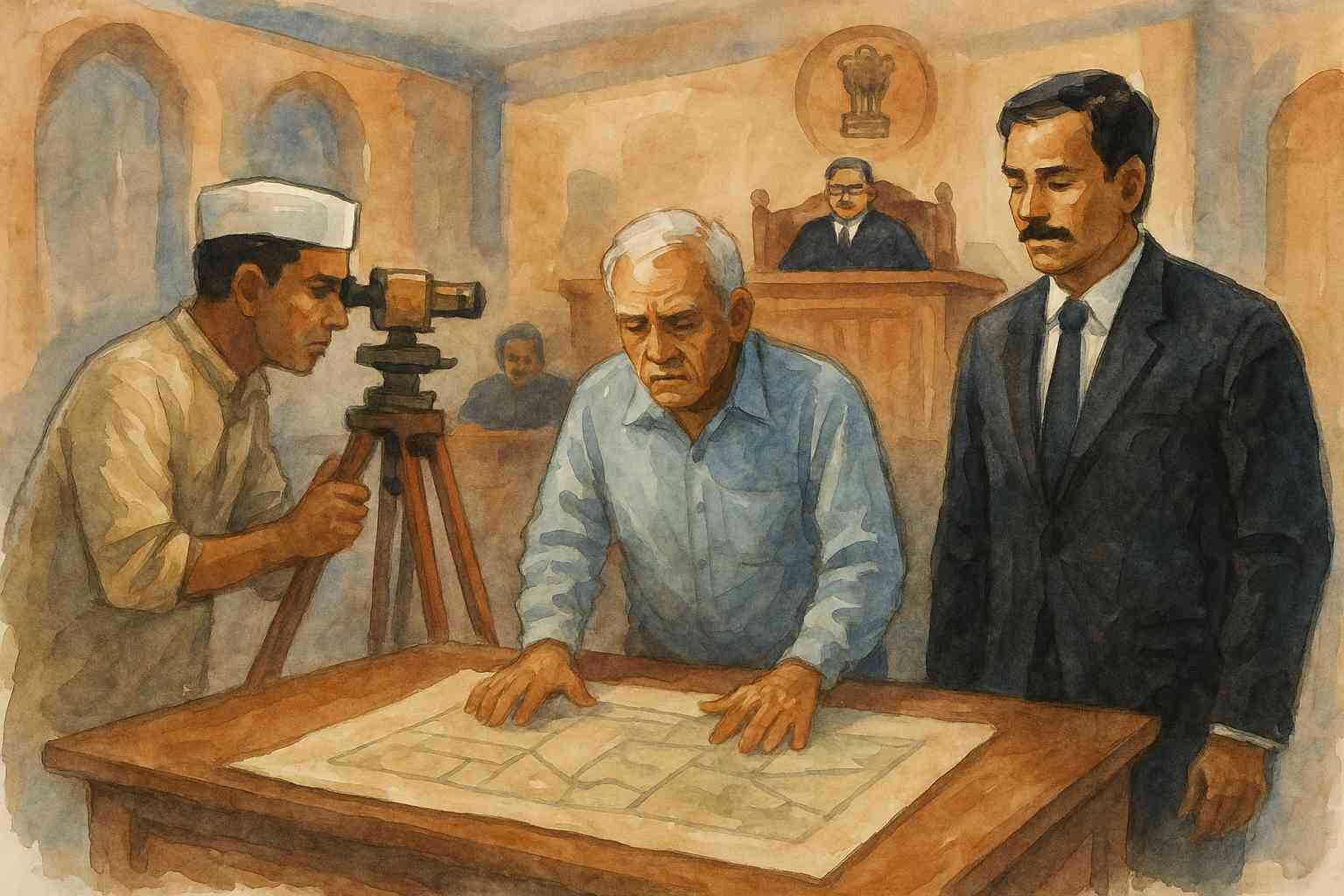
Simplified Explanation of the Judgment
In this civil miscellaneous case, the Patna High Court examined whether a trial court was justified in appointing a survey-knowing pleader commissioner to measure the extent of alleged encroachment in a land dispute. The petitioner, who was the defendant in the original title suit, challenged the trial court’s order that allowed the appointment of a commissioner to survey the disputed property.
The background of the case lies in a Title Suit (No. 349 of 2005) filed by the plaintiffs-respondents seeking a declaration of their ownership and possession rights over certain land, along with a request to remove the defendant’s encroachment from it. They claimed that the encroachment had increased even after the case was filed. The plaintiffs therefore moved an application under Order XVI Rule 10(a) of the Code of Civil Procedure (CPC) for appointment of a survey-knowing pleader commissioner to scientifically ascertain the current physical position of the land.
The trial court allowed the request, holding that in a case of alleged encroachment, such an appointment was legally permissible and necessary to reach a just decision.
The defendant-petitioner challenged this order before the High Court, arguing that:
- The trial court did not clarify what portion of the land would be measured;
- The plaintiffs had not specified the exact area of encroachment or the direction from which it would be measured;
- The suit was for declaration of title and possession, so the appointment of a commissioner was not necessary at that stage.
The High Court, after reviewing the materials on record—including the plaint and the trial court’s order—dismissed the petitioner’s objections.
Justice Anil Kumar Sinha noted that the plaint itself contained a site map showing the alleged encroached portion, and the plaintiffs had clearly stated that the area mentioned in the plaint was tentative because the encroachment had increased during the pendency of the case. To accurately determine the extent of encroachment, scientific measurement by a qualified person was essential.
The Court referred to the Karnataka High Court’s decision in Anil Kamalakar Shirodkar v. Dudhappa Santu Patit & Another (2001 SCC Online KAR 127), which held that appointing a commissioner to measure land in an encroachment dispute is not equivalent to “collecting evidence.” Rather, it assists the court in understanding the physical facts and boundaries necessary for an effective judgment.
Based on this reasoning, the Patna High Court concluded that the appointment of a survey-knowing pleader commissioner was both legal and appropriate. It held that such a step helps the court in adjudicating disputes involving boundaries and encroachments by providing an objective, technical report on the ground situation.
The Court also clarified that appointing a commissioner in such cases should not be viewed as prejudicial to either party—it is an impartial means to ascertain facts scientifically. Therefore, the High Court refused to interfere with the trial court’s order and dismissed the petitioner’s application.
Significance or Implication of the Judgment
This ruling reinforces the principle that courts should rely on technical and scientific assistance in land encroachment disputes to reach accurate conclusions. For litigants and lawyers, the judgment clarifies that:
- The appointment of a pleader commissioner is a valid judicial tool, not an illegal evidence-gathering exercise;
- In suits involving boundaries or encroachments, measurement through a trained surveyor is essential to prevent speculative or exaggerated claims;
- Defendants cannot block such appointments merely by arguing that plaintiffs failed to specify every measurement detail at the outset.
For lower courts, this order acts as a guide that encourages the use of survey-knowing commissioners whenever a dispute involves demarcation of property, ensuring decisions are grounded in objective data rather than assumptions.
From a broader perspective, this judgment strengthens the procedural fairness of civil suits related to land ownership and encroachment in Bihar. It promotes accuracy in fact-finding and helps minimize prolonged litigation caused by ambiguous boundary descriptions.
Legal Issue(s) Decided and the Court’s Decision with Reasoning
- Whether the appointment of a survey-knowing pleader commissioner is legally valid in a land encroachment case.
✅ Decision: Yes. The High Court upheld the appointment, observing that in cases involving boundary disputes or encroachments, such a measure is both just and necessary to determine the actual extent of possession and encroachment. - Whether such appointment amounts to “collecting evidence” prohibited under civil procedure law.
❌ Decision: No. The Court clarified, relying on Anil Kamalakar Shirodkar v. Dudhappa Santu Patit, that the commissioner’s role is to assist the court through factual measurement, not to collect evidence in favor of either party. - Whether the trial court erred in not specifying exact measurement details before appointing the commissioner.
❌ Decision: No. Since the suit and map already indicated tentative encroachment details, and further encroachment allegedly occurred during litigation, precise measurement was possible only through a surveyor’s report. - Final Outcome:
The High Court found no illegality in the trial court’s decision. The petition challenging the appointment was dismissed.
Judgments Relied Upon or Cited by Court
- Anil Kamalakar Shirodkar v. Dudhappa Santu Patit & Another, 2001 SCC Online KAR 127 — establishing that appointment of a commissioner for measurement is lawful and not an evidence-collection exercise.
Case Title
Petitioner vs. Respondents (names withheld for privacy)
Case Number
Civil Miscellaneous Jurisdiction No. 1695 of 2018
(Arising out of Title Suit No. 349 of 2005)
Citation(s)
2023 (1) PLJR 270
Coram and Names of Judges
Hon’ble Mr. Justice Anil Kumar Sinha
Names of Advocates and who they appeared for
- For the petitioner: Mr. Rajani Ranjan Pd. Singh
- For the respondents: Not specified in the order
Link to Judgment
NDQjMTY5NSMyMDE4IzMjTg==-FQpZwxLP–ak1–Iw=
If you found this explanation helpful and wish to stay informed about how legal developments may affect your rights in Bihar, you may consider following Samvida Law Associates for more updates.







