
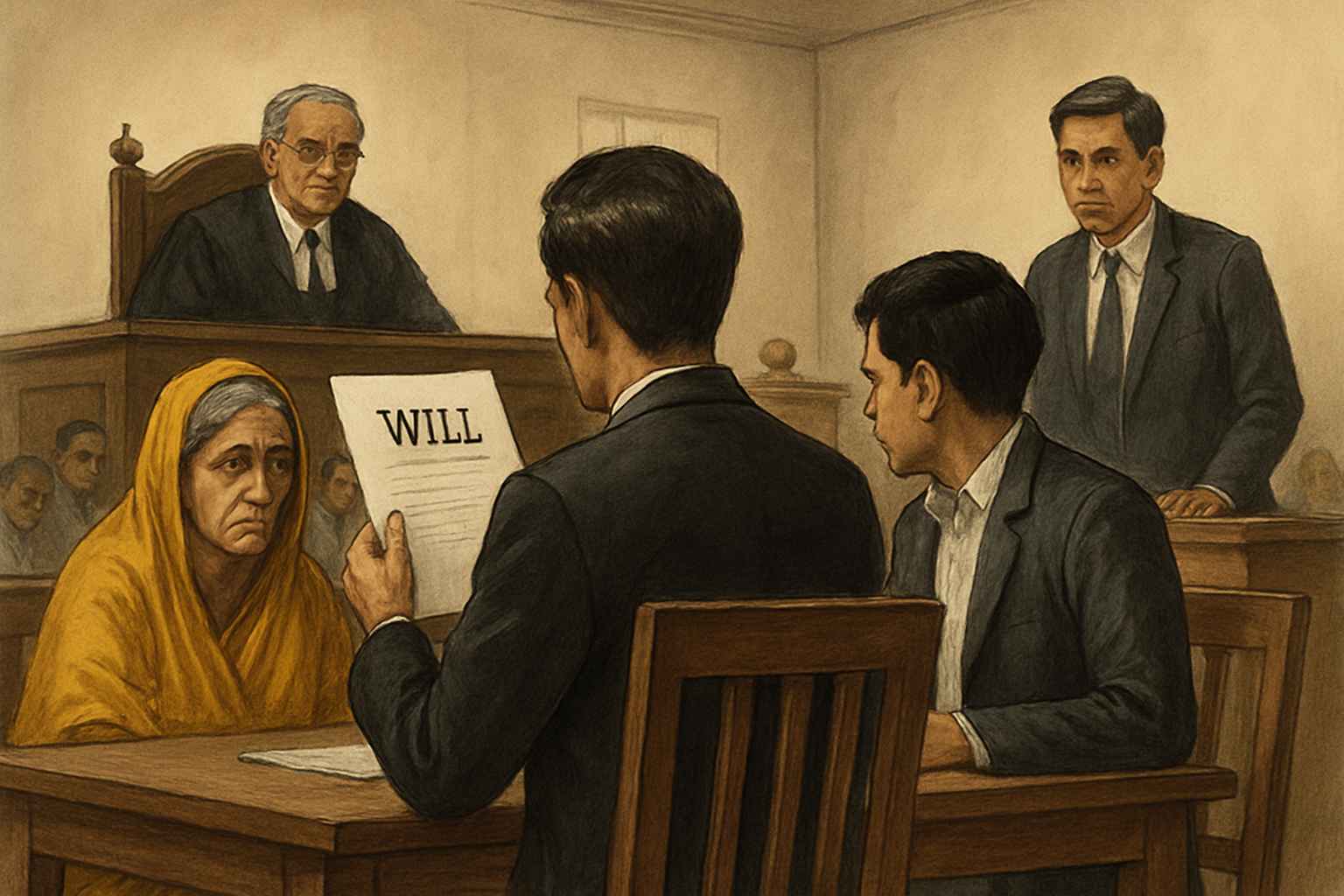
The present blog explains a Patna High Court judgment dated 16 December 2022 in Miscellaneous Appeal No. 1036 of 2016. The Court upheld the refusal to grant a Letter of Administration in favour of the appellant concerning a Will said to be executed by an elderly testator. The decision clarifies what a petitioner must prove in probate/letters of administration proceedings and how “suspicious circumstances” around a Will can defeat the request for grant even when there is no opposition on record.
Simplified Explanation of the Judgment
This appeal came to the High Court after the Additional District Judge-III, Aurangabad, rejected a petition seeking a Letter of Administration over the assets of a deceased woman (the testator). The appellant (the alleged beneficiary) asserted that the testator, an elderly woman, executed a registered Will in his favour in respect of a particular plot of land. He claimed that she did so because he had taken care of her. The High Court’s task was to re-examine whether the lower court rightly refused to grant the Letter of Administration.
Key background facts recorded in the judgment were as follows. The Will related to land bearing Plot No. 604, Khata No. 190, and it was said to be registered. The appellant filed the Letter of Administration case after the testator’s death, producing the Will and a death certificate. Several witnesses were examined in support of the petition, including the scribe, an identifier, and a close relative of the appellant. Since there was no opposition on record, these witnesses were not cross-examined. Despite that, the trial court declined the relief, and the beneficiary appealed to the High Court.
The High Court noted the trial court’s findings that there were “many suspicious circumstances” in the case. Among those, the court highlighted (i) a foundational requirement connected to how the Will described the testator’s authority over the property, and (ii) compliance with statutory disclosures required when seeking succession relief. The trial court had reasoned that a Will should narrate that the testator alone was entitled to deal with the property, yet the schedule to the Will did not clearly state this. That omission, read with other circumstances, suggested an attempt that could cause wrongful loss to other persons who might have a claim.
Another important circumstance concerned dates and the testator’s condition. The record showed the Will’s execution date as 27.06.2003 and the testator’s death as 18.12.2002—creating an obvious chronological concern within about six months. The trial court also underscored the testator’s advanced age—about 80 years—and the absence of cogent evidence proving that she was of sound mind and physically fit to comprehend the document at the time of execution. The High Court took these reasons into account.
A separate and independent statutory lapse also proved fatal. Under Section 372 of the Indian Succession Act (the provision prescribing what a petition for a succession certificate must contain and widely relied upon to emphasize disclosure obligations), the petitioner was required to lay out family details and near relatives. The courts treated this as a disclosure obligation in proceedings for posthumous estate relief. In this case, the testator’s daughter—an immediate heir—was not arrayed as a party. Instead, she appeared as a witness supporting the petitioner’s version. The courts found this omission deeply problematic because disclosure of near relatives is central to ensuring that persons with a prima facie claim can be heard.
The High Court reproduced and referred to the text of Section 372 to illustrate the kind of particulars that must be disclosed—particularly the “family or other near relatives of the deceased and their respective residences.” The point was not merely technical; it served the purpose of transparency and notice. When an immediate heir is not impleaded, and the petitioner instead produces that person as a supporting witness, the foundation of fairness and notice becomes shaky—inviting the court to treat the case with suspicion.
After considering the record, the High Court agreed with the Additional District Judge on three broad reasons: (1) failure to make all family members (including the testator’s daughter) parties to the proceeding; (2) absence of reliable proof that the elderly testator was of sound mind and fit when the Will was allegedly executed; and (3) omission to clearly establish that the property exclusively belonged to the testator, which, if unproven, risks depriving other lawful stakeholders. Finding “force” in these reasons, the High Court held that the lower court was right to reject the claim for a Letter of Administration and dismissed the appeal.
Why this matters for readers: In probate and letters of administration proceedings, the court is not a rubber stamp. Even if nobody contests, the petitioner must dispel suspicious circumstances and meet statutory requirements of disclosure and proof. A registered Will does not guarantee success if basic ingredients—like impleading close heirs or proving the testator’s capacity—are missing. On these facts, the High Court’s analysis teaches that (a) transparency about family members is non-negotiable; (b) medical or other reliable evidence about mental capacity becomes crucial where the testator is very old; and (c) the Will and pleadings should make it clear that the property was indeed the testator’s to bequeath. Where these pillars are weak, courts can and will refuse the grant.
Significance or Implication of the Judgment (For general public or government)
For the general public and legal practitioners in Bihar, this decision reinforces three practical lessons:
• Probate/administration is not automatic. Even uncontested Wills must survive judicial scrutiny. Petitioners should expect the court to look for clarity on ownership, capacity, and notice to heirs. If a close heir is missing from the array of parties, it can by itself trigger suspicion and derail the petition.
• Elderly testator = higher diligence. When the testator is of advanced age, the petitioner should proactively present materials showing that the testator had a sound and disposing mind at the time of execution—such as medical notes, testimony of the scribe/attesting witnesses addressing capacity, or other contemporaneous proof. In this case, such cogent evidence was absent.
• Clear title narrative is key. The Will and pleadings should clearly state that the testator had exclusive authority to bequeath the property. If there is a chance others could claim an interest, the court will demand clarity before granting any representative right over the estate. The omission in the schedule here contributed to the court’s conclusion that granting relief could cause wrongful loss to others.
Overall, the ruling serves as a compliance checklist for anyone planning to present a Will in court: identify and implead all near relatives; affirm capacity with credible evidence; and establish the testator’s title in plain terms. Government and court registries may also regard this as a reminder to ensure that succession filings present transparent family charts and addresses, enabling better notice and fewer contested grants later.
Legal Issue(s) Decided and the Court’s Decision with reasoning
• Whether a Letter of Administration can be granted when suspicious circumstances surround the Will and statutory disclosure obligations are not met.
Decision: No. The High Court affirmed the trial court’s refusal because (a) near relatives (including the testator’s daughter) were not made parties, (b) there was no cogent proof that the 80-year-old testator had a sound mind and understood the Will at execution, and (c) the Will/schedule did not clearly state that the property exclusively belonged to the testator—together giving rise to legitimate suspicion.
• Whether absence of opposition or non-cross-examination of witnesses assures grant of administration.
Decision: No. Even where witnesses are not cross-examined because there is no opposition, the court can still refuse relief if intrinsic defects or suspicious features persist on the record. Here, despite multiple supporting witnesses and exhibits, the statutory and substantive deficiencies remained fatal.
• Whether the appeal deserved interference with the trial court’s findings.
Decision: No. The High Court found “force” in the trial court’s reasoning and dismissed the appeal, confirming that the refusal to grant the Letter of Administration was justified.
Case Title
Miscellaneous Appeal concerning refusal of Letter of Administration (names anonymised for publication)
Case Number
Miscellaneous Appeal No. 1036 of 2016
Citation(s)
2023 (1) PLJR 218
Coram and Names of Judges
Hon’ble Mr. Justice Rajiv Roy (CAV Judgment dated 16.12.2022)
Names of Advocates and who they appeared for
• For the appellant(s): Mr. Mrigendra Kumar, Advocate.
• For the respondent(s): Not on record in the judgment extract.
Link to Judgment
https://patnahighcourt.gov.in/viewjudgment/MiMxMDM2IzIwMTYjMSNO-45lcy6Z8uMQ=
If you found this explanation helpful and wish to stay informed about how legal developments may affect your rights in Bihar, you may consider following Samvida Law Associates for more updates.







