
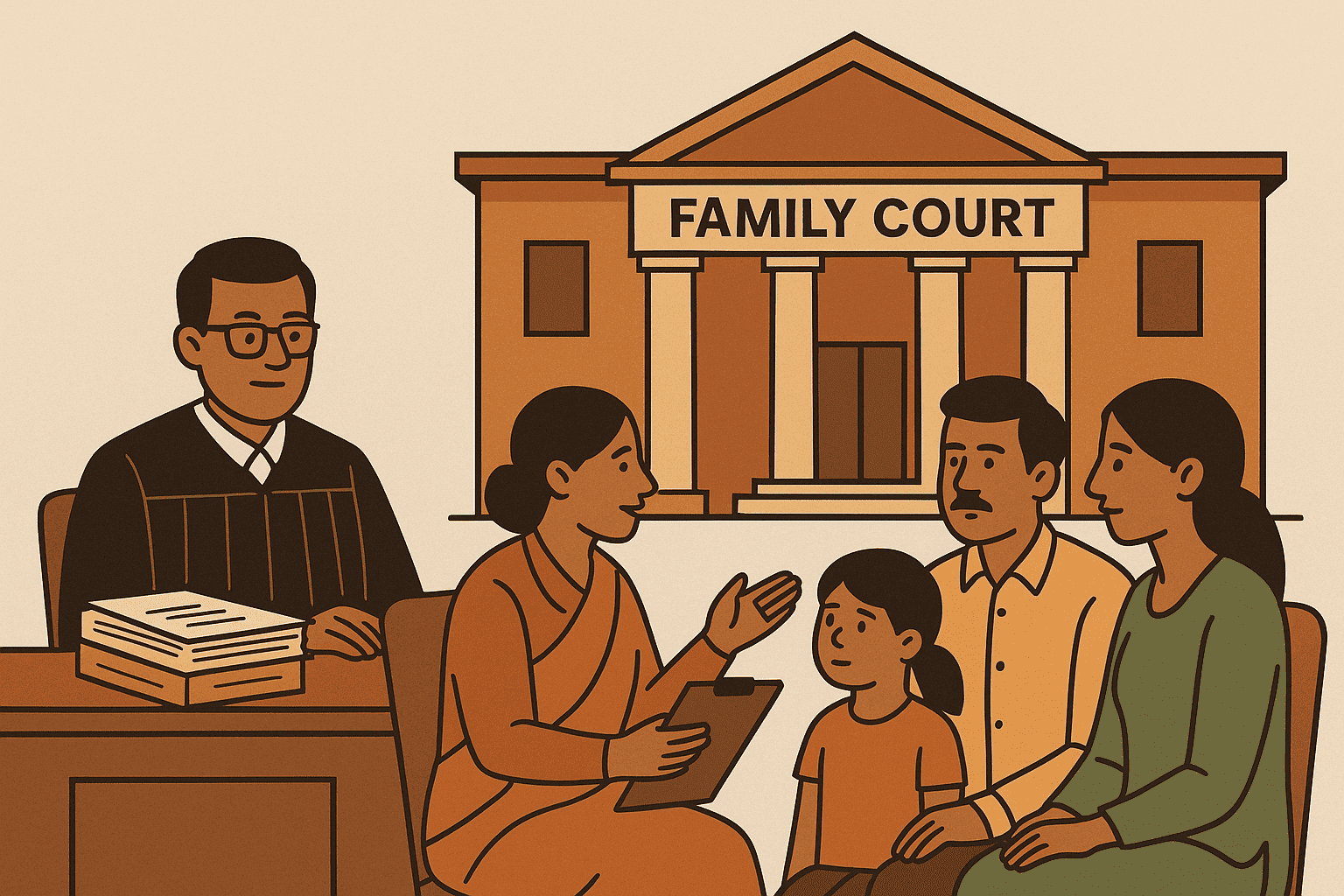
Act / Rule Name: The Bihar Family Courts Rules, 2011
Type: State Rules framed under Section 23 of the Family Courts Act, 1984 (Central Act 66 of 1984)
Year & Notification: S.O. 3336, dated 25 March 2011 (General Administration Department, Government of Bihar)
Territorial Extent: Whole of the State of Bihar
Last Updated (based on accessible sources): No published State amendment to these Rules could be traced up to 26 November 2025. Any later changes, if notified, are not reflected in this explainer.
Official Clean PDF:THE BIHAR FAMILY COURTS RULES, 2011.pdf – Google Drive
1. Introduction
The Bihar Family Courts Rules, 2011 are State-level rules made under the Family Courts Act, 1984. Their main purpose is to:
- Lay down how Family Court Judges in Bihar are appointed, and what service conditions they enjoy.
- Specify the staffing pattern and procedure for filing cases in Bihar Family Courts.
- Provide for medical experts, amicus curiae, counsellors and welfare-oriented procedures so that family disputes are handled in a less adversarial and more conciliatory way.
These Rules operate alongside:
- The Family Courts Act, 1984 (central law), which creates Family Courts and sets broad principles.
- The Family Courts (Patna High Court) Rules, 2000, which mainly deal with court procedure and case management from the High Court side.
Together, these frameworks govern how matrimonial and family disputes are handled in Family Courts across Bihar.
2. Structure of the Bihar Family Courts Rules, 2011
| Rule No. | Subject / Heading | What it broadly deals with |
|---|---|---|
| Rule 1 | Short title, extent, commencement | Name of the Rules, that they apply to whole Bihar, and start from date of Gazette publication. |
| Rule 2 | Definitions | Key terms like Act, Citizen of India, Governor, Government, High Court, Post, Section. |
| Rule 3 | Appointment of Judges | Modes of appointing Family Court Judges (deputation, re-appointment, direct appointment). |
| Rule 4 | Salary, allowances & service conditions of Judges | Pay, age limits, pension, re-appointment after superannuation, transfer, dress, car, facilities. |
| Rule 5 | Filing of applications | How applications are filed in Family Courts, link with Civil Court Rules and CrPC. |
| Rule 6 | Service conditions of officers & employees | Sanctioned strength, source of recruitment, deputation & pay parity with Civil Court staff. |
| Rule 7 | Medical Expert | Engagement and remuneration of medical / other experts. |
| Rule 8 | Amicus curiae | When and how experienced advocates may be appointed to assist the Court. |
| Rule 9 | Appointment of Counsellors & other persons | Panel of institutions/NGOs/persons, minimum age, honorarium and role of counsellors. |
| Rule 10 | Duties & functions of Counsellors | Reconciliation role, home visits, confidentiality, reporting and ongoing support to families. |
3. Key Provisions Explained – With Simple Examples
Rule 3 – Appointment of Family Court Judges
What it says (simplified):
A Family Court Judge in Bihar can be appointed in three ways:
- Deputation of a member of the Bihar Superior Judicial Service (BSJS) or a person with at least 7 years’ experience in a Tribunal or government post requiring special legal knowledge.
- Re-appointment of a retired person from the above categories.
- Direct appointment of a person who is otherwise eligible under Section 4(3)(b) & (c) of the Family Courts Act (e.g., experienced social workers or persons with special knowledge in family welfare).
There is also a specific selection process for appointments under clause (c):
- Patna High Court invites applications, scrutinises them through a committee of High Court Judges, interviews candidates and then recommends names to the State Government for appointment.
Special point: Appointment of a Principal Judge, Family Court directly from outside BSJS is meant to be rare and exceptional, purely on contract for a fixed term, with negotiable service terms.
Example (Bihar context):
If Patna Family Court needs an Additional Judge and no suitable BSJS officer is immediately available, the High Court might consider a retired District Judge or a legal academic with long family-law experience, through this clause—but only after following the formal process and treating it as an exception.
Rule 4 – Pay, Tenure and Conditions of Service
Key features:
- Deputation from BSJS:
- Salary & allowances same as a District Judge on deputation.
- Conditions cannot be changed to the Judge’s disadvantage after posting.
- Deputation from other services (e.g., IAS/State services with legal work):
- Governed by their parent service rules, with pay as per Bihar Service Rules for deputation.
- Direct appointees (Rule 3(1)(c)):
- Treated like members of BSJS (Selection Grade) for pay and conditions; pay starts at minimum of that scale.
- Age conditions:
- No one can be appointed before 35 years or after 62 years.
- If already a government servant, they automatically retire on reaching their normal superannuation age in the parent department; they may be re-appointed as Family Court Judge for up to 2 years, extendable, but never beyond 62 years.
- Retired BSJS Judges:
- Can be re-appointed as Family Court Judge for up to 2 years (extendable up to 62), on pay/allowances permitted to a retired government servant.
- Pension:
- For persons not drawn from BSJS or other services, pension is governed by contributory pension rules or any pension rules notified by the State Government from time to time.
- Administrative aspects:
- High Court can transfer any Family Court Judge within Bihar.
- Judge works under administrative control and superintendence of Patna High Court (this is now frequently cited in case law).
- Dress is similar to a District & Sessions Judge.
- Staff car with 100 litres of petrol per month, telephone at residence and chamber, and a small library are provided.
Example:
A BSJS officer posted as District Judge, Gaya, may be deputed as Principal Judge, Family Court, Gaya. She continues to enjoy the same seniority and pay protections as in BSJS, and the High Court can later transfer her to another Family Court or back to a regular district judgeship.
Rule 5 – Filing of Applications
Civil-type matters:
- Filing is governed by Rule 212 and 214 of the Civil Court Rules of Patna High Court, as far as applicable.
- Every application must carry a verification certificate that its contents are true to the applicant’s knowledge and belief.
Criminal-type matters:
- Applications under the Code of Criminal Procedure, 1973 (the Rule mentions Chapter “X”; in practice, maintenance proceedings under Chapter IX / Section 125 CrPC are handled in Family Courts) are to be presented before the Family Court and dealt with in the manner provided in that Chapter of CrPC.
Service of summons/notices:
- Done through the Nazarat of the Civil Court and as per Order V CPC, i.e., similar to regular civil suits.
Example:
A wife in Muzaffarpur wants maintenance under Section 125 CrPC. Instead of going to the Judicial Magistrate, her petition is filed directly in the Family Court, Muzaffarpur, and summons are served via Nazarat like any civil case.
Rule 6 – Officers and Employees
- Family Court gets the same categories and numbers of staff as an equivalent level civil court (e.g., Sheristedar, Bench Clerk, Reader, Stenographer, Peons, etc.).
- Normally, staff are appointed or deputed from District Civil Courts.
- If the District Judge cannot spare staff, the Principal Judge, Family Court can make temporary/contractual appointments in line with Bihar Civil Court Staff (Class III and IV) Rules, 1998, with High Court consultation.
- Pay and allowances mirror those of Civil Court staff.
Example:
If a new outlying Family Court starts at a sub-division where no separate civil court staff are available, the Principal Judge can temporarily hire a stenographer and orderly peon following the Civil Court Staff Rules, until regular deployment is made.
Rule 7 – Medical Experts
- Family Court can secure the services of medical experts or other experts as needed.
- Local experts: honorarium of ₹250 per day.
- Non-local experts: ₹750 per day plus TA as per rules for witnesses before the Sessions Judge.
- Fees are to be revised at least once every five years (though in practice this may need formal government action).
Example:
In a disputed paternity case in Bhagalpur Family Court, a government doctor from a nearby district hospital is summoned to give evidence on DNA test reports and is paid as per this Rule.
Rule 8 – Amicus Curiae
- In appropriate cases, the Judge may appoint an advocate with at least 7 years’ experience as amicus curiae to assist the Court.
- Fees are paid by the State Government, at rates similar to Additional Public Prosecutors in Civil Courts.
Example:
In a complex child custody matter involving cross-border issues, the Family Court at Patna may appoint a senior family-law practitioner as amicus curiae to help analyse welfare of the child, foreign orders, and Indian law.
Rule 9 – Panel & Appointment of Counsellors
Key points:
- State Government, in consultation with the High Court, must notify a panel (district-wise/area-wise) of:
- Institutions/organisations, and
- Individual persons (preferably women)
engaged in social welfare and family welfare.
- Names are sourced from the Welfare Department, District Magistrate and District & Principal Judges.
- Panel can be revised anytime (additions/removals) based on Family Court reports.
- Minimum age for counsellors: 30 years.
- The Court appoints counsellors from this notified panel.
- Honorarium: ₹750 per case, payable at a suitable stage determined by the Principal Judge, and revisable at least every five years.
Example:
An NGO in Nalanda working on domestic violence and family counselling is placed on the panel. When a couple approaches the Family Court for divorce, the Court may assign a counsellor from this NGO to attempt reconciliation or to help in crafting a mutually agreed settlement, especially on child custody and maintenance.
Rule 10 – Duties and Functions of Counsellors
Counsellors are central to the conciliation-focused model of Family Courts:
- Reconciliation: They must assist the Court and advise parties to settle disputes, doing their best to bring about reconciliation.
- Home visits & interviews:
- May visit parties’ homes, meet relatives, friends, colleagues to understand family environment.
- Cannot visit the house of a lone female without prior Family Court permission.
- Confidentiality:
- All information, statements and notes are confidential.
- Can be disclosed only with consent of both parties and leave of the Court.
- Counsellor cannot be summoned as a witness about these communications.
- Reporting:
- May submit a report on home environment, relationship of spouses, children, income and standard of living.
- Report should be objective, without assigning blame when reconciliation fails.
- Party is entitled to a copy of the report and may make submissions on it.
- No private fees / advocacy:
- Counsellor cannot accept fees from parties or act/plead for either side.
- Post-settlement support:
- May continue to guide and support the reconciled couple even after a settlement.
Example (linked to current Patna High Court view):
In Abdul Rehan Khan @ Abdul Raihan Khan v. State of Bihar & Anr. (2025), Patna High Court stressed that non-appointment of counsellors and failure to send cases for conciliation violates Section 9 of the Family Courts Act and Rules 9–10 of the Bihar Family Courts Rules, 2011, and the Family Courts (Patna High Court) Rules, 2000.
4. Practical Implications in Bihar
For Citizens and Families
- Where to file:
- Matrimonial disputes (divorce, restitution, judicial separation), custody, guardianship and even maintenance under Section 125 CrPC typically go to the Family Court, not ordinary civil or criminal courts, in districts where Family Courts are established.
- Conciliation first:
- You should expect counselling and settlement efforts before a full trial. Courts are meant to be less formal and more solution-oriented.
- Confidentiality:
- Things told to counsellors are normally confidential and not used as evidence, which encourages frank discussion.
- Report access:
- You can ask for a copy of the counsellor’s report and place your response before the Court.
For Advocates
- Be mindful that Family Courts are not purely adversarial forums; they are required to promote conciliation.
- Where counsellors are not appointed or not used, Patna High Court has started treating it as a serious procedural lapse.
- The Rules also allow for appointment as amicus curiae (with minimum 7 years’ experience), which may be relevant in complex or sensitive matters.
For Government Departments / Judiciary
- State Government must:
- Maintain and periodically revise panels of counsellors and welfare organisations for each district.
- Provide budget for honorarium, experts, amicus, staff car, library, etc.
- Patna High Court:
- Exercises administrative control over Family Court Judges and can transfer them.
- Must coordinate with Government to ensure counsellor appointments and effective implementation of conciliation-related rules.
5. FAQs – Common Questions about Bihar Family Courts Rules, 2011
1. Who appoints Family Court Judges in Bihar?
Appointments are ultimately made by the State Government, but only after recommendations from Patna High Court—especially for direct appointees under Rule 3(1)(c), where a High Court committee scrutinises candidates and sends names to the Government.
2. Are counsellors mandatory in Bihar Family Courts?
Yes. Under Rules 9–10 and Section 9 of the Family Courts Act, appointment and use of counsellors is part of the statutory scheme. Patna High Court has recently held that non-appointment of counsellors and failure to send cases to them for conciliation violate mandatory provisions.
3. Can I still file a Section 125 CrPC maintenance case in Magistrate’s court in Bihar?
Where a Family Court exists, maintenance and other family-related proceedings are normally handled by that Family Court, as per the Family Courts Act and these Rules. However, exact forum choice can depend on local notifications and judicial interpretation, so parties generally check the local Family Court’s practice and jurisdictional notifications.
4. Do these Rules change substantive family law (Hindu Marriage Act, Muslim law, etc.)?
No. The Rules mainly deal with appointments, procedure, staffing and welfare mechanisms (counsellors, experts, etc.). Substantive rights still come from central Acts like the Hindu Marriage Act, 1955; Hindu Minority and Guardianship Act, 1956; CrPC; and personal laws.
5. Is what I say to a counsellor in Family Court admissible as evidence?
Ordinarily, no. Rule 10 explicitly states that information given to counsellors, their notes and reports are confidential and cannot be disclosed or used as evidence, unless both parties agree and the Court permits. Counsellors cannot be called as witnesses about such communications.
6. Are Family Court working hours and holidays different from other Courts?
Family Courts in Bihar follow the same working hours, holidays and vacations as civil courts, as fixed by Patna High Court. The Rules also make the District Registrar/Judge-in-Charge responsible for building maintenance and administrative support.
6. Case Laws & Illustrative Decisions
(A) Patna High Court on Mandatory Counsellors – 2025
In Abdul Rehan Khan @ Abdul Raihan Khan v. State of Bihar & Anr. (2025, Patna High Court), the Court dealt with a criminal revision against a maintenance order passed by a Family Court. The husband argued that:
- No counsellor had been appointed under the Bihar Family Courts Rules, 2011, and
- The case had not been referred to conciliation as required by Section 9 of the Family Courts Act and the Family Courts (Patna High Court) Rules, 2000.
The High Court observed that:
- Appointment of counsellors and recourse to conciliation are mandatory, not optional.
- Failure to do so undermines the statutory objective of Family Courts and risks turning them into ordinary adversarial forums.
- The Registrar General was directed to report on counsellor appointments and their functioning across Bihar.
This decision significantly emphasises practical implementation of Rules 9–10.
(B) Supreme Court on Conciliation & Family Courts’ Role – K.A. Abdul Jaleel v. T.A. Shahida (2003)
Although not Bihar-specific, the Supreme Court in K.A. Abdul Jaleel v. T.A. Shahida, (2003) 4 SCC 166 underscored that the Family Courts Act exists to:
- Promote conciliation and speedy settlement of family disputes.
- Be interpreted liberally, so that disputes “relating to marriage and family affairs” (including property disputes between spouses, even after divorce) can be dealt with in Family Courts.
This broader reading supports the conciliatory and welfare-oriented approach embedded in the Bihar Family Courts Rules, especially around counsellors, experts and simplified procedures.
7. Related Laws & Instruments in Bihar
Readers may also wish to see:
- Family Courts Act, 1984 (Central Act 66 of 1984).
- Family Courts (Patna High Court) Rules, 2000 – procedural rules issued by the High Court.
- Bihar Civil Court Staff (Class III and IV) Rules, 1998 – applied for staff appointments in Rule 6.
- Substantive family laws such as:
- Hindu Marriage Act, 1955
- Hindu Minority and Guardianship Act, 1956
- Muslim personal law (as applied by courts)
- Guardians and Wards Act, 1890
- Code of Criminal Procedure, 1973 (particularly Chapter IX – maintenance).
8. Summary
The Bihar Family Courts Rules, 2011 are State-framed rules that operationalise the Family Courts Act, 1984 within Bihar. They do not re-write substantive family law but instead organise the institutional architecture—who will preside over Family Courts, how they will be supported, and what welfare-oriented mechanisms (like counsellors and experts) must be in place.
On the judicial side, the Rules explain how Family Court Judges are appointed, largely from the Bihar Superior Judicial Service or from comparable legal positions, with clear conditions on age, tenure, pay and re-appointment. The High Court’s role is central: it supervises judges administratively, manages transfers and contributes to the selection process, especially where external appointees are considered. Judges receive facilities similar to District Judges, including staff car, library resources and administrative support from the local civil court establishment.
On the procedural and administrative side, the Rules link Family Court filing practice with existing Civil Court Rules and CrPC provisions, while channelling summons through the Nazarat. Staff are generally drawn from District Civil Courts, with fallback powers for temporary appointments when necessary. Experts, including doctors and other specialists, can be engaged on defined terms to assist in technical aspects like medical evidence.
The distinctive feature of these Rules is the structured system of counsellors and social-welfare partners. The State Government, in consultation with Patna High Court, must create and update district-wise panels of institutions and individuals who can act as counsellors. The Rules spell out who can serve, what honorarium they receive, how they interact with parties, and how they report back to the Court while maintaining confidentiality. Their statutory duty is to promote reconciliation, understand family dynamics through home visits and interviews, and assist the Court in framing welfare-oriented outcomes.
Recent Patna High Court decisions highlight that non-implementation of these counselling provisions can amount to a breach of mandatory statutory requirements, reinforcing that Bihar’s Family Courts are expected to be reconciliation-driven, not merely miniature civil and criminal courts. Citizens, advocates and officials in Bihar should therefore view these Rules as a practical roadmap for how family disputes ought to be approached—firm on rights, but with a strong institutional bias towards settlement, privacy and welfare of the family unit.
🗣️ This article is part of Samvida Law Associates’ effort to simplify Bihar’s laws for public understanding. For individual legal problems, it is always advisable to consult a qualified advocate.
Disclaimer: This post is for informational purposes only and does not constitute legal advice.







