
Act / Rule Name: The Bihar Chowkidar Cadre (Amendment) Rules, 2014
Notification No.: 01/Chow-90-01/2014, H.P. 1896 (Home (Police) Department, Bihar)
Parent Law: Bihar Chowkidar Cadre Rules, 2006 (as amended from time to time)
Year: 2014
Last Updated (this explainer): 14 November 2025
Official Clean PDF: https://drive.google.com/file/d/1m2EVjvH6L0SG7W_sXsbM7NlGGrL4XBjR/view?usp=share_link
Where available, the official text can be cross-checked with:
- Bihar Chowkidar Cadre (Amendment) Rules, 2014 – text as hosted on legal databases
- Patna High Court judgments referring to Notification No. 1896 dated 05.03.2014
1. Introduction
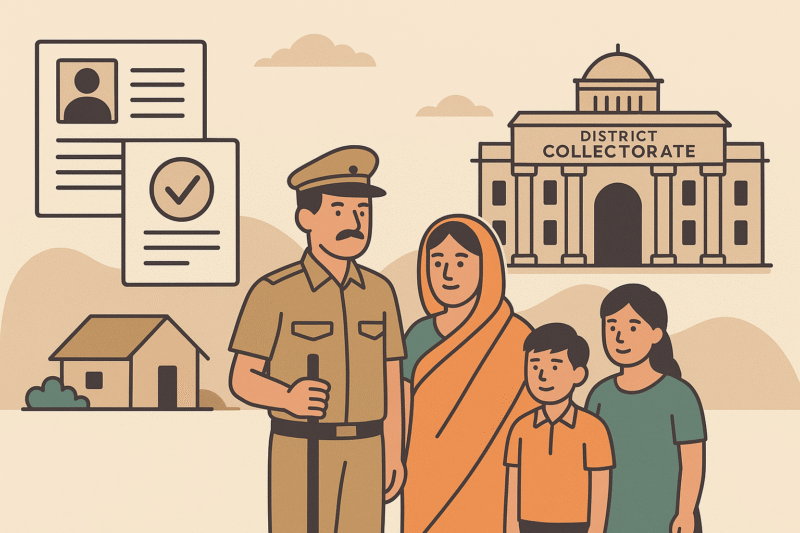
The Bihar Chowkidar Cadre (Amendment) Rules, 2014 are a short but very important set of service rules for village watchmen (Chowkidars) and Dafadars working under the Bihar government. They amend the original Bihar Chowkidar Cadre Rules, 2006.
Broadly, the 2014 Amendment Rules do three key things:
- Define when a Chowkidar/Dafadar can take voluntary retirement.
- Clarify who counts as a “dependent” for getting a job after such voluntary retirement.
- Raise the minimum educational qualification for fresh appointment from 8th pass to 10th pass (or equivalent), and introduce a structured process for voluntary retirement with appointment of a dependent.
In practice, this amendment is heavily used in matters relating to:
- Voluntary retirement of existing Chowkidars and Dafadars
- Appointment of their dependents on the post of Chowkidar
- Disputes before the District Magistrate (DM), Home (Police) Department and the Patna High Court (CaseMine)
Later amendments, particularly in 2016 and 2019, further changed the cadre structure and certain powers, but the 2014 amendment remains the core basis for voluntary retirement with nomination of a dependent. (LegitQuest)
2. Structure of the 2014 Amendment Rules
Although it is only a one-page notification, it amends important parts of the 2006 Rules. Its internal structure can be seen like this:
| Part / Rule | Subject | What it really deals with |
|---|---|---|
| Rule 1 | Short title, extent, commencement | Gives the name “The Bihar Chowkidar Cadre (Amendment) Rules, 2014”, applies to whole Bihar, and comes into force at once. |
| Rule 2 | Insertion of sub-rules (6) and (7) in Rule 2 of the 2006 Rules | Defines who is “eligible for voluntary retirement” and who is a “dependent”. |
| Rule 3 | Amendments to Rule 5 of the 2006 Rules | (i) Raises qualification from 8th to 10th pass; (ii) adds a new proviso for voluntary retirement and appointment of a dependent, with timing and age-limit conditions. |
3. Key Provisions Explained (with examples)
Rule 1 – Short title, extent and commencement
- The Rules are formally called “The Bihar Chowkidar Cadre (Amendment) Rules, 2014”.
- They extend to the whole State of Bihar.
- They come into force at once – meaning from the date of notification in 2014.
Practical meaning:
From the date of notification (05.03.2014, as noted by the Patna High Court), all matters of voluntary retirement and dependent appointments under the Chowkidar Cadre must follow these amended provisions.
Rule 2 – Who is eligible for voluntary retirement & who is a “dependent”
Rule 2 of the 2006 Rules (definitions) gets two new sub-rules:
- Sub-rule (6) – Person eligible for voluntary retirement
- A “person eligible for voluntary retirement” means:
- a watchman (Chowkidar) or Dafadar,
- with qualifying service of 20 years, and
- not less than 55 years of age.
- A Chowkidar aged 54 with 25 years of service → cannot use these rules yet (age is less than 55).
- A Dafadar aged 56 with 19 years of service → cannot use these rules (service is less than 20 years).
- A Chowkidar aged 57 with 22 years of service → eligible to seek voluntary retirement under this amendment.
- A “person eligible for voluntary retirement” means:
- Sub-rule (7) – Definition of “dependent” The amendment defines “dependent” to mean:
- Wife of the government servant
- Son
- Unmarried daughter
- Widowed daughter-in-law (described as “widowed son bride”) who has not remarried
- Married daughter is not included in this definition.
- Adopted children are not expressly mentioned; treatment may depend on general service law and case-law.
- A widowed daughter-in-law loses eligibility if she remarries.
- A Chowkidar wants to nominate:
- his married daughter – not covered;
- his widowed daughter-in-law (who has not remarried) – covered;
- his younger unmarried daughter – covered;
- his younger brother – not covered.
Courts have repeatedly relied on this definition while testing who can claim appointment after voluntary retirement.
Rule 3 – Changes in educational qualification & voluntary retirement with nomination of a dependent
Rule 3 of the 2014 Amendment makes two significant changes in Rule 5 of the 2006 Rules (relating to appointment and conditions):
(A) Educational qualification – 8th → 10th pass
- In sub-rule (2) of Rule 5 of the 2006 Rules, the word “eighth” is replaced with “tenth or equivalent”.
Effect:
For new recruitment under the Bihar Chowkidar Cadre Rules, the minimum qualification becomes Matric (10th pass or equivalent). This is consistent with later recruitment notices that specify 10th pass for Chowkidar posts in Bihar.
Example:
- Earlier: 8th pass person could apply for Chowkidar.
- After this amendment: Candidate must be 10th pass or equivalent to be considered.
(B) New provisos after Rule 5(7) – Voluntary retirement and appointment of a dependent
The amendment adds a cluster of provisos after sub-rule (7) of Rule 5. In substance, they say:
- Right to seek voluntary retirement with nomination of a dependent A Chowkidar employee can apply for voluntary retirement and for employment of a dependent named by him on the watchman post, at least one month before the date of his retirement. Meaning & timing:
- The employee must file the application minimum one month before the date from which he wants retirement to take effect.
- In the same application, he can ask for his dependent’s appointment as Chowkidar.
- Age-limit rules still apply to the dependent The minimum and maximum age limits fixed by the General Administration Department (GAD) from time to time will continue to apply. Meaning:
- Even if a person is a “dependent” under the definition, he/she must also fall within the prescribed age-limits for recruitment to Chowkidar post.
- Relaxations (if any) are as per normal GAD rules.
- No “second” dependent appointment After voluntary retirement, the dependent of the person appointed will not get the benefit of this proviso. Meaning:
- Once the first Chowkidar retires and his dependent gets the job, that dependent cannot again use the same voluntary retirement + dependent appointment route as an automatic chain.
- It prevents “hereditary” succession beyond one step.
- Where to apply – District Magistrate & timeline An employee of Chowkidar cadre desirous of voluntary retirement must submit his application to the District Officer (District Magistrate) of his posting district at least one month before his intended date of retirement. Meaning:
- Application goes to the DM (Cadre Controlling / Appointing Authority).
- It must reach at least one month before the requested retirement date.
How courts have read these provisos (important practical point):
Patna High Court has clarified that:
- There are two related timelines:
- One month gap before the date of voluntary retirement; and
- One month gap before superannuation, if the person wants to retire earlier and get dependent appointment before normal retirement.
- Applications filed more than one month before the date of retirement/voluntary retirement are generally treated as within time, and rejection only on hyper-technical grounds (e.g., failure to write the exact date clearly when the intention is otherwise clear) has been disapproved by the High Court.
4. Practical Implications in Bihar
For Chowkidars & Dafadars
- You can plan voluntary retirement after 20 years of service and once you are 55+.
- You can request appointment of one dependent (wife, son, unmarried daughter, or widowed daughter-in-law who has not remarried) as Chowkidar.
- You must submit the application at least one month before the date from which you want retirement, routed to the DM of your district.
- The dependent must satisfy educational qualification (10th pass) and age limits set by GAD.
For dependents seeking appointment
- Your right is not automatic – it depends on:
- Eligibility of the employee (service length + age).
- Timely application.
- Your own compliance with education and age norms.
- Courts have often directed authorities to reconsider or grant appointment where the employee did everything within time but the DM misread the rules.
For District Magistrates & district administration
- DM acts as appointing and cadre-controlling authority for Chowkidar cadre.
- While deciding voluntary retirement & dependent appointment:
- Check service + age of the employee.
- Check definition of dependent carefully.
- Verify that the application date is at least one month before the intended date.
- Apply GAD age-limit rules to the dependent.
- High Court orders show that mechanical rejections (for small technicalities where substance is fulfilled) can be set aside.
For recruitment & policy (Home (Police) Department / GAD)
- The 2014 amendment aligns Chowkidar qualification with Matric level, similar to many other Class IV/Group D positions now requiring 10th pass.
- Later amendments (2016, 2019) build on this foundation – introducing Senior Dafadar posts, pay-bands and altering some disciplinary control; these must be read together with 2014 Rules for present-day administration.
5. FAQs – Real-world Questions People Often Ask
1. Who exactly can take voluntary retirement under the 2014 Rules?
A Chowkidar or Dafadar who has:
- At least 20 years of qualifying service, and
- Completed 55 years of age.
Both conditions must be satisfied together.
2. Is my dependent’s appointment guaranteed if I take voluntary retirement?
No. The Rules only permit the employee to apply for appointment of a dependent. Actual appointment depends on:
- Proper timing (application filed at least one month before the desired retirement date),
- The dependent meeting minimum qualification (10th pass) and age criteria, and
- Administrative satisfaction and availability of the post.
Courts have granted relief where authorities wrongly rejected cases despite these conditions being met.
3. Can a married daughter be treated as “dependent” for this purpose?
Under the specific definition in the 2014 amendment, “dependent” includes only:
- Wife
- Son
- Unmarried daughter
- Widowed daughter-in-law who has not remarried
A married daughter is not listed, so she is normally not eligible for appointment as dependent under these specific Rules.
4. My father’s application was filed within one month but the DM rejected for technical reasons. Is there any precedent?
Yes. Patna High Court in cases like Sanjay Paswan v. State of Bihar (2017) and Nageshwar Prasad Yadav & Anr v. State of Bihar (2018) interfered where the administration had misread the timing requirements or insisted on overly technical details despite the application being within time.
However, each case depends on its own facts, and only a court can finally decide disputes.
5. Does the dependent also need to be 10th pass?
Yes. After the 2014 amendment, the minimum educational qualification for appointment as Chowkidar is 10th class pass or equivalent, and this applies even to dependents appointed under voluntary retirement cases.
6. Are these rules still valid after the 2016 and 2019 amendments?
The 2014 amendment provisions on voluntary retirement and definition of “dependent” continue to be applied and interpreted by Patna High Court, but they now co-exist with later amendments restructuring cadre and powers.
For any current case, all relevant amendments (2014, 2016, 2019) and latest Government circulars must be read together.
6. Case Laws & Illustrative Examples
(A) Sanjay Paswan v. State of Bihar, Patna High Court (CWJC 1109/2016, judgment dated 22.06.2017)
- The petitioner’s father, a Chowkidar, applied for voluntary retirement and appointment of his son as successor under the 2014 amendment.
- The application was filed on 29.04.2015; retirement was due on 31.05.2015 – i.e., more than one month before the retirement date.
- Authorities rejected the request saying the application was not within time.
- The Court examined Clause 3(ii)(ka) and Clause (gha) of the 2014 amendment and held:
- Both clauses require a one-month gap, but they apply to slightly different situations.
- Since the application was indeed more than one month before retirement, it could not be rejected on the ground of delay.
- The rejection order was quashed and authorities were directed to appoint the petitioner, subject to rules.
Takeaway:
Where an application is timely and in substance complies with the Rules, authorities cannot deny dependent appointment on a narrow technical interpretation.
(B) Nageshwar Prasad Yadav & Anr v. State of Bihar, Patna High Court (C.W.J.C. 189/2017 & 1142/2017, judgment by the same Court)
- Two Chowkidars, both due to retire on 30.04.2015, sought voluntary retirement and appointment of their sons.
- Their applications were rejected because they did not clearly mention the exact date of voluntary retirement and were allegedly not filed a month before that date.
- The Court relied heavily on its earlier reasoning in Sanjay Paswan and held:
- When applications are filed more than a month before the due date of retirement, they must be treated as within time for the purposes of the proviso.
- Rejecting them on mere formality about date wording was contrary to the spirit of the amendment.
- The Court quashed the rejection orders and directed authorities to take steps for appointment of the petitioners’ sons.
Takeaway:
Courts favour a purposive interpretation that protects the scheme’s objective—giving one-time dependent appointment where the employee voluntarily retires with adequate notice.
7. Related Laws & Notifications
Readers dealing with Chowkidar cadre matters in Bihar should also look at:
- Bihar Chowkidar Cadre Rules, 2006 – the parent rules governing constitution of cadre, appointment process, and general conditions of service.
- Bihar Chowkidar Cadre (Amendment) Rules, 2016 – creates Senior Dafadar post, revises pay-bands & clarifies cadre structure.
- Bihar Chowkidar Cadre (Amendment) Rules, 2019 – adds further sub-rules related to disciplinary control and other aspects.
- General Administration Department circulars on age-limits and reservation, which apply to Chowkidar appointments, including dependents.
8. Summary (in simple terms)
The Bihar Chowkidar Cadre (Amendment) Rules, 2014 are a focused service-rule amendment aimed at modernising and regulating the village watchman (Chowkidar) cadre in Bihar. They amend the original 2006 Rules mainly in three areas: defining who can take voluntary retirement, who is treated as a “dependent” for appointment after such retirement, and raising the educational qualification for Chowkidars from 8th to 10th pass.
Under these Rules, a Chowkidar or Dafadar who has completed at least 20 years of service and has attained 55 years of age can seek voluntary retirement. Along with that, he can ask for appointment of one eligible dependent—wife, son, unmarried daughter or widowed daughter-in-law who has not remarried—on the post of Chowkidar. The application must reach the District Magistrate of his posting district at least one month before the desired date of retirement, and the dependent must meet the same age-limit and qualification conditions applicable to other candidates. The amendment also ensures that this benefit is one-time and does not create an endless hereditary chain of appointments.
Courts in Bihar, particularly the Patna High Court, have interpreted these provisions in a purposive manner, emphasising that genuine applications filed within the prescribed time should not be rejected for minor technical reasons. Key decisions like Sanjay Paswan and Nageshwar Prasad Yadav clarify that the authorities must focus on whether the one-month time requirement and basic eligibility are substantively met. At the same time, later amendments in 2016 and 2019 modify the overall structure and control of the Chowkidar cadre, so administrators and employees must read all these rules together.
For citizens, these Rules are most relevant when a Chowkidar/Dafadar wishes to retire slightly early and secure a job for an eligible family member. For District Magistrates and the Home (Police) Department, they provide a clear framework to process such applications fairly and lawfully. A Hindi-language explainer of these Rules can also be prepared on request for wider public understanding in Bihar.
🗣️ This article is part of Samvida Law Associates’ effort to simplify Bihar’s laws for public understanding. For individual legal problems, it is always advisable to consult a qualified advocate.
Disclaimer: This post is for informational purposes only and does not constitute legal advice.







