
Simplified Explanation of the Judgment
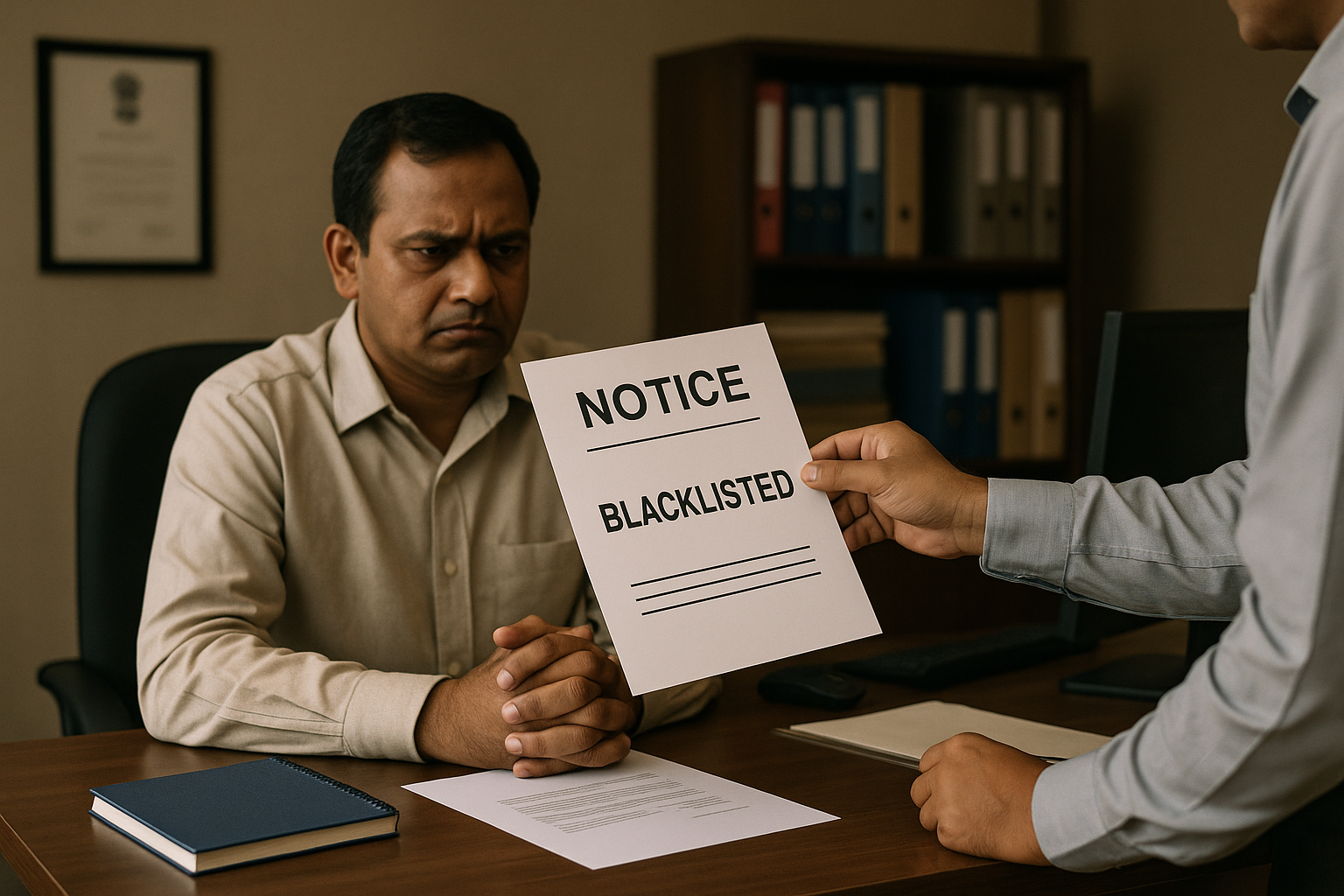
The Patna High Court, in a significant decision, has clarified that any act of blacklisting by a government department must strictly follow the principles of natural justice. A vendor or contractor cannot be blacklisted unless they are first given a clear, detailed, and specific notice about the proposed action and the grounds on which it is being considered.
The case arose from a contractual dispute between a technology service provider (the petitioner) and the Prohibition, Excise and Registration Department of Bihar. The petitioner had been engaged through a tender process to design, install, and operate the Integrated Excise Management System (IEMS), a digital solution meant to streamline excise operations in the state. The arrangement was formalized through a Master Service Agreement (MSA) with a state corporation. An implementation agency was also empanelled under the same contract to handle operational tasks.
Over time, the Department expressed dissatisfaction with the performance of the system. It alleged delays in the implementation of certain software modules, inadequate maintenance, and inefficient handling of the IEMS and call centres. The Department therefore issued an office memorandum/show-cause notice, directing the petitioner to resolve all operational issues within 30 days. It also mentioned that the petitioner might be replaced or its empanelled agency changed if the situation did not improve. Importantly, the memorandum included a line asking why the petitioner and its agency should not be blacklisted for three years—but the overall tone of the notice was more advisory than accusatory.
The petitioner and its agency submitted written explanations addressing the issues raised. However, without properly examining these replies, the Department went ahead and passed an order on 3rd June 2022, blacklisting the petitioner and the implementation agency for three years. The order also referred to an alleged “server shutdown” incident on 31st May 2022, which occurred after the issuance of the memorandum and was never mentioned as a ground for blacklisting.
Feeling aggrieved, the petitioner approached the Patna High Court, arguing that:
- The so-called “notice” was vague and did not clearly state that blacklisting was under active consideration.
- Their reply was never evaluated before taking the final decision.
- Post-notice events like the server shutdown could not legally be used as grounds for punitive action.
The State and its corporation defended the order, asserting that sufficient opportunity had been given and that the petitioner’s poor performance justified the blacklisting.
After examining the record, the Division Bench found that the memorandum could not be treated as a legally adequate notice for the purpose of blacklisting. The Court noted that while the document contained the words “show cause,” it primarily served as an administrative instruction urging the petitioner to improve its functioning and complete pending modules. The communication lacked the essential elements of a valid notice — namely, a clear statement that blacklisting was being proposed, specific allegations, and the consequences of non-compliance.
The Court observed that blacklisting is not a routine administrative act; it carries serious civil consequences since it disqualifies a person or company from future government contracts. Therefore, it must be preceded by:
- A definite and specific notice,
- An opportunity for the affected party to respond,
- Objective satisfaction by the authority based on evidence, and
- A reasoned order showing application of mind.
The Bench further held that relying on the server shutdown incident—which was not part of the show-cause process—was unfair. An authority cannot use facts or events that were never put to the notice of the affected party as grounds for punishment.
On these findings, the Court set aside the blacklisting order, declaring it legally unsustainable. However, it left the door open for the Department to reinitiate the process correctly. The Court directed the authorities to issue a fresh notice, consider the petitioner’s reply, and take a fresh, reasoned decision within three months of producing the Court’s order before them.
In essence, the High Court balanced the scales of fairness: it did not shield the contractor from accountability but ensured that government authorities follow due process before taking punitive measures.
Significance or Implication of the Judgment
This judgment has far-reaching implications for government contracting and administrative fairness in Bihar. It reinforces that blacklisting, even for a limited period, is a punitive and stigmatic measure that cannot be imposed casually.
For government departments, this ruling serves as a reminder to draft clear and unambiguous notices before proceeding with disciplinary actions against vendors. Notices should specifically mention that blacklisting is being considered, list out the grounds, and invite a proper response. Failure to do so can result in the entire action being struck down by the courts.
For vendors, contractors, and technology firms working with government agencies, the judgment affirms the right to a fair hearing and procedural transparency. Even if performance issues exist, the government must act through a transparent, accountable process — not through vague memorandums or one-sided decisions.
The decision also reflects the High Court’s continued emphasis on administrative fairness. It ensures that public authorities act responsibly, respecting both efficiency in governance and fairness in dealing with private entities.
Legal Issue(s) Decided and the Court’s Decision with Reasoning
- Issue 1: Whether the Department’s memorandum qualified as a proper notice for blacklisting.
Decision: No. The communication was primarily advisory, urging better performance rather than serving as a formal notice of blacklisting. Hence, it failed the test of procedural fairness. - Issue 2: Whether the Department could rely on post-notice events (like the server shutdown) to justify blacklisting.
Decision: No. Any new event not included in the notice cannot form the basis for punitive action. This violated the principle of natural justice. - Issue 3: What is the standard governing blacklisting by government authorities.
Decision: Blacklisting entails serious civil consequences. Authorities must provide clear notice, reasonable opportunity, and record objective satisfaction before imposing such a disability. - Issue 4: What relief was granted.
Decision: The High Court set aside the blacklisting order, but allowed the Department to issue a fresh, legally compliant notice and take a fresh decision within three months.
Judgments Referred by Parties
- Erusian Equipment & Chemicals Ltd. v. State of West Bengal, (1975) 1 SCC 70
- Patel Engineering Ltd. v. Union of India, (2012) 11 SCC 257
- Kulja Industries Ltd. v. Chief General Manager, W.T. Project, BSNL, (2014) 14 SCC 731
- Southern Painters v. Fertilizers & Chemicals Travancore Ltd., 1994 Supp (2) SCC 699
- BSN Joshi & Sons Ltd. v. Nair Coal Services Ltd., (2006) 11 SCC 548
Judgments Relied Upon or Cited by Court
- Erusian Equipment & Chemicals Ltd. v. State of West Bengal, (1975) 1 SCC 70
- Patel Engineering Ltd. v. Union of India, (2012) 11 SCC 257
- Kulja Industries Ltd. v. Chief General Manager, W.T. Project, BSNL, (2014) 14 SCC 731
- Southern Painters v. Fertilizers & Chemicals Travancore Ltd., 1994 Supp (2) SCC 699
- BSN Joshi & Sons Ltd. v. Nair Coal Services Ltd., (2006) 11 SCC 548
Case Title
Karnataka State Electronics Development Corporation Ltd. v. State of Bihar & Ors.
Case Number
Civil Writ Jurisdiction Case No. 13184 of 2022
Citation(s)
2023 (1) PLJR 162
Coram and Names of Judges
Hon’ble Mr. Justice Ashutosh Kumar
Hon’ble Mr. Justice Nawneet Kumar Pandey
Names of Advocates and who they appeared for
- For the petitioner: Mr. Kumar Amit, Advocate; Mr. Dhananjay Kumar, Advocate
- For the State (respondents): Mr. Vivek Prasad, GP-7
- For the Corporation (BSBCL): Mr. Vikash Kumar, Advocate; Mr. Girijesh Kumar, Advocate
Link to Judgment
MTUjMTMxODQjMjAyMiMxI04=-Mk1GMeN3iZk=
If you found this explanation helpful and wish to stay informed about how legal developments may affect your rights in Bihar, you may consider following Samvida Law Associates for more updates.







