
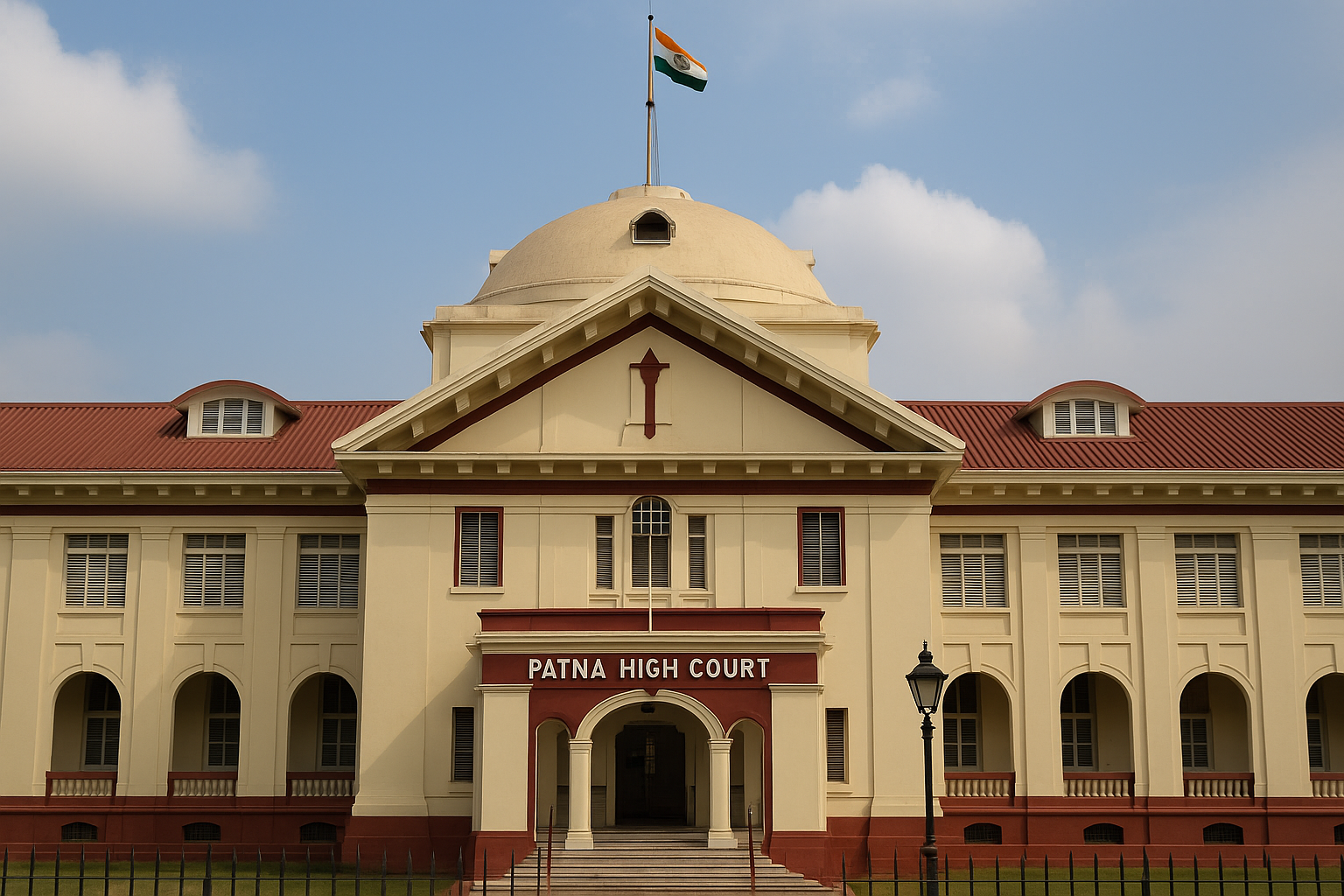
Simplified Explanation of the Judgment
The Patna High Court, in Letters Patent Appeal No. 1659 of 2019, decided on 29 November 2022, dealt with the case of a person who claimed to have worked as a messenger in a State Bank of India branch but whose employment was not recognized by the Bank. The Court upheld the earlier decisions of the Labour Court and the Single Judge, both of which had rejected the employee’s claim for reinstatement and regularization.
The appellant (the aggrieved person) had approached the Court asserting that he had worked for over 240 days as a messenger at the Arwal branch of the State Bank of India. He alleged that he was unjustly terminated from service and sought reinstatement along with other consequential benefits.
Initially, the matter was brought before the High Court through a writ petition, where a learned Single Judge had directed the Bank to consider the petitioner’s case for absorption under a circular dated 06.04.1991. However, this order was later challenged by the State Bank of India, and the Division Bench held that the petitioner had an alternative remedy through the Industrial Tribunal or Labour Court. Consequently, the matter was referred to the Labour Court to determine whether the termination of the petitioner’s service was justified.
Before the Labour Court, the appellant was the sole witness on his behalf, while two witnesses appeared for the Bank. The Labour Court, after reviewing the evidence, found that the petitioner had not been appointed by the Bank itself but had worked as a Canteen Boy, engaged by the Canteen Committee of the Arwal branch. The committee was a local welfare initiative managed by the branch but not formally part of the Bank’s statutory employment structure.
Importantly, the Labour Court relied on the landmark Supreme Court case State Bank of India & Ors. v. State Bank of India Canteen Employees Union (Bengal Circle), (2000) 5 SCC 531. In that case, the Supreme Court had categorically held that employees of canteens run by local committees under SBI’s welfare schemes do not automatically become employees of the Bank. The Bank has no statutory or contractual obligation to run such canteens or to absorb the workers employed by them into the Bank’s regular service.
In this particular case, the Labour Court noted that there was no record or document to prove that the petitioner was ever appointed as a messenger by the Arwal branch or by any competent authority of the Bank. The only documents the petitioner produced were:
- A handwritten list showing monthly payments made to him, and
- A letter written by a branch manager expressing a personal, non-binding recommendation that the petitioner’s services be regularized.
The Court found that these two documents did not constitute proof of formal employment or entitlement to reinstatement.
When the petitioner challenged the Labour Court’s award before the learned Single Judge, the Court carefully examined the evidence and reasoning. It found no legal infirmity or procedural irregularity in the Labour Court’s decision. The Single Judge concluded that there was no material to suggest that the petitioner was an employee of the State Bank of India. The Court also noted that it could not re-evaluate the factual findings of the Labour Court like an appellate forum unless there was a glaring legal error.
Upon further appeal (Letters Patent Appeal), the Division Bench—comprising Hon’ble Mr. Justice Ashutosh Kumar and Hon’ble Mr. Justice Nawneet Kumar Pandey—reviewed the matter in depth. The Bench expressed sympathy toward the appellant, acknowledging that he was a poor person who had served for meagre remuneration of ₹30 per month, but clarified that sympathy cannot replace legal proof.
The Bench observed that, although the petitioner’s services were utilized by the Canteen Committee, such engagement did not establish an employer-employee relationship with the State Bank of India. In the absence of documentary evidence showing official appointment, salary slips, or service records, the claim for regularization or reinstatement could not be accepted.
The Division Bench finally held that there was no flaw in either the Labour Court’s award or the Single Judge’s decision. Consequently, the appeal was dismissed without costs.
Significance or Implication of the Judgment
This judgment is significant for both contract and casual workers associated with public sector institutions and banks, as well as for the institutions themselves.
- Clarification on Employment Relationship: The Court reaffirmed that merely working within the premises of a government institution or public sector bank does not automatically make a worker its employee. There must be a clear employer-employee relationship evidenced by appointment letters, pay records, or statutory recognition.
- Canteen Employees under Welfare Schemes: Workers engaged by welfare or canteen committees—especially those functioning locally without statutory backing—cannot claim regularization or permanent absorption in the parent organization unless there is a specific rule or contractual obligation.
- Limits of Judicial Intervention: The High Court emphasized that Labour Courts are the appropriate forums for fact-finding on employment issues, and higher courts should not interfere unless there is a manifest error of law or violation of natural justice.
- Sympathy vs. Legality: The Bench’s remark that sympathy cannot override legal requirements serves as a reminder that equitable considerations must be balanced with statutory provisions.
- Impact on Public Sector Employment: This decision strengthens the distinction between core employees and those engaged through committees or contractors in public sector entities like SBI. It helps avoid misinterpretation of casual or welfare-based engagements as regular employment.
For workers, this judgment highlights the importance of documented service records and formal appointments if they wish to claim regularization. For employers, it reinforces the need to maintain clear documentation and ensure that welfare-based or local committee arrangements are properly distinguished from regular employment contracts.
Legal Issue(s) Decided and the Court’s Decision with Reasoning
- Issue 1: Whether the appellant, who worked in the canteen of SBI’s Arwal branch, could be treated as an employee of the State Bank of India.
Decision: No. The Court held that he was engaged by the Canteen Committee, not by the Bank. As per SBI Canteen Employees Union (2000) 5 SCC 531, such canteen workers are not employees of the Bank. - Issue 2: Whether the appellant was entitled to reinstatement or absorption as a messenger in the Bank.
Decision: No. There was no evidence to establish an employer-employee relationship with the Bank. The documents provided were insufficient to prove formal employment. - Issue 3: Whether the High Court should interfere with the Labour Court’s findings.
Decision: No. The Labour Court’s findings were based on evidence and Supreme Court precedent. There was no legal or procedural error warranting interference.
Judgments Relied Upon or Cited by Court
- State Bank of India & Ors. v. State Bank of India Canteen Employees Union (Bengal Circle), (2000) 5 SCC 531.
Case Title
Appellant v. State Bank of India & Ors.
Case Number
Letters Patent Appeal No. 1659 of 2019
(in Civil Writ Jurisdiction Case No. 19517 of 2019)
Citation(s)
2023 (1) PLJR 160
Coram and Names of Judges
Hon’ble Mr. Justice Ashutosh Kumar
Hon’ble Mr. Justice Nawneet Kumar Pandey
Names of Advocates and Who They Appeared For
- For the Appellant: Mr. Raghwendra Sharan Pandey, Advocate
- For the Respondent (State Bank of India): Mr. Binod Bihari Sinha, Advocate
Link to Judgment
MyMxNjU5IzIwMTkjMSNO-P3ENiY35–ak1–uk=
If you found this explanation helpful and wish to stay informed about how legal developments may affect your rights in Bihar, you may consider following Samvida Law Associates for more updates.







