
Simplified Explanation of the Judgment
The Patna High Court was asked to decide whether a criminal case registered by the Central Bureau of Investigation (CBI) against a serving railway officer (the petitioner) could continue when, according to the petitioner, the CBI had not first obtained the “previous approval” required under Section 17A of the Prevention of Corruption Act, 1988 (PC Act). The judgment was delivered on 25 February 2025 by Hon’ble Mr. Justice Bibek Chaudhuri.
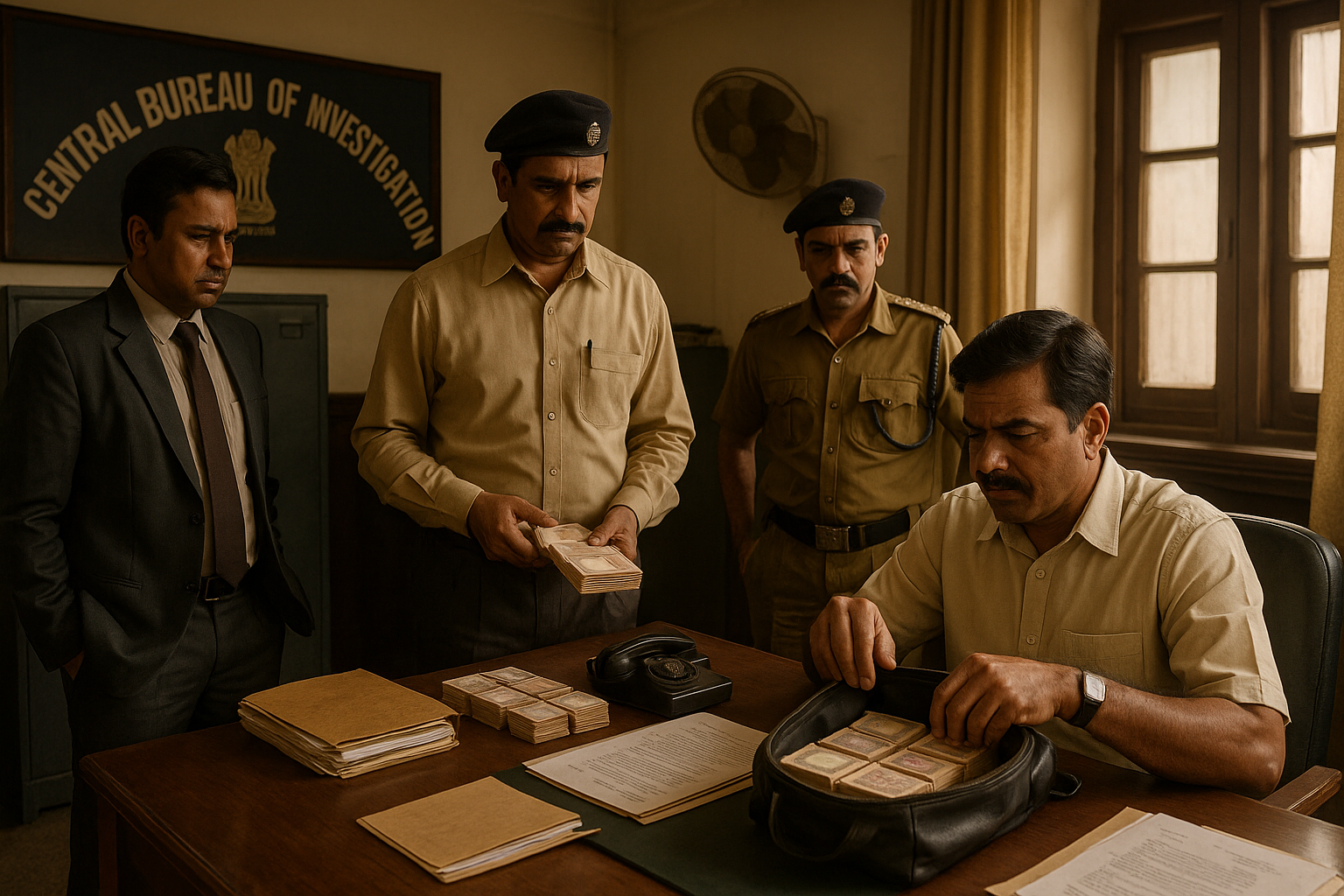
The background was this: the petitioner was working in the East Central Railway. According to the CBI, there was an illegal arrangement between some railway officials and a private company engaged in goods movement. The allegation was that the petitioner and other railway officers were helping that company get rakes/wagons out of turn, and in exchange, cash was being sent from West Bengal to Bihar to be distributed among different railway officials. The CBI claimed that on 31 July 2022, a trap team kept watch at Patliputra Rail Parisar, Digha, Patna, and intercepted a vehicle. The driver disclosed that he had just delivered ₹6 lakh to one senior railway officer. That officer was caught, the money was seized, and a case was registered. Further material—like multiple cash packets, statements of the driver, call interceptions, and a statement of a milk supplier who used to collect packets—was used by the CBI to implicate the present petitioner also.
The petitioner came to the High Court in a criminal writ. His argument was not so much on facts (that will be tested at trial) but on legality: he said that Section 17A of the PC Act—inserted in 2018—clearly says that before any “enquiry, inquiry or investigation” is made against a public servant for an act relatable to a decision or recommendation made in the discharge of official duty, the investigating agency must first take prior approval from the competent authority (in Union cases, the Central Government). Since he was a railway officer and the allegations against him were about allotment of rakes—something he does as part of his official duty—he argued that the entire investigation done by the CBI without such approval was void, and therefore the charge-sheet and the order taking cognizance should be quashed.
To support this, the petitioner relied on several High Court and Supreme Court judgments which say that Section 17A was brought in to protect honest officers from harassment. He said: “I took a decision in my official capacity. You cannot investigate me unless you get approval. You did not. So everything after that is illegal.” He also pointed out that in this case there was no “on-the-spot” arrest of him with bribe money, so the exception contained in the proviso to Section 17A (which says that no approval is needed if a person is caught red-handed while taking bribe) would not apply to him.
The CBI and the Union of India opposed this. Their stand was: this is not a case of a bona fide official decision which is now being questioned; this is a case where official position was allegedly misused to give “undue advantage” in exchange for illegal gratification. Section 17A, they argued, was never meant to become a shield for corrupt acts. They also argued that this was, in essence, a trap-originated case—illegal money was being transported and delivered to railway officers—so the first proviso to Section 17A applies and no prior approval is needed for such cases. They further argued that even if there is some defect in sanction/approval, such an issue normally has to be examined during trial, not at the stage of quashing.
The High Court agreed with the respondents.
The Court made an important distinction: Section 17A protects lawful discharge of official functions, not tainted exercise of power. Allotment of rakes is certainly an official function. But if that function is performed in a corrupt manner—for a private company, out of turn, in exchange for cash—then it ceases to be “in discharge of official function” for the purpose of Section 17A. If officers could say, “I was doing my duty” even while taking money, then Section 17A would become a tool to block every corruption case, which cannot be the intention of Parliament.
The Court also noted that in trap-driven or spot-acceptance cases, Parliament itself has said that no prior approval is needed. Here, according to the CBI papers, the flow of money was detected, one officer was caught with ₹6 lakh, further packets and documents were recovered, and statements of the carrier and the milk supplier were recorded. Therefore, the investigation could not be said to be entirely without jurisdiction just because no prior approval was taken.
Another crucial point the Court made was procedural: even if the petitioner wants to say “this was actually part of my official duty and I acted bona fide,” that is a matter of evidence. Such questions of fact cannot be gone into in a writ petition to quash the entire criminal proceeding. The proper stage to test the validity of sanction, the applicability of Section 17A, and the question whether the act was really in discharge of duty is at trial—when the documents, approvals, notings, and witness statements are all before the court. Courts have consistently held that where a sanction/approval order exists, but its validity or sufficiency is questioned, that must ordinarily be left to trial.
Finally, the Court dismissed the writ petition, refused to quash the charge-sheet or the cognizance order, and allowed the criminal case to proceed.
Significance or Implication of the Judgment
- The Patna High Court has sent out a clear signal that Section 17A is not a safe harbour for public servants in every corruption-related allegation.
- If the act is prima facie corrupt—i.e. done for illegal gratification or to give undue advantage—then the officer cannot stop the investigation at the threshold by citing lack of prior approval.
- For investigating agencies like the CBI, this judgment is reassuring: in trap-related and cash-delivery cases, they can proceed without 17A approval, especially where the statute itself carves out an exception.
- For the public, the judgment explains that the 2018 amendment to the PC Act was intended to protect honest decision-making, not to make it impossible to prosecute corruption in government departments.
- For government departments, it is a reminder to frame and follow Standard Operating Procedures (SOPs) for 17A approvals, because officers will increasingly question investigations on this ground.
Legal Issue(s) Decided and the Court’s Decision (with reasoning)
- Whether prior approval under Section 17A of the PC Act was mandatory before the CBI could investigate the petitioner (a public servant) for corruption linked with rake allotment.
- Court’s view: Not in the facts of this case. The protection of Section 17A applies to lawful discharge of duty, not to acts done in a tainted/corrupt manner. A public servant who allegedly used his position to give undue advantage cannot claim 17A to stall investigation.
- Whether the investigation and charge-sheet could be quashed at the writ stage only because the petitioner challenges sanction/approval.
- Court’s view: No. When a sanction/approval order exists or when the agency invokes the statutory exception (first proviso to Section 17A), the issue of validity is a matter for trial, not for quashing.
- Whether trap/spot-acceptance type cases need prior approval under Section 17A.
- Court’s view: The statute itself says no approval is necessary for cases involving arrest on the spot for accepting undue advantage; the case was of that genre, so investigation was not vitiated.
- Whether the entire criminal proceeding should be quashed under Article 226 applying the principles of State of Haryana v. Bhajan Lal.
- Court’s view: No. There was no express legal bar that made continuation of the proceeding impossible; there was material collected by CBI; therefore, writ jurisdiction could not be used to short-circuit the trial.
Judgments Referred by Parties
- Yogesh Nayyar & Anr. v. State of M.P. & Anr., 2023 SCC OnLine MP 2049 (on mandatory nature of Section 17A for investigations into official decisions).
- Himanshu Yadav v. State of Rajasthan & Ors., 2022 SCC OnLine Raj 1303 (relying on Yashwant Sinha v. CBI, (2020) 2 SCC 338, to underline that 17A is a condition precedent).
- Yashwant Sinha v. CBI, (2020) 2 SCC 338.
- Nara Chandrababu Naidu v. State of Andhra Pradesh & Anr., 2024 SCC OnLine SC 47 (on object of Section 17A and protection of bona fide decisions).
- Vineeta Sharma v. Rakesh Sharma & Ors., (2020) 9 SCC 1 (on prospective, retrospective, and retroactive operation of statutes).
- Darshan Singh v. Ram Pal Singh, 1992 Supp (1) SCC 191 (on retrospectivity principles).
- Neeraj Dutta v. State (NCT of Delhi), (2023) 4 SCC 731 (on demand being sine qua non under Section 7 PC Act).
- Kim Wansoo v. State of Uttar Pradesh & Ors., 2025 SCC OnLine SC 17.
- State of Haryana v. Bhajan Lal, 1992 Supp (1) SCC 335 (for the quashing parameters).
Judgments Relied Upon or Cited by Court
- Central Bureau of Investigation v. Santosh Karnani, (2023) 3 SCR 476 (holding that lack of 17A approval in certain situations does not vitiate proceedings, and that trap cases stand on a different footing).
- Dinesh Kumar v. Chairman, Airport Authority of India, (2012) 1 SCC 532 (distinguishing absence of sanction from validity of sanction).
- Prakash Singh Badal v. Union of India, (2007) 1 SCC 1 (principle that when sanction exists, its validity is normally a matter for trial).
- Mithilesh Kumar Singh v. State of Bihar, 1998 (2) BLJR 866 (Patna High Court) (validity of sanction to be tested at trial).
Case Title
RUPESH KUMAR Vs. The Union of India, Ministry of Railways represented through the Under Secretary, Railway Board
Case Number
Criminal Writ Jurisdiction Case No. 1766 of 2023
(Arising out of CBI Case No. 8(A)/2022, Patna)
Citation(s)
2025 (2) PLJR 150
Coram and Names of Judges
Hon’ble Mr. Justice Bibek Chaudhuri
Names of Advocates and who they appeared for
- For the petitioner: Senior Advocate (lead) assisted by two Advocates (for railway officer/petitioner)
- For the CBI: Special Public Prosecutor, assisted by Advocates (for investigating agency)
- For the Union of India / Ministry of Railways: Senior Central Government Counsel, assisted by Advocates (for competent authority/sanctioning authority)
Link to Judgment
MTYjMTc2NiMyMDIzIzEjTg==-So8bCAOncHE=
If you found this explanation helpful and wish to stay informed about how legal developments may affect your rights in Bihar, you may consider following Samvida Law Associates for more updates.







