
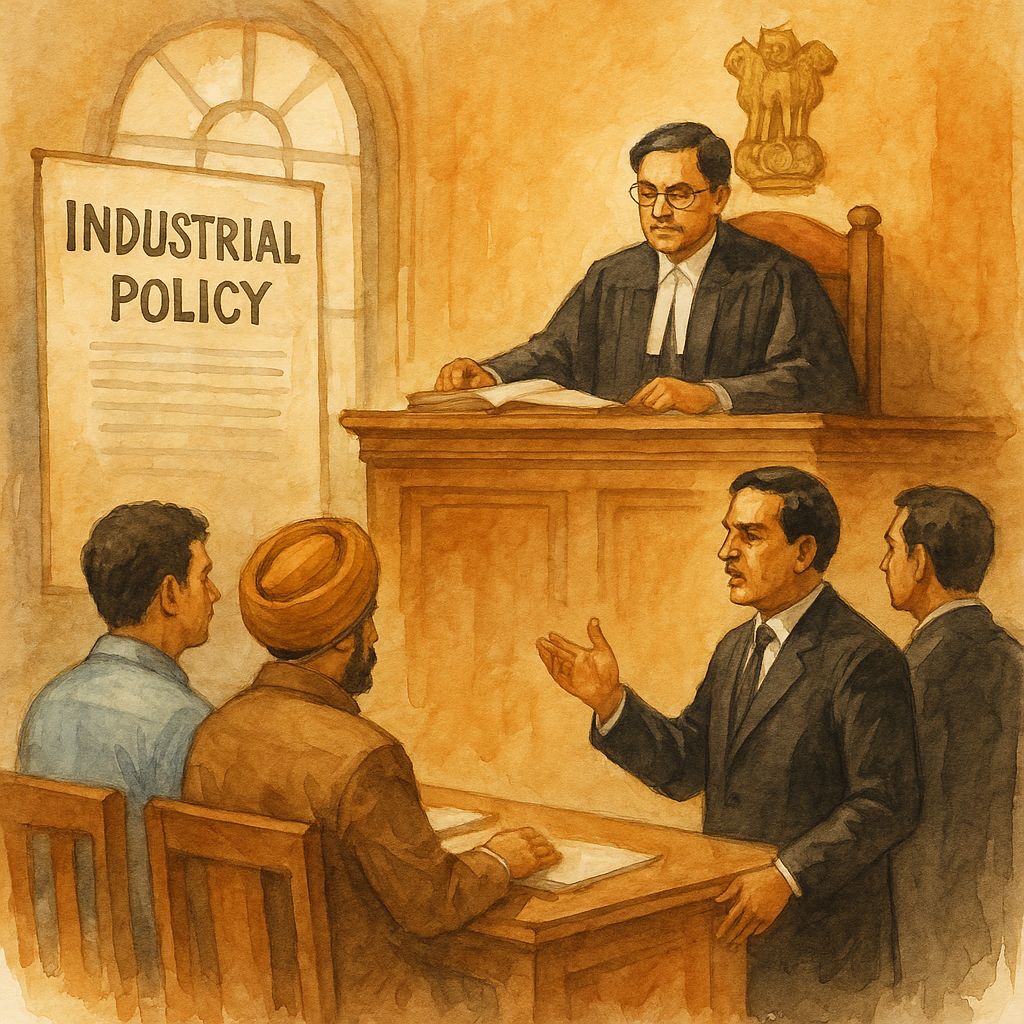
The Patna High Court, in a 2023 judgment, clarified an important issue under the Bihar Industrial Incentive Policy, 2011. The dispute arose when an industrial unit (petitioner) was denied post-production incentives such as reimbursement of VAT/ET/SGST on the ground that it had started commercial production before securing formal approval from the State Investment Promotion Board (SIPB). The Court held that such denial was unjustified when the policy itself did not make “prior SIPB approval before production” a mandatory condition for availing incentives.
This ruling is significant for industrial units that had invested in Bihar and commenced operations promptly but later faced objections from departments on purely procedural grounds. The Court reiterated that government departments cannot frustrate the object of an incentive policy by taking hyper-technical views or by reading additional conditions into the policy.
Simplified Explanation of the Judgment
The petitioner was an industrial unit set up in Bihar that had applied under the Bihar Industrial Incentive Policy, 2011 for various post-production benefits. These benefits included reimbursement of VAT/Entry Tax/State GST that the unit had deposited with the State authorities after starting its commercial activities. The purpose of such reimbursement under the 2011 policy was to encourage investment, promote industrialization, and compensate new industries during their initial years.
However, the concerned department rejected the petitioner’s claim by an email dated 05.11.2022 and by an earlier memo dated 23.11.2017. The rejection was based on a single reason: that the petitioner had started commercial production on 08.08.2014, whereas the SIPB had granted its formal approval on 30.06.2015. On that basis, the authorities concluded that the petitioner had violated the policy and was, therefore, disentitled to all incentives.
The petitioner challenged this stand before the Patna High Court through a writ petition and sought:
- quashing of the rejection orders;
- a declaration that incentives cannot be withheld once entitlement under the 2011 policy is recognized; and
- a mandamus to release reimbursement of VAT/ET/SGST.
What the petitioner argued
The petitioner’s counsel submitted that there was no clause in the 2011 policy that made prior approval of the SIPB a condition precedent for starting commercial production. The State had issued the policy to encourage entrepreneurs to set up industries in Bihar. If an entrepreneur, acting in good faith, started production early, that could not be used later to deny the very incentives that were promised.
The petitioner further submitted that the authorities were taking a stand not supported by the policy document, and such a stand was arbitrary, contrary to the object of the scheme, and violative of Article 14 of the Constitution.
What the State argued
The State, on the other hand, opposed the writ. It argued that the petitioner should have waited for formal approval from SIPB before starting production. Since the petitioner started production before approval, the authorities considered it a violation of the policy and hence rejection of incentive was justified. The State also submitted that in a similar case of another industrial unit (a publishing/printing concern at Gaya), the authorities had taken the same view after obtaining the opinion of the Law Department, and therefore, the present case was treated alike.
What the Court found
Justice A. Abhishek Reddy of the Patna High Court examined the purpose and language of the Bihar Industrial Incentive Policy, 2011. The Court noted a few crucial facts:
- The Bihar government had brought the 2011 policy to attract industries to the State and to offer incentives to those who actually set up units.
- The petitioner had, in fact, applied to the competent authority and was ultimately granted SIPB approval on 30.06.2015.
- The only reason for denying incentives was that commercial production had commenced in August 2014, i.e. before June 2015.
The Court found that the State’s reasoning was “arbitrary and frivolous.” The Court categorically observed that the 2011 policy “does not lay any guidelines or restrictions” that an industrial unit cannot start production before SIPB approval. Nor does it say that if production starts earlier, the unit automatically loses all incentive benefits.
The Court further reasoned that the State cannot on the one hand invite investors and, on the other hand, later deny them the very incentives by introducing new conditions that are not in the policy. If the policy does not prohibit starting production earlier, the department cannot invent such a prohibition.
Important direction of the Court
While the Court accepted that the unit had started commercial production before the date of SIPB approval, it did not say that incentives must be paid for the period before approval. Instead, the Court took a balanced and legally sustainable view: the unit would be entitled to incentives from the date of approval of the SIPB i.e. 30.06.2015. In other words, early commencement of production cannot be used to deny incentives altogether; at best, the State can limit reimbursement to the period after formal approval.
Accordingly, the Court set aside the rejection orders and directed the authorities to grant incentives to the petitioner under the Bihar Industrial Incentive Policy, 2011 from the date of SIPB approval and to make necessary payments within three months from receipt of the Court’s order.
Why this is important
This judgment tells government departments that they must implement incentive schemes in a practical, investor-friendly manner. The State cannot punish an entrepreneur merely for being proactive. Once the State has invited investment and the unit has subsequently been approved, incentives cannot be denied on a technicality unless the policy itself clearly bars it.
Significance or Implication of the Judgment
- For industrial units in Bihar: Units that started production slightly earlier than formal SIPB approval, but were otherwise eligible, can rely on this decision to claim incentives at least from the date of approval.
- For government departments: The judgment is a reminder that policy implementation must align with the stated object of the scheme. Administrative authorities cannot read in conditions that are not expressly provided.
- For future investors: It reassures investors that the Patna High Court will protect legitimate expectations arising from government incentive policies.
- For policy clarity: The decision may prompt the State Government to issue clearer SOPs so that District Industries Centres and the Industries Department act uniformly.
- For litigation reduction: By clarifying that incentives can be limited from date of approval (instead of being denied completely), the Court has offered a workable, equitable formula.
Legal Issue(s) Decided and the Court’s Decision with Reasoning
- Whether prior SIPB approval is a mandatory precondition for claiming incentives under the Bihar Industrial Incentive Policy, 2011.
- Court’s view: No such condition exists in the policy. Authorities cannot invent it later.
- Whether the State can deny all incentives merely because the unit started commercial production before SIPB approval.
- Court’s view: No. At the most, incentives can be restricted to start from the date of SIPB approval. Total denial is arbitrary.
- Whether rejection orders based solely on “early start of production” are sustainable.
- Court’s view: Such orders are arbitrary and without legal basis; hence, liable to be set aside.
- What relief should be granted.
- Court’s direction: Set aside the impugned email dated 05.11.2022 and memo dated 23.11.2017 (to the extent it related to the unit); direct authorities to release incentives under the 2011 policy from 30.06.2015 and make payment within three months.
Case Title
- M/S Ace Infra and Security Pvt. Ltd., Vs. The State of Bihar
Case Number
- Civil Writ Jurisdiction Case No. 7240 of 2023
Coram and Names of Judges
- Hon’ble Mr. Justice A. Abhishek Reddy (Oral Judgment dated 10-11-2023)
Names of Advocates and who they appeared for
- For the petitioner: Mr. Madan Kumar, Advocate
- For the State/Respondents: Mr. Dhirdyuti Kumar Verma, AC to SC-11
Link to Judgment
If you found this explanation helpful and wish to stay informed about how legal developments may affect your rights in Bihar, you may consider following Samvida Law Associates for more updates.







