
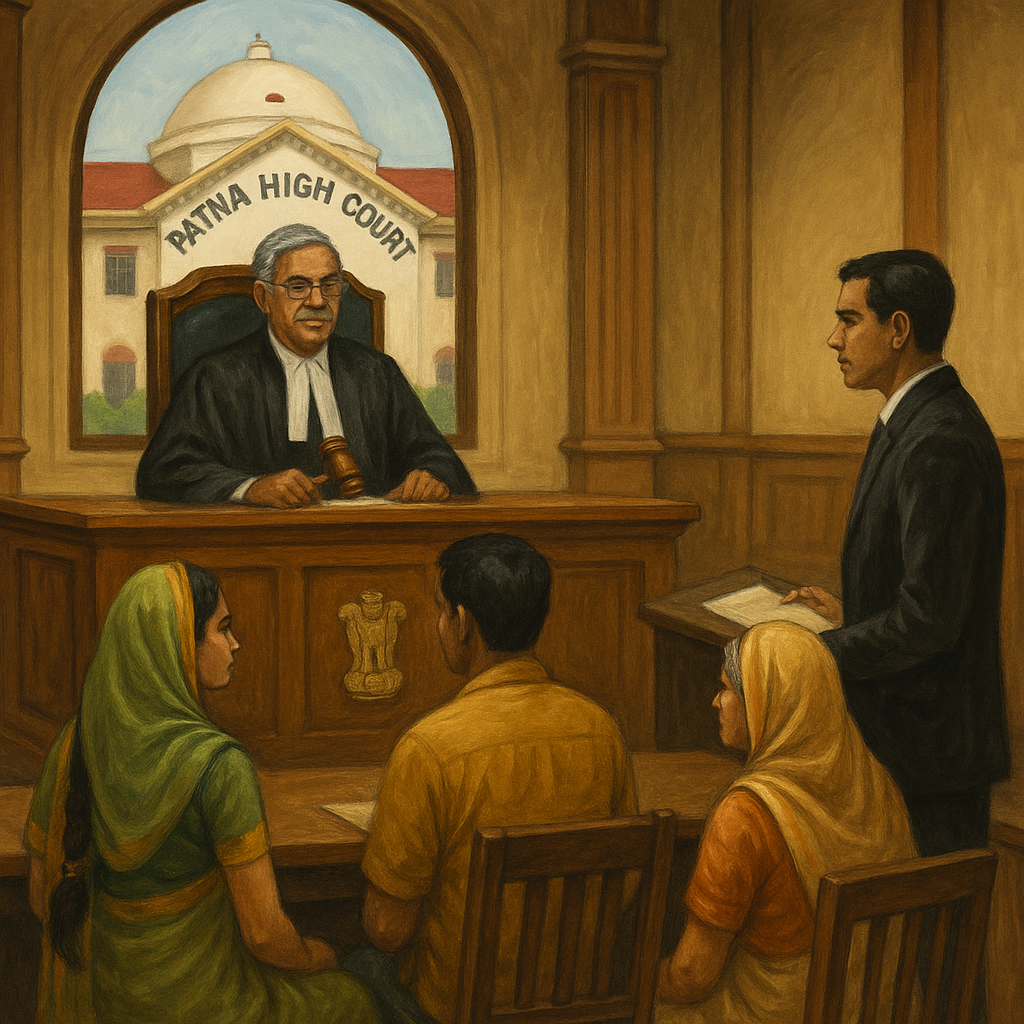
Simplified Explanation of the Judgment
The Patna High Court, in a detailed judgment delivered on 15 April 2021, acquitted three members of a family who had been convicted under Section 304-B of the Indian Penal Code (dowry death). The Court held that the prosecution failed to prove consistent evidence of dowry demand, cruelty, or harassment, and that procedural lapses during trial caused serious prejudice to the accused.
This case arose from a tragic incident in September 2013 involving a young woman, Namita Devi, who died in her matrimonial home within a year of her marriage. She had been married to appellant Prashant Kumar in December 2012. Prashant’s parents, Shivjee Sah and Manju Devi, were also accused. The prosecution alleged that Namita was repeatedly harassed and assaulted for dowry—first for a gold chain and later for a motorcycle.
Namita’s brother lodged a written complaint stating that after marriage, she went with her husband to Visakhapatnam where he worked as a locomotive driver. There, she was allegedly beaten and tortured for dowry. On her request, her mother gave a gold chain to Prashant, but the harassment allegedly continued. On 24 September 2013, Namita reportedly called her family to say she had been assaulted again. Later that night, they received a phone call informing them that she had died.
Following investigation, police filed a chargesheet against the husband and in-laws under Section 304-B IPC (dowry death). The trial court convicted Prashant Kumar and sentenced him to 10 years’ rigorous imprisonment, while his parents were sentenced to 7 years each.
In appeal, the High Court examined whether the prosecution had proved dowry-related cruelty “soon before death,” a key requirement for conviction under Section 304-B IPC.
The defence contended that:
- There was no consistent evidence of dowry demand after the gold chain was given.
- The allegation of a motorcycle demand appeared for the first time during trial and was not part of earlier witness statements.
- Two brothers of the deceased, who were family witnesses, did not support the prosecution case.
- The post-mortem report suggested suicide by hanging, not strangulation or homicidal death.
- The trial judge failed to put specific questions about the nature of dowry demand or alleged torture during the accused’s examination under Section 313 Cr.P.C., violating fair trial principles.
The State argued that the death occurred within a year of marriage under unnatural circumstances in the matrimonial home, so a presumption of dowry death applied under Section 113-B of the Evidence Act.
However, Justice Birendra Kumar found several flaws in the prosecution case:
- Witnesses PW-2 and PW-4 (brothers of the deceased) did not corroborate claims of continuing dowry demand or cruelty.
- The alleged new demand of a motorcycle was an afterthought made during trial, which the investigating officer confirmed was not stated earlier.
- The medical evidence confirmed suicide by hanging, contradicting the allegation of throttling.
- No independent or neighbour witness corroborated any claim of cruelty.
- No injuries were found on the deceased except for the ligature mark.
Importantly, the High Court noted that the accused were not properly questioned about specific incriminating circumstances during their examination under Section 313 Cr.P.C. The trial judge had asked vague questions such as “You have heard the witnesses; what do you have to say?” without specifying the nature of alleged dowry demand or cruelty. Citing several Supreme Court judgments, including Naval Kishore Singh v. State of Bihar (2004), Maheshwar Tigga v. State of Jharkhand (2020), and Asraf Ali v. State of Assam (2008), the Court held that such omissions amounted to denial of fair opportunity to the accused and could vitiate the trial.
The Court also considered the defence version, which suggested that the deceased had an argument with her mother over ornaments she had left behind before traveling, and later committed suicide. The defence supported this claim with witness testimonies and insurance documents showing mutual financial arrangements between husband and wife.
Ultimately, the Court found that the prosecution had failed to establish:
- A consistent and proven demand for dowry soon before death.
- Any reliable evidence of cruelty or harassment by the appellants.
- Homicidal death, as medical evidence pointed to suicide.
- Proper examination of the accused in compliance with Section 313 Cr.P.C.
Given these deficiencies, the Court extended the benefit of doubt to all the appellants and set aside their convictions. They were ordered to be released immediately.
Significance or Implication of the Judgment
This ruling is a significant reaffirmation of due process in criminal trials, particularly in cases involving serious charges like dowry death. While the judiciary strongly condemns dowry-related cruelty, this case demonstrates that conviction must be based on credible, consistent, and corroborated evidence, not on presumption alone.
For investigating agencies, the decision highlights the importance of meticulous and impartial investigation, accurate recording of witness statements, and ensuring medical evidence aligns with the prosecution theory.
For trial courts, it underscores the duty to conduct meaningful questioning under Section 313 Cr.P.C. — a vital safeguard ensuring the accused understands and can respond to the charges.
For the public, the case serves as a reminder that while dowry deaths are a social evil, every accused person is entitled to a fair trial, and guilt must be proven beyond reasonable doubt.
Legal Issue(s) Decided and the Court’s Decision with Reasoning
- Whether the prosecution proved that the deceased was subjected to cruelty for dowry soon before her death?
❌ No. The alleged demand of a motorcycle was introduced belatedly, not stated to the police, and uncorroborated by close relatives or independent witnesses. - Whether the death was homicidal (as alleged) or suicidal (as found by medical evidence)?
✔️ Suicidal. The doctor confirmed death due to hanging, not strangulation, and found no injuries suggesting physical assault. - Whether vague questioning under Section 313 Cr.P.C. prejudiced the defence?
✔️ Yes. The Court held that the trial judge’s failure to ask specific questions about alleged dowry demand and torture violated fair trial norms. - Whether conviction under Section 304-B IPC was sustainable?
❌ No. Essential ingredients of dowry death were not proved beyond reasonable doubt; therefore, benefit of doubt was extended to the appellants.
Judgments Referred by Parties
- Raja Ram v. State of Rajasthan (2005) 5 SCC 272
- Mukhtiar Ahmed Ansari v. State (NCT of Delhi) (2005) 5 SCC 258
Judgments Relied Upon or Cited by Court
- Bakshish Ram v. State of Punjab (2013) 4 SCC 131
- Sunil Bajaj v. State of Madhya Pradesh (2001 Cri LJ 4700)
- Naval Kishore Singh v. State of Bihar (2004) 7 SCC 502
- Maheshwar Tigga v. State of Jharkhand (2020) 10 SCC 108
- Asraf Ali v. State of Assam (2008) 16 SCC 328
- Samsul Haque v. State of Assam (2019) 18 SCC 161
Case Title
Shivjee Sah & Ors. v. State of Bihar
Case Number
Criminal Appeal (SJ) No. 4273 of 2018 with Criminal Appeal (SJ) No. 126 of 2019
(Arising out of Karakat P.S. Case No. 218 of 2013, District – Rohtas)
Citation(s)
2021(2) PLJR 374
Coram and Names of Judges
Hon’ble Mr. Justice Birendra Kumar (C.A.V. Judgment dated 15.04.2021)
Names of Advocates and who they appeared for
- For the Appellants (in Cr. App. 4273/2018): Dr. Amarendra Kumar, Advocate; Mrs. Surya, Advocate
- For the Appellant (in Cr. App. 126/2019): Mr. Vikram Deo Singh, Advocate
- For the Informant: Mr. Mithilesh Kumar Singh, Advocate
- For the State: Mr. Sujit Kumar Singh, A.P.P.
Link to Judgment
MjQjNDI3MyMyMDE4IzEjTg==-Vm1rcTUVv9U=
If you found this explanation helpful and wish to stay informed about how legal developments may affect your rights in Bihar, you may consider following Samvida Law Associates for more updates.







