
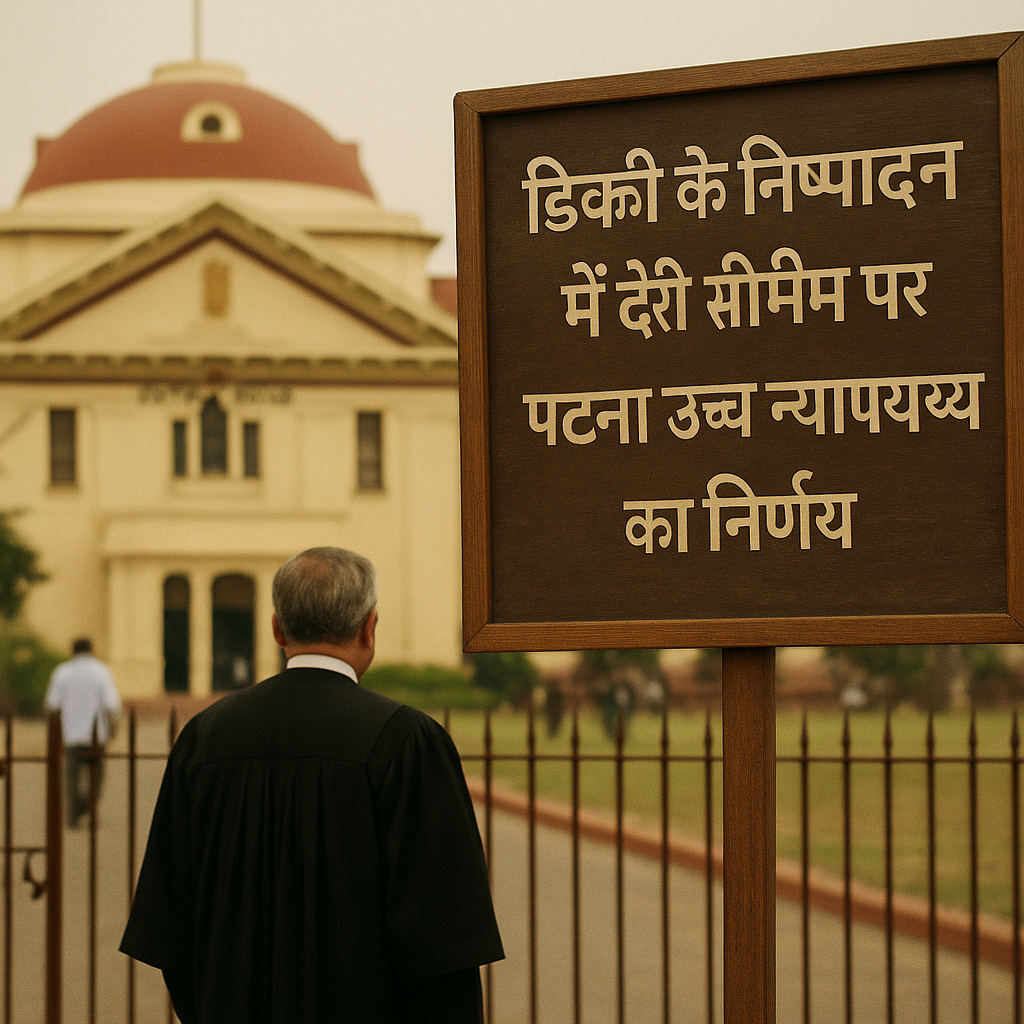
Simplified Explanation of the Judgment
This Patna High Court decision (dated 10 December 2024) addresses a common and practical question: when does the 12-year limitation period for executing a civil court decree begin? The case arose from an ex parte decree of specific performance passed by a trial court in January 1998. The decree-holder (respondent) did not immediately file an execution case. Instead, years of collateral challenges followed—an Order IX Rule 13 CPC petition to set aside the ex parte decree, a miscellaneous appeal before the District Judge, and then civil revisions before the High Court. Ultimately, the decree-holder filed an execution case in 2018. The subsequent purchaser (petitioner) objected that the execution was hopelessly time-barred because more than 12 years had passed from the original decree in 1998.
The Munsif (Executing Court) rejected the limitation objection in December 2019. The petitioner then approached the High Court under Civil Miscellaneous Jurisdiction, challenging that order. The Patna High Court has now dismissed the challenge and upheld the Executing Court’s decision.
Why? The Court applied the “doctrine of merger” and clarified how Article 136 of the Limitation Act, 1963 operates alongside appellate/revisional proceedings. Under Article 136, a decree may be executed within 12 years “when the decree or order becomes enforceable.” Normally, a decree becomes enforceable on the date it is passed unless stayed. However, if appellate or revisional proceedings are pursued and culminate in an order that affirms, modifies, or reverses the decree, the law recognizes that the original decree merges into the superior court’s order. In such situations, limitation can begin from the date of that final superior court order.
Here, the ex parte decree (January 1998) was attacked under Order IX Rule 13 CPC and then carried through a chain of appellate/revisional scrutiny, culminating in the High Court’s common order of 31 August 2006 dismissing the civil revisions. The High Court in the present judgment treats these steps not as standalone miscellaneous skirmishes but, in substance, as appellate scrutiny of the trial court decree. As a result, the original ex parte decree merged into the High Court’s 2006 order. Therefore, for limitation purposes, the 12-year clock began from 31 August 2006, not from January 1998. An execution case filed in 2018 was thus within time—at the tail end of the 12-year window but still inside it.
The Court also addressed the petitioner’s other arguments: alleged fraud in service of summons, the plea that the trial court became “functus officio” after passing the ex parte decree, and the contention that various procedural steps in 2016–2018 were attempts to “circumvent” limitation. The High Court noted that service issues had already been conclusively addressed in the earlier High Court order (2006), where service was found duly effected by multiple modes. With that foundational challenge settled, the focus returned to limitation. On limitation, the Court declined to follow authorities that reckon time exclusively from the original decree date where later proceedings do not culminate in a decree; instead, it preferred binding Supreme Court guidance and a Patna Division Bench reference decision that align with the merger doctrine. In short, once the decree had been carried to the High Court and affirmed, the enforceability—and hence limitation—ran from the High Court’s 2006 decision. Consequently, the Munsif’s 2019 rejection of the limitation objection was correct, and the High Court dismissed the petitioner’s Civil Miscellaneous case, vacating the interim stay granted earlier in 2024.
Significance or Implication of the Judgment
This ruling is significant for decree-holders and judgment-debtors in Bihar:
- It clarifies that the 12-year limitation period may start from the final appellate/revisional order (where the doctrine of merger applies), not necessarily from the date of the original decree.
- Parties who spend years litigating post-decree challenges must account for how those proceedings affect enforceability and limitation.
- Decree-holders should still act diligently—waiting until the very end of limitation is risky—but this ruling ensures that genuine appellate/revisional scrutiny does not inadvertently penalize a decree-holder who awaits finality.
- Judgment-debtors cannot assume that delay alone (measured from the trial decree) bars execution where the decree was carried through higher forums and affirmed.
- For government offices handling mutations and revenue records, the judgment reinforces that specific performance decrees, once taken through the chain of challenges and affirmed, remain enforceable within 12 years from the final affirming order.
Legal Issue(s) Decided and the Court’s Decision with reasoning
- Whether the execution case filed in 2018 was barred by the 12-year limitation under Article 136 of the Limitation Act, 1963.
— Decision: Not barred. The Patna High Court held that because the ex parte decree (1998) was pursued through appellate/revisional scrutiny culminating in dismissal of civil revisions by the High Court in 2006, the doctrine of merger applied. Limitation began from the High Court’s 31 August 2006 order, making the 2018 execution petition timely. - Whether collateral proceedings like an Order IX Rule 13 petition, miscellaneous appeal, and civil revisions can, in substance, constitute appellate/revisional affirmation sufficient to trigger merger.
— Decision: Yes, in substance. The Court emphasized substance over form/nomenclature. If a superior forum affirms, modifies, or reverses the decision, the lower court’s decree merges into that decision for enforceability and limitation computation. - Whether earlier authorities relied on by the petitioner (suggesting limitation runs from the original decree where appeals are dismissed as time-barred or without a decree) controlled the present case.
— Decision: No. The Court preferred binding Supreme Court authority and Patna Division Bench precedent that specifically articulate when merger applies and how limitation is computed after higher-court affirmance.
Judgments Referred by Parties (with citations)
- Ratan Singh v. Vijay Singh, AIR 2001 SC 469 (relied upon by the petitioner to argue limitation runs from original decree).
- Ram Bachan Rai & Ors. v. Ram Udar Rai, AIR 2006 SC 2248; (2006) 9 SCC 446 (limitation for execution; reliance for petitioner’s position).
- Branch Manager, Central Bank of India v. M/s. A.M. Brothers, 2013 (3) PLJR 807 (Patna) (limitation reckoning; relied on by petitioner).
- Jokhan Rai v. Baikunth Singh, AIR 1987 Pat 133 (Full Bench; discussed below in context of trial court’s reliance).
Judgments Relied Upon or Cited by Court (with citations)
- Kunhayammed v. State of Kerala, (2000) 6 SCC 359 — foundational exposition of the doctrine of merger when superior forums exercise appellate jurisdiction and affirm/modify/reverse lower orders.
- Shyam Sundar Singh v. Pannalal Jaiswal, (2005) 1 SCC 436 — clarified that earlier views in Ratan Singh were not laying down the correct law where merger and appellate scrutiny are concerned.
- Ram Murti Choudhary @ Ram Murat Prasad v. Ram Nihora Choudhary, 2016 SCC OnLine Pat 10395; (2017) 2 PLJR 136 (DB) — Patna Division Bench reference aligning limitation reckoning with the merger doctrine after superior court affirmation.
- High Court’s common order dated 31.08.2006 in Civil Revision Nos. 2189/2000 & 2196/2000 — affirmed that service had been duly effected and sustained the ex parte decree; this is the final order to which the trial decree merged, starting the limitation for execution.
Case Title
Sudarshan Prasad Vs. Smt. Rajpati Devi
Case Number
Civil Miscellaneous Jurisdiction No. 157 of 2020
Citation(s)
2025 (1) PLJR 312
Coram and Names of Judges
Hon’ble Mr. Justice Sandeep Kumar
Names of Advocates and who they appeared for
- For the Petitioner: Mr. Bal Bhushan Choudhary, Advocate
- For the Respondent: Mr. Rajendra Prasad, Senior Advocate; Mr. Pramod Kumar, Advocate; Mr. Ritesh Kumar, Advocate
Link to Judgment
NDQjMTU3IzIwMjAjMSNO-bzv61jX5fiQ=
If you found this explanation helpful and wish to stay informed about how legal developments may affect your rights in Bihar, you may consider following Samvida Law Associates for more updates.







