
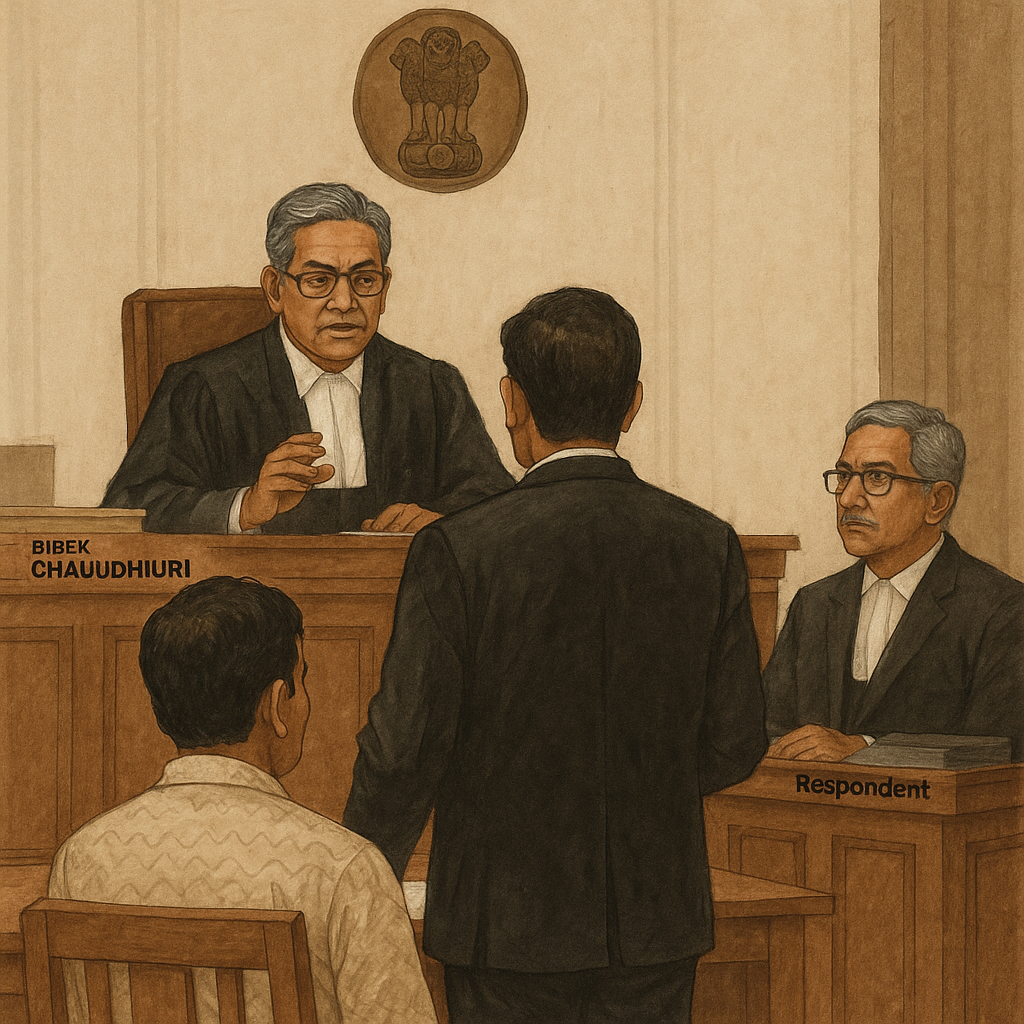
The Patna High Court has clarified an important service law issue concerning the minimum eligibility criteria for appointment of Panchayat/Block Teachers in Bihar—specifically, whether a candidate with 44.8% marks at the Intermediate level can be treated as having 45% through the accepted rule of rounding off. In this writ petition, the Court examined the termination of a teacher who had initially been appointed after the authorities treated his 44.8% as 45%, but was later removed from service on the ground that he did not actually possess the minimum 45% required at the time of appointment. The Court set aside the termination and directed reinstatement within a fixed timeline.
Briefly, the litigant had been engaged as a Shiksha Mitra around 2005 and, in 2006, became a Primary/Block Teacher under the unreserved category. Years later, during verification, the authorities noticed that his Intermediate marks were 44.8%, i.e., marginally short of 45%. The service was terminated; his challenge before the District Appellate Authority and subsequently before the State Appellate Authority failed, prompting him to approach the High Court. The High Court relied on the well-settled rule of rounding off endorsed by the Supreme Court and held that 44.8% ought to be treated as 45% for the limited purpose of meeting the minimum eligibility threshold. On that reasoning, it ordered reinstatement within sixty (60) days of communication of the order.
The Court drew support from the Supreme Court decision in State of U.P. v. Pawan Kumar Tiwari, AIR 2005 SC 658, which articulates the common-sense rule: where the fraction is one-half or more, it is increased to the next integer; if less than one-half, it is ignored. Applying that rationale, the Court reasoned that the petitioner’s 44.8% (i.e., 44.80%) should be rounded off to 45%. The High Court therefore found no infirmity in the original selection decision that had treated the candidate as meeting the 45% threshold. It further observed that the appellate authorities erred in nullifying the employment on the premise that the appointing authority lacked the power to round off the marks. The Court also clarified that no other dispute survived for examination in the writ, and it consciously refrained from comparing the inter-se eligibility of the petitioner with private respondents named in the service dispute.
Importantly, the Court’s direction is precise and time-bound: reinstate the petitioner within 60 days from the date the order is communicated. This part of the order ensures practical relief and implementation certainty, reducing the scope for administrative delay.
Significance or Implication of the Judgment
This decision holds significance for teachers and other public employees in Bihar who face service disputes tied to marginal shortfalls against minimum qualifying marks:
- It affirms the application of the rounding-off principle to minimum eligibility thresholds when the fraction is at or above 0.5. For recruitment processes that stipulate a minimum percentage (like 45% or 50%), this offers clarity and uniformity.
- It cautions appellate authorities and administrative bodies against retrospectively unsettling appointments that were originally made by applying widely recognized rounding-off norms.
- It provides a remedy-oriented framework: where termination is based solely on discounting a permissible rounding off, reinstatement is the logical corrective measure.
- For the general public, the judgment underscores that small fractional differences—when covered by established rounding rules—should not lead to loss of livelihood, especially in mass recruitment settings such as Panchayat/Block Teachers.
- For government departments, it emphasizes the need to apply consistent, Supreme-Court-approved rounding rules during initial scrutiny to avoid prolonged litigation and service disruption.
Legal Issue(s) Decided and the Court’s Decision with Reasoning
- Whether 44.8% in Intermediate could be treated as 45% for eligibility
Decision: Yes. The Court held that the rule of rounding off is applicable; 44.8% must be rounded to 45% and treated as meeting the minimum eligibility requirement prescribed for appointment as Shiksha Mitra/Primary (Block) Teacher.
Reasoning: The Court relied on the Supreme Court’s articulation of the rounding-off principle in State of U.P. v. Pawan Kumar Tiwari (AIR 2005 SC 658): if a fraction is one-half or more, it should be rounded to the next whole number; if less, it should be ignored. Thus 44.80% becomes 45%, validating the original selection. - Whether the termination and appellate rejections could stand when the initial appointment applied rounding off
Decision: No. The High Court found fault with the later decision to disregard rounding off and terminate the appointment, and it set aside that action.
Reasoning: Once the authority had correctly applied the rounding-off rule at the time of selection, subsequent appellate bodies could not quash the appointment by holding that rounding off was impermissible. The Court concluded the appointment was rightly made and directed reinstatement within 60 days. - Whether other disputes—like inter-se claims between competing candidates—needed adjudication
Decision: Not necessary in this writ.
Reasoning: The Court restricted itself to the narrow legal issue of eligibility through rounding off and declined to enter into comparisons with private respondents in the facts of this case.
Judgments Referred by Parties
- State of U.P. and another v. Pawan Kumar Tiwari and others, AIR 2005 SC 658. (Cited to support the rounding-off principle.)
Judgments Relied Upon or Cited by Court
- State of U.P. and another v. Pawan Kumar Tiwari and others, AIR 2005 SC 658. (Applied by the High Court to hold that 44.80% must be treated as 45% for eligibility.)
Case Title
- AKHILESH KUMAR SINGH v. State of Bihar & Others (Service—Teacher Appointment/Termination).
Case Number
- Civil Writ Jurisdiction Case (CWJC) No. 3783 of 2021.
Citation(s)
2025 (1) PLJR 289
Coram and Names of Judges
- Hon’ble Mr. Justice Bibek Chaudhuri. (Oral order dated 25-11-2024.)
Names of Advocates and who they appeared for
- For the petitioner: Mr. Parmeshwar Vishwakarma, Advocate.
- For the respondents/State: Mr. Lalit Kishore, Advocate General; Mr. J.K. Roi-I-SC-13.
Link to Judgment
MTUjMzc4MyMyMDIxIzUjTg==-QtgZ8FWHQJA=
If you found this explanation helpful and wish to stay informed about how legal developments may affect your rights in Bihar, you may consider following Samvida Law Associates for more updates.







