
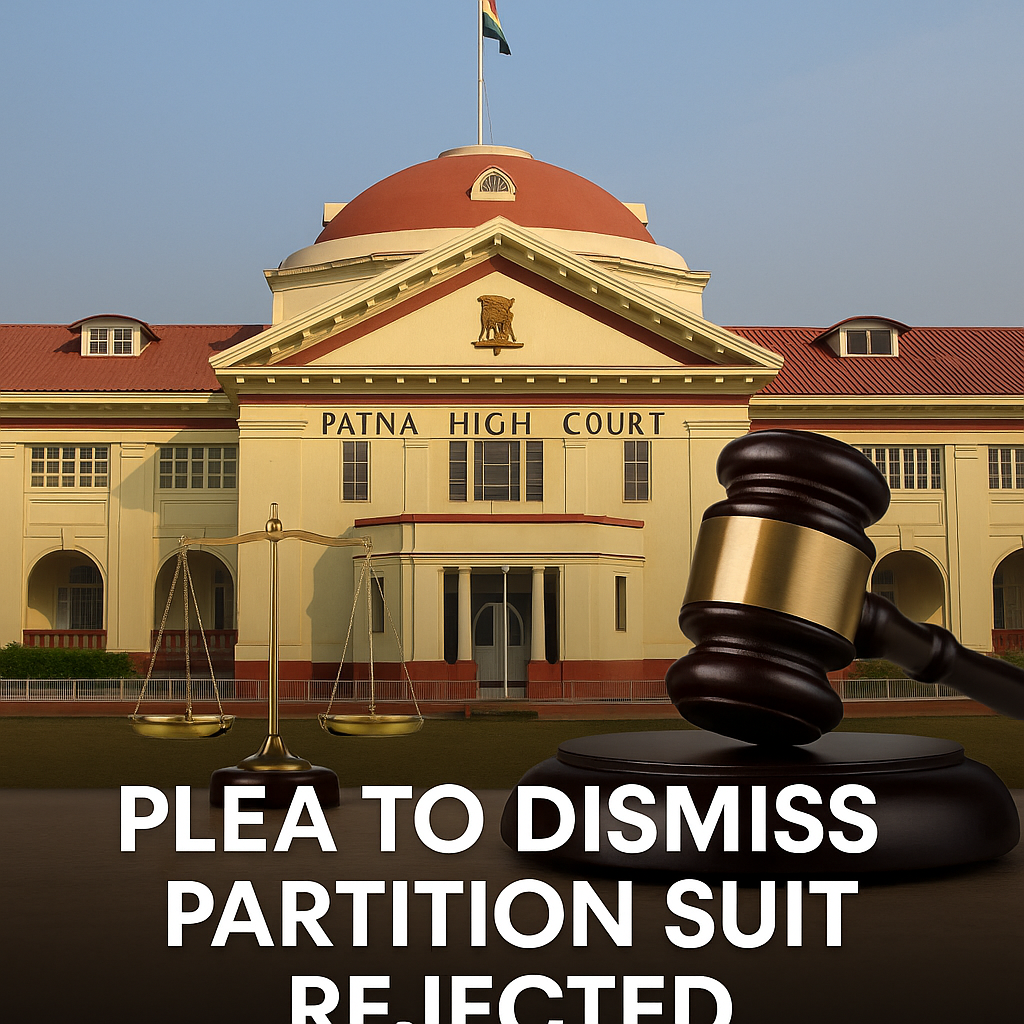
Simplified Explanation of the Judgment
In Civil Miscellaneous Jurisdiction No. 564 of 2019, the Patna High Court examined whether a partition suit could be dismissed at the initial stage under Order VII Rule 11(d) of the Civil Procedure Code (CPC) on the grounds of limitation.
The petitioners, who were defendants in a partition suit (Title Partition Suit No. 209 of 2018) filed before the Sub-Judge, Danapur, sought to reject the plaint by arguing that the suit was time-barred. They claimed the plaintiff had full knowledge of property transactions and mutation orders as early as 2005 and had delayed initiating the suit until 2018. Hence, the suit should be dismissed as per Article 59 of the Limitation Act.
The trial court, however, found meritless their application under Order VII Rule 11(d) CPC and held that limitation in this case was a mixed question of law and fact—something that should be determined after trial, not at the preliminary stage. The High Court, upon reviewing the facts, upheld this reasoning.
The plaintiff had sought partition and possession of the disputed property, along with a declaration that certain development agreements and sale deeds (dated 2015 and 2017) were void. The plaintiff also mentioned that the mutation orders, though issued in 2005, were under revision and pending before the Collector. The court noted that the delay could not be definitively concluded as fatal to the case at the initial stage.
Citing the Supreme Court’s decisions in Chhotanben v. Kiritbhai (2018 SCCR 593) and Popat and Kotecha Property v. SBI Staff Association (2005), the High Court reiterated that limitation must be judged based on plaint averments alone and if disputed, the matter must proceed to trial.
Therefore, the Patna High Court refused to exercise its supervisory powers under Article 227 to interfere with the trial court’s decision and dismissed the miscellaneous application.
Significance or Implication of the Judgment
This judgment reinforces a well-established legal principle that the issue of limitation is often not suitable for summary rejection unless it is evident from the plaint itself. It provides crucial guidance to litigants and courts dealing with civil suits, especially partition matters involving long-standing family properties.
By refusing to reject the plaint at the outset, the Court has affirmed that a fair trial must be allowed where facts regarding limitation are disputed. This approach prevents premature dismissal and upholds the right to a full hearing on merits.
For those contesting property cases, this decision shows that raising limitation issues requires more than just referencing old documents—it must clearly reflect from the plaint. For courts, the judgment is a reminder to balance procedural safeguards with access to justice.
Legal Issue(s) Decided and the Court’s Decision
- Whether a plaint can be rejected under Order VII Rule 11(d) CPC for being time-barred.
- Decision: No, not unless the limitation is evident from the plaint. In this case, it involved disputed facts, hence not suitable for summary rejection.
- Whether High Court should interfere under Article 227 with the trial court’s refusal to reject plaint.
- Decision: No. The High Court held that no case for interference was made out.
Judgments Referred by Parties
- Raghwendra Sharan Singh v. Ram Prasanna Singh, AIR 2019 SC 1430
Judgments Relied Upon or Cited by Court
- Chhotanben & Anr. v. Kiritbhai Jalkrushnabhai Thakkar & Ors., 2018 SCCR 593
- Popat and Kotecha Property v. SBI Staff Association, (2005) 7 SCC 510
- Balasaria Construction (P) Ltd. v. Hanuman Seva Trust & Ors., (2006) 5 SCC 658
- N.V. Srinivasa Murthy v. Mariyamma, AIR 2005 SC 2897
Case Title
Syed Tabin Rushad & Anr. v. Md. Sohaib & Ors.
Case Number
Civil Miscellaneous Jurisdiction No. 564 of 2019
Citation(s)
2020 (1) PLJR 43
Coram and Names of Judges
Hon’ble Mr. Justice Ashwani Kumar Singh
Names of Advocates and who they appeared for
- Mr. Rajendra Prasad Singh, Advocate for the Petitioners
- Mr. Shiva Shankar Prasad Singh, Advocate for the Respondents
Link to Judgment
https://patnahighcourt.gov.in/viewjudgment/NDQjNTY0IzIwMTkjMSNO-C3JNo3jCOFE=
If you found this explanation helpful and wish to stay informed about how legal developments may affect your rights in Bihar, you may consider following Samvida Law Associates for more updates.







